

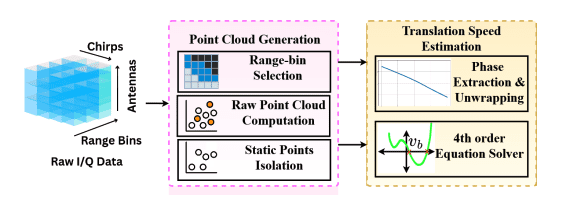
On April 20, 2025, researchers Argha Sen and team published RadarTrack: Enhancing Ego-Vehicle Speed Estimation with Single-chip mmWave Radar, presenting a novel phase-based approach that improves speed estimation for real-time robotics applications.
RadarTrack is an innovative framework using single-chip mmWave radar for robust ego-speed estimation in mobile platforms. Unlike previous methods relying on DNNs or cross-modal learning, it employs a novel phase-based approach, overcoming limitations of conventional doppler-based methods that require static surroundings. Designed for low-latency embedded systems, RadarTrack enables real-time applications with efficient signal processing. Key contributions include the phase-based technique and a validated prototype tested in real-world scenarios. This lightweight solution offers reliable speed estimation for applications like micro-mobility, augmented reality, and autonomous navigation.
The field of robotics has witnessed significant progress over the past decade, driven by advancements in sensors, algorithms, and computing power. Among these innovations, one technology stands out for its potential to transform how robots navigate and interact with their environments: mmWave radar. This article examines the growing role of mmWave radar in robotics, focusing on its applications, challenges, and future prospects.
The Innovation: mmWave Radar in Robotics
mmWave radar operates in the millimeter-wave frequency range, providing high-resolution detection of objects and precise measurement of distances. Unlike traditional sensors such as LiDAR or cameras, mmWave radar excels in challenging environments where visibility is limited—such as through smoke, fog, or darkness. Recent research has demonstrated its ability to enable robots to perform accurate egomotion estimation, a critical capability for navigation and mapping.
By integrating mmWave radar with inertial measurement units (IMUs), researchers have developed systems that can track a robot’s movement with high precision, even in dynamic and cluttered environments. This integration enhances robustness and reduces reliance on external infrastructure, making robots more autonomous.
Methodology: How It Works
The core of this innovation lies in the fusion of radar data with other sensor inputs. For instance, combining mmWave radar with IMUs improves the accuracy of inertial odometry—the process by which a robot calculates its position based on acceleration and rotation measurements. This fusion approach compensates for the drift inherent in IMU-based systems, providing more reliable localization over time.
Additionally, researchers have explored the use of mmWave radar for obstacle detection and avoidance. By analyzing reflected signals from objects in the environment, robots can create detailed maps of their surroundings and plan paths accordingly. This capability is particularly valuable in scenarios where visual sensors may fail, such as in low-light conditions or through opaque obstacles like smoke.
Key Findings: Advancements and Applications
The integration of mmWave radar into robotics has yielded several key advancements:
- Improved Navigation Accuracy: Leveraging high-resolution data from mmWave radar enables robots to navigate with greater precision, even in complex environments.
- Enhanced Robustness: The ability to operate in low-visibility conditions makes mmWave radar a reliable alternative to traditional sensors.
- Real-Time Obstacle Avoidance: By analyzing reflected signals, robots can detect and avoid obstacles more effectively, enhancing safety and efficiency.
Applications Across Domains
mmWave radar is finding applications across various domains:
- Indoor Navigation: Robots equipped with mmWave radar can navigate through cluttered indoor environments with high precision, making them suitable for tasks such as delivery or cleaning.
- Autonomous Vehicles: In outdoor settings, mmWave radar complements other sensors in autonomous vehicles, improving obstacle detection and navigation in adverse weather conditions.
- Industrial Automation: The technology is being used in industrial settings to enhance the safety and efficiency of robotic systems operating in dynamic environments.
Conclusion
mmWave radar represents a significant advancement in robotics, offering high-resolution sensing capabilities that enable robots to operate more effectively in challenging environments. Its integration with other sensors enhances navigation, obstacle avoidance, and overall autonomy, making it a valuable tool across various applications. As research continues, mmWave radar is poised to play an increasingly important role in shaping the future of robotics.
👉 More information
🗞 RadarTrack: Enhancing Ego-Vehicle Speed Estimation with Single-chip mmWave Radar
🧠 DOI: https://doi.org/10.48550/arXiv.2504.14495


