Controlling and manipulating quantum states of light is crucial for advancing technologies like quantum computing and communication, and researchers are continually seeking new methods to achieve this. E. Blumenthal, N. Gutman, I. Kaminer, and colleagues at the Technion, Israel Institute of Technology, now demonstrate a technique for generating squeezed states of light using a carefully controlled interaction between a qubit and one or two harmonic oscillators. Their approach, which relies on modulating the coupling between these quantum systems, predicts significant levels of squeezing, exceeding 12dB in some configurations, and importantly, establishes a pathway towards universal control over photonic states. This breakthrough expands the possibilities for continuous-variable quantum information processing and offers a promising route to building more powerful and versatile quantum technologies on existing circuit QED platforms.
Single- and Two-Mode Squeezing by Modulated Coupling to a Rabi Driven Qubit Advanced bosonic quantum computing architectures require nonlocal Gaussian operations, such as two-mode squeezing, to unlock universal control, enable entanglement generation, and implement logical operations across distributed modes. This work presents a novel method for generating conditional squeezing using a qubit dispersively coupled to one or more harmonic modes. The approach leverages modulated coupling between the qubit and the harmonic modes to induce a time-dependent displacement of the harmonic mode quadratures, effectively creating squeezing. Specifically, the research investigates the generation of both single-mode and two-mode squeezing by carefully controlling the modulation frequency and amplitude of the qubit drive. The ability to generate tailored squeezed states is crucial for enhancing the performance of quantum information processing tasks and for realising robust quantum communication protocols.
Qubit-Driven Squeezed Light Generation and Control
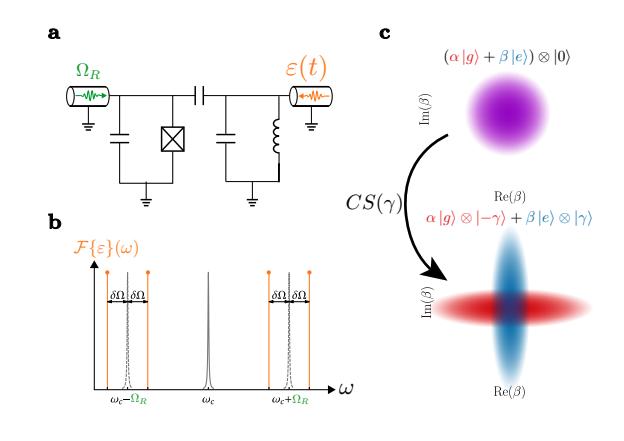
Researchers developed a novel method for generating and controlling squeezed states of light, essential for advancing continuous-variable quantum computing and sensing technologies. The approach centers on a carefully orchestrated interaction between a qubit and one or two harmonic oscillators, which represent the light’s vibrational modes. This system allows for the creation of squeezed light, where quantum uncertainty is redistributed to reduce noise in specific measurements, enhancing sensitivity and precision. The core of the methodology lies in a dispersive coupling between the qubit and the harmonic oscillator(s), driven by precisely timed microwave signals.
By modulating the interaction between these components, the researchers effectively sculpt the quantum state of the light, generating single-mode and two-mode squeezing. This technique differs from traditional methods by generating squeezed states directly within the system where they will be used, minimizing signal loss and improving efficiency. Simulations predict the generation of substantial squeezing, up to 13 decibels for single-mode and 12 decibels for two-mode squeezing, levels comparable to the highest achieved in current experiments. A key innovation is the ability to generate not only single-mode but also two-mode squeezed states, which entangle multiple light modes. Furthermore, the method allows for conditional squeezing, meaning the squeezed state is dependent on the state of the qubit, providing an additional layer of control. The researchers demonstrated that this operation, combined with standard qubit manipulations, provides universal control over the bosonic modes, opening doors to more sophisticated quantum algorithms and protocols.
Qubit Control Generates Squeezed Light States
Researchers have developed a new method for generating and controlling squeezed states of light, crucial for advancing quantum technologies. Squeezed states exhibit reduced uncertainty in one property of light at the expense of increased uncertainty in another, enhancing the precision of measurements and improving the performance of quantum devices. This work demonstrates a technique for creating these states by precisely manipulating the interaction between a qubit and one or two harmonic oscillators, effectively “squeezing” the quantum properties of the light. The team’s approach utilizes a carefully designed interaction where a qubit, driven by radio waves, influences the quantum state of light within a resonator.
Through precise modulation of this interaction, they can generate squeezed states, achieving a significant 13 decibel level of squeezing for a single mode of light, comparable to the highest levels demonstrated to date. Importantly, the method extends beyond single modes, successfully generating two-mode squeezed states with 12 decibels of squeezing, a more complex configuration that allows for entanglement between multiple light modes. Beyond simply generating squeezed states, the research establishes that this technique provides universal control over bosonic modes, meaning it can be used to implement any desired quantum operation on light. This is achieved by combining the squeezing operation with standard qubit rotations and displacements, opening up possibilities for complex quantum computations and simulations.
Qubit Control Generates High-Squeezing Light
This research presents a new method for generating squeezed states of light, both in single and multiple modes, using a carefully controlled interaction between a qubit and harmonic oscillators. The team demonstrates, through simulation, the potential to achieve significant levels of squeezing, up to 13dB for single-mode and 12dB for two-mode squeezing, by engineering a modulated interaction between the qubit and the light. This approach links the properties of the squeezed light directly to the state of the qubit, offering a versatile tool for advanced quantum technologies. The findings establish a new paradigm for controlling photonic states and lay a foundation for exploring conditional squeezing in complex quantum architectures.
While the simulations predict substantial squeezing, the authors acknowledge that higher-order effects currently limit the amplitude of the squeezed superposition. Future research will focus on mitigating these effects to enhance squeezing levels and extending the method to more complex, multi-mode systems, potentially enabling more sophisticated quantum state engineering. This work represents a significant step towards harnessing conditional squeezing for practical applications in quantum information processing.
🗞 Single- and Two-Mode Squeezing by Modulated Coupling to a Rabi Driven Qubit
🧠 ArXiv: https://arxiv.org/abs/2507.22641