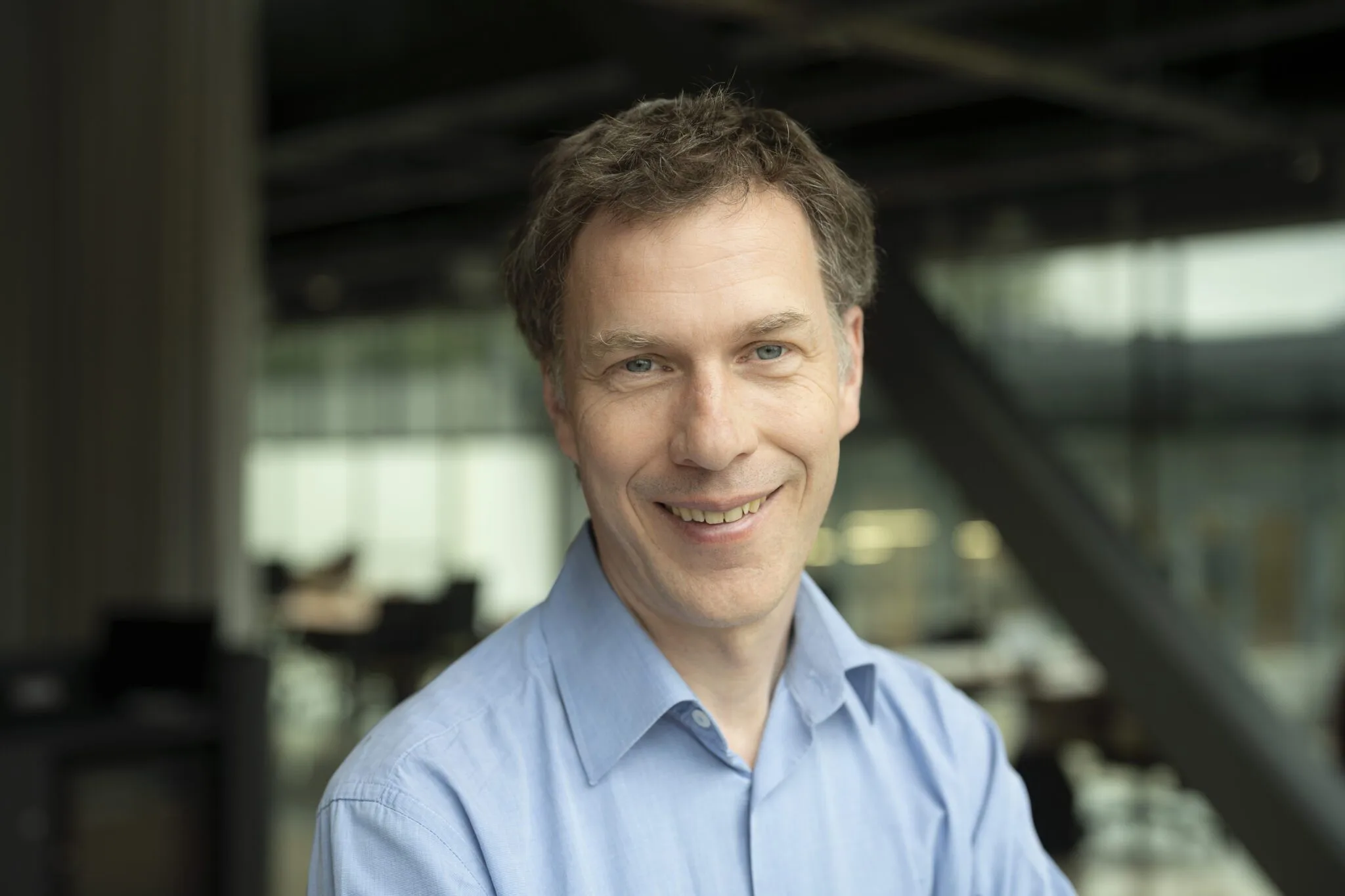
Scientific director at QuTech, Lieven Vandersypen, has been appointed as a member of the Royal Netherlands Academy of Arts and Sciences (KNAW). Vandersypen has made significant breakthroughs in quantum computing, demonstrating that quantum computers can perform certain calculations much faster than traditional computers. He has developed scalable quantum bits, or qubits, which are the information-processing units of quantum computers. This work has the potential to contribute to the development of a usable quantum computer. Vandersypen is also a professor of quantum nanoscience at Delft University of Technology.
Lieven Vandersypen Inducted into the Royal Netherlands Academy of Arts and Sciences
Lieven Vandersypen, the scientific director at QuTech, has been selected as a member of the Royal Netherlands Academy of Arts and Sciences (KNAW). This prestigious appointment, which is lifelong, is set to take place on September 30, along with the induction of 16 other new members.
The KNAW is a distinguished society of eminent Dutch scientists. Membership is granted based on significant scientific accomplishments. Each year, the KNAW elects new members to fill vacant positions, with nominations coming from both within and outside the KNAW. The selection process also takes into account the opinions of external referees.
Being a member of the KNAW is a significant honor in the scientific community in the Netherlands. The KNAW has both ordinary and foreign members, and until May 2011, correspondents were also appointed. The approximately 600 members of the KNAW are respected scientists from a wide range of disciplines.
Lieven Vandersypen’s Contributions to Quantum Computing
Vandersypen has made several significant advancements in the field of quantum computing. Quantum computers have the potential to perform certain calculations much faster than traditional computers. Vandersypen has demonstrated this principle in practice by executing it in molecules. This application of the Shor algorithm resulted in the calculation 15 = 3 x 5.
However, this molecular approach cannot be scaled up to more complex systems. Instead, this can be achieved with other types of quantum bits or qubits, which are the information-processing units of quantum computers. These qubits are analogous to the bits in a traditional computer that can store a 1 or a 0.
Vandersypen has developed several such quantum bits that can be scaled and have the potential to yield a usable quantum computer. He is the scientific director of the research institute QuTech, which he also co-founded. In addition to his role at QuTech, Vandersypen is a professor of quantum nanoscience at Delft University of Technology.
External Link: Click Here For More