

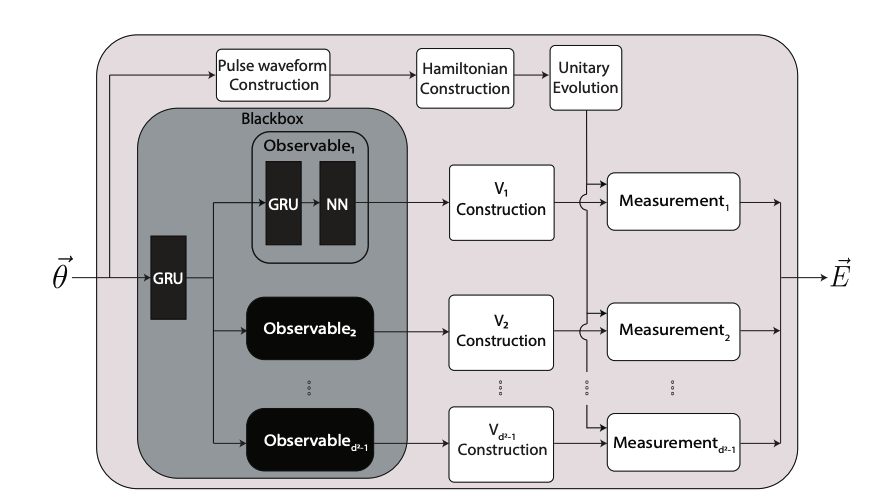
Researchers develop a machine learning framework to control and characterise qudits, quantum systems extending beyond the standard qubit, with arbitrary dimensionality. This approach utilises an analytic expansion to model noise dynamics, enabling interpretable control and distinction of noise sources, and achieving high-fidelity gate implementations.
The increasing complexity of quantum systems necessitates innovative approaches to both control and characterisation, particularly as researchers move beyond simple two-level quantum bits, or qubits, to higher-dimensional qudits. These qudits promise enhanced information density and resilience to errors, but their manipulation is complicated by realistic imperfections in physical systems, such as noise and imprecise control pulses. A team led by Yule Mayevsky, Akram Youssry, and Ritik Sareen from RMIT University, in collaboration with Gerardo A. Paz-Silva at Griffith University and Alberto Peruzzo from both RMIT University and the quantum technology company Quandela, addresses these challenges in their recent work, entitled “Quantum Engineering of Qudits with Interpretable Machine Learning”. They present a novel machine-learning framework that not only controls qudits of arbitrary dimension but also provides a transparent understanding of the noise affecting their performance, a crucial step towards building reliable quantum technologies.
Advancements in qubit control increasingly leverage higher-dimensional quantum systems, known as qudits, to enhance information encoding and processing capabilities. These systems, extending beyond the binary nature of traditional qubits, offer potential benefits but present significant challenges regarding realistic noise and control imperfections. Recent research addresses these issues by developing innovative solutions to improve the performance of emerging quantum technologies.
The research team extends established methodologies designed for single-qubit systems to accommodate the increased complexity inherent in qudits, ensuring compatibility with existing quantum infrastructure. A key innovation lies in the implementation of a local analytic expansion, a mathematical technique that facilitates an interpretable modelling of noise dynamics. This approach provides a structured and efficient method for understanding how the system behaves under various disturbances. The successful demonstration of high-fidelity implementation of both global unitary operations – transformations that preserve the quantum state – and two-level subspace gates, which operate on a limited portion of the qudit’s state space, validates the effectiveness of this framework.
A mathematical model, employing a perturbation approach utilising
A mathematical model, employing a perturbation approach utilising matrices denoted as X0, X1, and X2, provides a comprehensive understanding of system dynamics. These matrices represent successive orders of approximation, allowing for detailed analysis of the system’s response to external influences. The presence of complex numbers within these matrices reveals crucial information about the system’s inherent oscillatory or wave-like behaviour, a characteristic of quantum systems. Perturbation theory is a mathematical technique used to approximate solutions to problems that cannot be solved exactly.
Distinguishing between ‘strong noise’ scenarios, where noise significantly disrupts the quantum state, and ‘closed system’ scenarios, where the system is largely isolated from external disturbances, is critical for accurately modelling system behaviour. The model’s potential applications extend beyond quantum computing, encompassing diverse fields such as control systems, fluid dynamics, electrical circuits, and even biological systems, demonstrating its versatility and broad applicability.
Future work will focus on identifying specific variables and elucidating the underlying differential equations that govern system dynamics, providing a deeper, more fundamental understanding of the observed behaviour. Expanding the analysis to incorporate non-Markovian noise – where future noise is dependent on past noise – non-ideal control pulses, and dynamics beyond the rotating wave approximation (RWA), a simplification often used in quantum calculations, will enhance the model’s realism and applicability to increasingly complex systems. Specifically, a machine-learning-based graybox framework, coupled with the local analytic expansion, offers a promising avenue for interpretable modelling of noise dynamics and distinguishing between noise sources that produce similar effects, potentially pushing the boundaries of quantum control and facilitating the development of practical quantum applications.
👉 More information🗞Quantum Engineering of Qudits with Interpretable
🗞 Quantum Engineering of Qudits with Interpretable Machine Learning
🧠 DOI: https://doi.org/10.48550/arXiv.2506.13075


