The pursuit of reliable quantum computation faces a fundamental challenge, spontaneous emission, which introduces errors that limit the precision of logic gates. Yuan Sun from the Shanghai Institute of Optics and Fine Mechanics, Chinese Academy of Sciences, and colleagues demonstrate that even the potential for spontaneous emission, even when it doesn’t actually occur, subtly affects the behaviour of atomic qubits. The team reveals that standard calculations fail to account for these influences, and a modified approach to describing qubit dynamics, conditioned on the absence of decay, is essential. This work establishes that achieving high-fidelity quantum gates requires careful consideration of these subtle effects, paving the way for more robust and accurate manipulation of qubits in atomic systems.
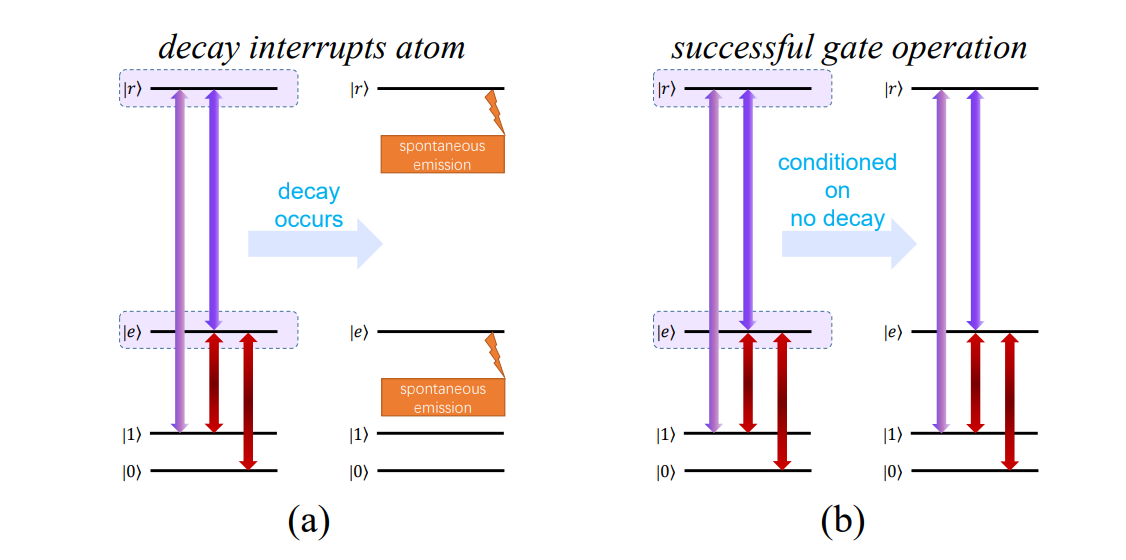
on the condition that no decay event occurs. These successes can be ensured by post-selection based on syndrome extraction, according to the theory of quantum error correction or quantum error mitigation. In this case, the wave function of qubits remains a pure state, but is subject to additional influences from spontaneous emission, even without actual decay events. Therefore, this process must be appropriately described by a modified version of Schrödinger equation for the dynamics conditioned on no-decay. Calculations reveal that this effect must be seriously taken into consideration for the design of high-fidelity quantum logic gates.
Simulating Rydberg Atom Qubit Dynamics Accurately
Scientists have developed a sophisticated numerical method, termed SECOND, to accurately simulate the behavior of neutral atom qubits, particularly those employing the Rydberg blockade mechanism for quantum gates. This method improves simulation accuracy by explicitly accounting for realistic effects such as spontaneous emission, imperfect detection, and decoherence. The team employs a Monte Carlo Wave Function approach, representing the quantum state as a collection of wave packets and tracking their evolution over time. This technique is well-suited for simulating open quantum systems, allowing for the inclusion of environmental interactions and decoherence effects. The research demonstrates how SECOND can be used to simulate the performance of Rydberg blockade controlled-not gates, calculating the gate’s fidelity while accounting for the detrimental effects of spontaneous emission, imperfect detection, and decoherence. A key output of the simulation is the no-decay probability, which quantifies the likelihood that atoms remain in an excited state for a specific duration, serving as a crucial metric for evaluating gate performance.
Spontaneous Emission Perturbs Qubit Dynamics Significantly
Scientists have refined their understanding of qubit behavior by meticulously analyzing the subtle effects of spontaneous emission, a phenomenon that typically degrades the fidelity of quantum logic gates. The research demonstrates that even without actual decay events, spontaneous emission influences qubit dynamics, necessitating a modified Schrödinger equation to accurately describe the system when conditioned on no-decay. Calculations reveal that these influences are significant and must be carefully considered in the design of high-fidelity logic gates. The team developed a wave function approach to model qubit evolution, specifically conditioning the calculations on the absence of decay.
This method allows for precise tracking of qubit states, accounting for the subtle perturbations caused by potential spontaneous emission. Experiments confirm that this approach accurately predicts qubit behavior, even under conditions where traditional models would fail to capture the full picture. The data shows that by accounting for the conditional dynamics, scientists can significantly improve the fidelity of manipulating physical qubits. Specifically, the research focused on atomic qubit platforms, where spontaneous emission is a prominent concern. Measurements demonstrate that population-transfer gates and purely phase gates experience distinct influences from these effects. By implementing the refined wave function approach, the team achieved improved control over qubit states, leading to enhanced performance in quantum operations. The results indicate that this method provides a powerful tool for mitigating the detrimental effects of spontaneous emission and advancing the development of robust quantum technologies.
Spontaneous Emission Impacts Qubit Fidelity and Gates
This research introduces a refined theoretical approach to understanding the influence of spontaneous emission on quantum computing processes. The team developed a wave function approach specifically conditioned on the absence of decay, acknowledging that even without actual decay events, spontaneous emission subtly affects qubit behavior. Calculations demonstrate that these effects are significant and must be carefully considered when designing high-fidelity quantum logic gates and readout mechanisms, particularly for atomic qubit platforms. The study reveals distinct influences on population-transfer and phase gates, highlighting the need for tailored design considerations.
The findings emphasize that achieving improved fidelity in manipulating qubits, and implementing quantum error correction, requires accounting for these subtle effects of spontaneous emission. By accurately modeling the conditional probability of no decay, the researchers provide a framework for in-depth analysis of experimental observables and offer insights applicable to both quantum computing and quantum precision measurement. The authors acknowledge that this work focuses on theoretical modeling and further research is needed to fully validate these predictions through experimental verification. They anticipate that this refined understanding will contribute to the development of more robust and reliable quantum technologies.
🗞 Refine coherent control of atomic qubits via wave-function approach conditioned on no-decay
🧠 ArXiv: https://arxiv.org/abs/2509.20042