Controlling the interaction between molecular spins and electromagnetic fields represents a significant challenge in developing quantum technologies, and recent work by Marcos Rubín-Osanz, Marina C. de Ory, and Ignacio Gimeno from the Instituto de Nanociencia y Materiales de Aragón, alongside colleagues including Wenzel Kersten and Marta Mas-Torrent, demonstrates a substantial advance in this area. The team engineered superconducting resonators that maximise magnetic coupling to molecular spin systems, achieving record single-spin couplings of up to 100kHz and collective couplings exceeding 10MHz. This innovative approach, utilising carefully designed ‘lumped element’ resonators interacting with organic free radicals, establishes a scalable route towards integrated molecular-spin quantum processors by enabling stronger and more controllable interactions between spins and the quantum circuit. The research also reveals insights into spin relaxation and coherent dynamics, confirming the Purcell effect and providing a method to characterise the distribution of spin-photon couplings within these devices.
Molecular Spins in Superconducting Circuits
Research at the forefront of quantum technology explores integrating molecular spintronics with superconducting circuits, aiming to harness the unique properties of single-molecule magnets as qubits. This field focuses on designing and synthesizing molecular materials with enhanced magnetic properties and integrating them with superconducting microwave circuits to control and read out their quantum states. Investigations center on creating hybrid systems where molecules interact with resonators, presenting both challenges and opportunities for advancing quantum information processing. Fundamental work lays the groundwork by focusing on the synthesis, characterization, and fundamental properties of single-molecule magnets.
Researchers explore diverse molecular structures to enhance magnetic anisotropy and slow down relaxation, crucial for achieving high-performance magnets. Detailed characterization techniques are employed to study these properties, alongside investigations into how these molecules respond to external stimuli like magnetic fields and light. Many studies concentrate on lanthanide-based molecules due to their strong magnetic anisotropy, and explore the use of multiple metal centers to further enhance magnetic properties. A central theme involves integrating single-molecule magnets with superconducting microwave resonators.
The goal is to achieve strong interaction between the molecular spin and the resonator’s photons, essential for quantum control and readout. This utilizes the principles of circuit QED, manipulating and measuring the molecular quantum states through carefully designed resonators. Researchers detail the design and fabrication of these resonators, optimizing them for coupling to the molecules, and explore various methods for reading out the molecular spin state using microwave signals. The Purcell effect, which enhances spontaneous emission, is leveraged to increase readout speed and efficiency, while strategies are developed to protect the molecular quantum state from environmental noise and decoherence.
Generating entangled states between the molecular spin and the resonator photons is a key objective, paving the way for molecular qubits in quantum information processing. Theoretical and computational modeling plays a vital role, employing simulations to understand the behavior of these hybrid systems and optimize their performance. Researchers develop Hamiltonians that describe the interaction between the molecule, the resonator, and the environment, and utilize quantum master equations to model the system’s dynamics and account for decoherence.
Strong Magnetic Coupling to Molecular Spin Ensembles
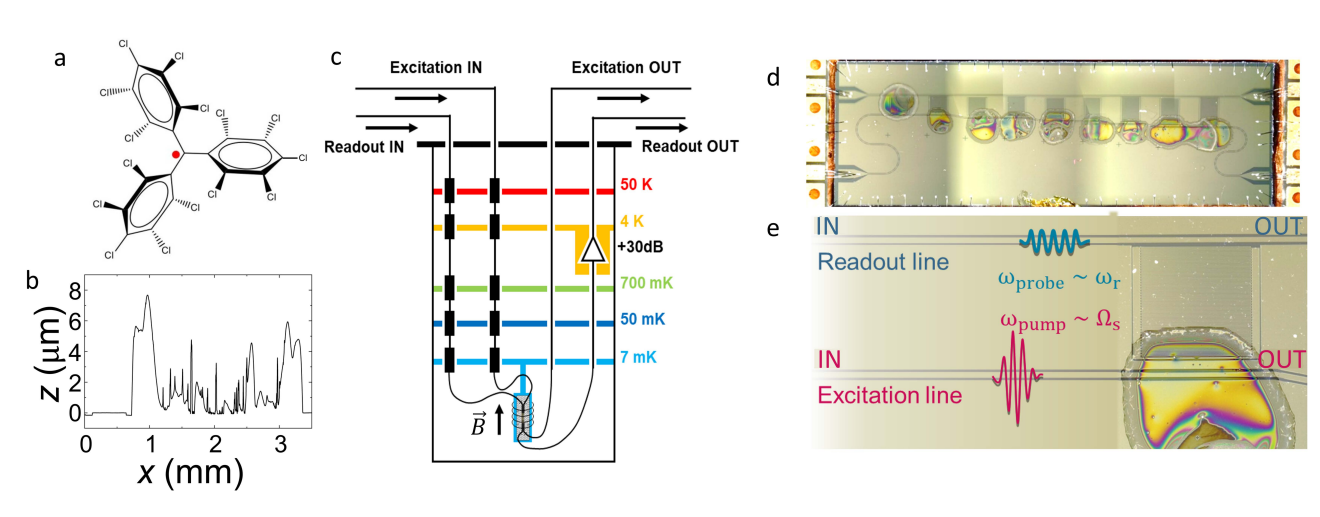
Researchers have engineered lumped-element resonators to maximize magnetic coupling to molecular spins, achieving record single-spin couplings of up to 100kHz and collective couplings exceeding 10MHz. These resonators were integrated with PTMr organic free radicals, model spin systems dispersed within a polystyrene polymer matrix, with radical concentrations carefully controlled. The team maximized interaction with the majority of spins by utilizing large inductors, while minimizing inductor size maximized coupling to individual spins, demonstrating a dual approach to studying both collective and individual spin behavior. Devices were fabricated by depositing PTMr and polymer mixtures onto resonator surfaces using micropipettes, creating thin layers ensuring nearly all molecules interacted with the resonator’s magnetic field.
Atomic force microscopy characterized the morphology and topography of these deposits, revealing a homogeneous distribution of PTMr. By varying deposited volume and solution concentration, the team precisely controlled the number of coupled spins. Regions near constrictions within the resonators demonstrated enhanced spin-photon coupling for molecules in close proximity. The experimental setup thermally anchored the superconducting devices to a dilution refrigerator with a base temperature of 10 mK, placing them within a 1 Tesla superconducting magnet. Microwave signals were delivered and received via cryogenic coaxial lines, incorporating attenuators and amplifiers to optimize signal quality.
Continuous wave experiments utilized a Vector Network Analyzer to probe microwave transmission, while pump-probe experiments employed sequences of excitation and readout pulses. This setup allowed researchers to measure Rabi oscillations with frequencies up to 20. 1MHz, and to characterize spin relaxation and coherent dynamics, establishing a scalable route toward integrated molecular-spin quantum processors.
Strong Molecular Spin Coupling via Resonators
Researchers have engineered lumped-element resonators to strongly couple with molecular spins, achieving record single-spin couplings of up to 100kHz and collective couplings exceeding 10MHz with PTMr organic free radicals embedded in a polymer matrix. By tailoring the resonator’s inductor geometry, specifically utilizing both large, meandering inductors and minimized single-microwire inductors, the team maximized either collective or individual spin interactions, respectively. The study further reveals insights into spin dynamics by observing the Purcell effect, demonstrating photon-induced spin relaxation, and inferring the distribution of single-spin photon couplings. Through precise control of excitation pulses, researchers were able to induce and observe coherent Rabi oscillations in the molecular spins, and to eliminate unwanted cavity hybridization effects by shaping the excitation pulses.
These findings establish a scalable platform for building integrated molecular-spin quantum processors, paving the way for novel quantum technologies. The authors acknowledge that the achieved coupling strengths are dependent on the specific molecular spin sample and resonator design, and that further optimization is needed to improve device performance and scalability. Future research directions include exploring different molecular spin systems, refining resonator designs, and integrating multiple resonators to create more complex quantum circuits.
🗞 Optimizing magnetic coupling in lumped element superconducting resonators for molecular spin qubits
🧠 ArXiv: https://arxiv.org/abs/2511.00857