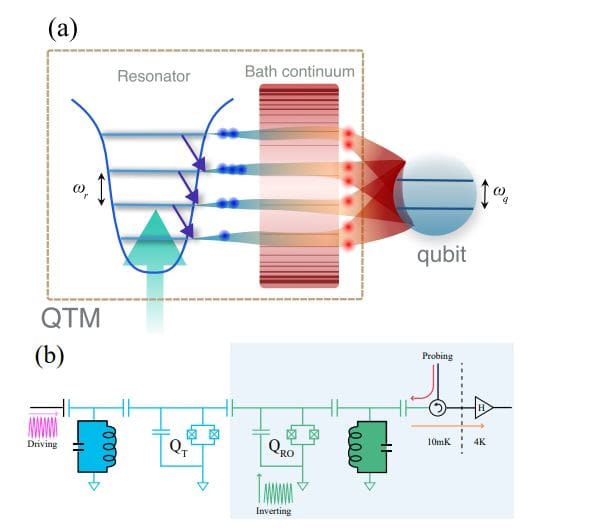
The uncontrolled flow of heat typically hinders the performance of quantum systems, but researchers now demonstrate that engineered thermal interactions can actually exert precise control over qubit behaviour. Ziyang You, Wenhui Huang, and Libo Zhang, alongside Song Liu, Youpeng Zhong, and Yibo Gao, reveal a method for converting microwave signals into controlled heat flow within a specially designed resonator. This allows a receiving qubit to rapidly reach a desired temperature, achieving quasi-thermal equilibrium in just hundreds of nanoseconds, and represents a significant step towards more robust and predictable quantum computation. The team’s work demonstrates that this process relies on carefully engineered ‘thermalizing channel states’, offering a new pathway for manipulating and stabilising quantum information.
Qubit Relaxation Without Readout Resonators
This research presents a theoretical framework for characterizing superconducting qubits without relying on a dedicated readout resonator, a crucial step towards building larger, more scalable quantum computers. Scientists developed a mathematical model, based on a master equation, to describe how a qubit evolves and loses energy to its environment, accounting for both coherent and incoherent processes. By carefully defining and calculating relaxation rates using specific channel states, the team determined how quickly the qubit loses energy and reaches a stable state, demonstrating that characterization is possible even without a traditional readout resonator.
Engineered Heat Flow Controls Superconducting Qubits
Scientists have pioneered a new method for controlling superconducting qubits by engineering the flow of heat at the nanoscale. The team developed an experimental technique utilizing a leaky resonator to convert microwave energy into heat, enabling rapid thermal equilibration of a target qubit within hundreds of nanoseconds. This conversion relies on establishing thermalizing channel states generated by ‘dressing’ the resonator with applied microwave driving and the qubit coupling. By adjusting driving power and qubit-resonator detuning, scientists achieved effective temperatures ranging from the equilibrating bath temperature up to infinity, demonstrating precise thermal control and building upon recent discoveries like the inverse quantum Mpemba effect.
Qubit Thermalization via Microwave-Engineered Heat Flow
Researchers have demonstrated a method for precisely controlling heat flow to a superconducting qubit, achieving quasi-thermal equilibrium with arbitrary target temperatures within hundreds of nanoseconds. This breakthrough centers on engineering a leaky resonator to transduce microwave driving into heat, effectively directing thermal energy to the qubit, governed by thermalizing channel states. Experiments reveal that the qubit’s effective temperature can be significantly higher than the bath temperature, demonstrating successful thermalization driven by the engineered heat flow, validated by a master equation model closely matching experimental measurements.
Controlled Heat Transfer Manipulates Superconducting Qubits
Researchers have demonstrated a method to intentionally control the flow of heat to superconducting qubits, achieving a surprising degree of control over thermal processes at the nanoscale. Traditionally viewed as a source of unwanted decoherence, thermal baths can, when carefully engineered, be harnessed to manipulate qubit states. The team achieved this by using a specially designed resonator to convert microwave signals into heat, relying on channel states to mediate energy transfer, and achieving optimized heat transfer rates aligning with theoretical predictions.
👉 More information
🗞 Thermalizing channel states for rapid qubit heating
🧠 ArXiv: https://arxiv.org/abs/2511.15314