

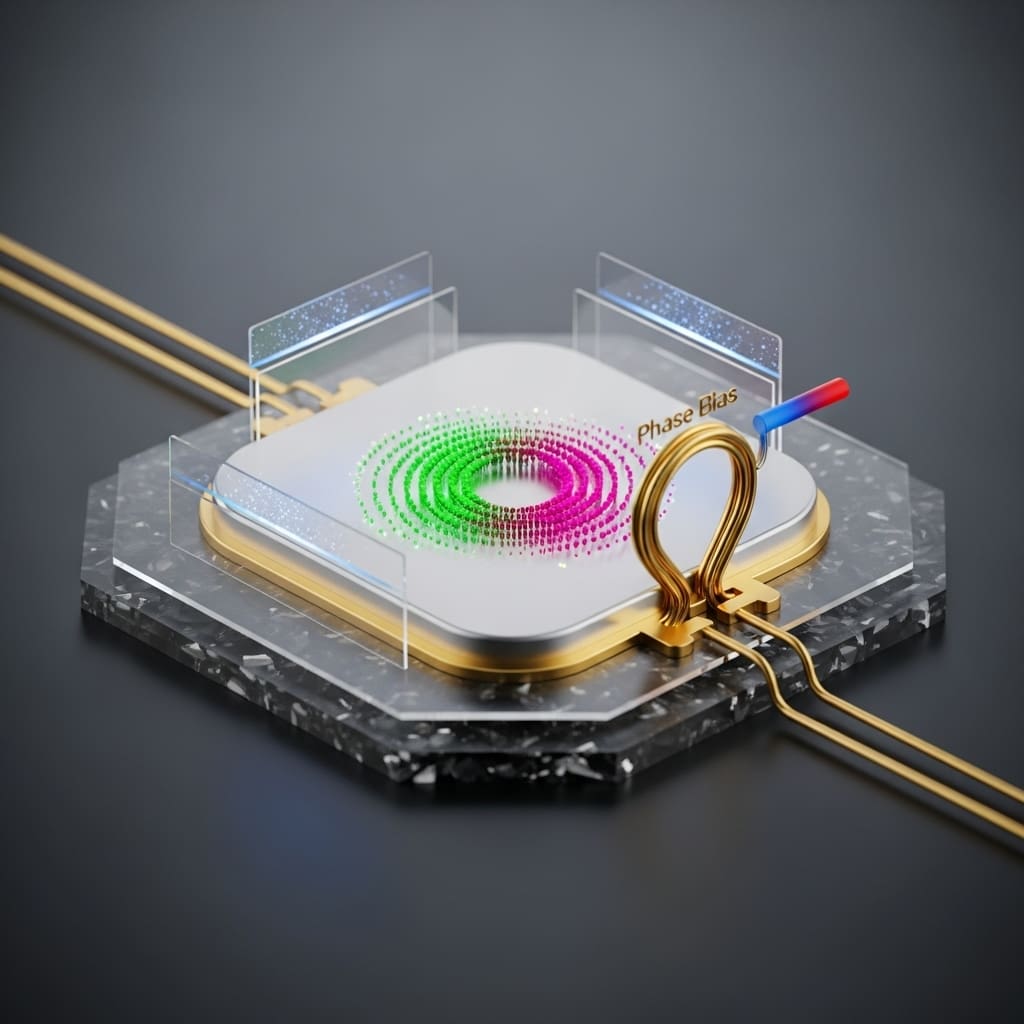
Andreev pair qubits, which harness the unique properties of electrons in superconducting materials, represent a promising avenue for building the quantum computers of the future. Teodor Iličin and Rok Žitko, from the Jožef Stefan Institute, alongside their colleagues, now demonstrate how interactions between electrons and a phenomenon called spin-orbit coupling significantly influence these qubits. Their work explores the behaviour of these quantum states within tiny semiconductor structures, known as quantum dots, and reveals that these interactions can dramatically enhance the sensitivity of the qubits to external disturbances. This increased sensitivity, while posing challenges for maintaining quantum information, also opens up exciting possibilities for precisely controlling and manipulating the qubits’ spin, potentially leading to new methods for quantum transduction and advanced quantum computing architectures.
The research focuses on modelling quantum dot Josephson junctions, incorporating spin-orbit coupling and background tunneling to accurately represent these complex systems, and demonstrates that interactions between electrons significantly alter the character of the qubits.
Experiments reveal that electron-electron interactions cause a strong mixing between Andreev bound states (ABS) and Yu-Shiba-Rusinov (YSR) states, fundamentally changing the qubit’s properties. The team measured the local-moment fraction within the ABS, demonstrating that even-parity Andreev pair qubits are not simply charge qubits, but exhibit a degree of local-moment character due to the YSR admixture, particularly for interaction strengths around a specific energy scale related to the superconducting gap.
Measurements confirm that spin-orbit coupling, combined with the system’s inherent chirality, generates spin polarization and robust spin transitions even without an external magnetic field. Further analysis shows that in a crossover region between purely ABS and YSR states, the matrix elements governing charge, spin, and inductive transitions all become strong and tunable, offering potential for significant control over the qubit’s state through external stimuli.
The theoretical model, validated using the numerical renormalization group method, accurately predicts the behaviour of these complex quantum systems, paving the way for advanced spin control and quantum transduction applications. This breakthrough delivers a pathway towards manipulating and sensing quantum information using Andreev pair qubits with enhanced sensitivity and controllability.
Andreev Pairs and Magnetic Fluctuation Sensitivity
This research investigates quantum dots integrated into Josephson junctions, focusing on even-parity states called Andreev pairs, which are potential candidates for quantum information storage. Scientists successfully modelled these systems using a combination of numerical and analytical techniques, including the zero-bandwidth approximation and the numerical renormalization group, to understand their behaviour.
The results demonstrate that interactions between electrons within the quantum dot significantly alter the properties of the Andreev bound states, mixing them with states characteristic of a local magnetic moment, known as Yu-Shiba-Rusinov states. This mixing enhances the sensitivity of the Andreev pairs to local magnetic field fluctuations, a factor that could impact the coherence of quantum information stored within them.
However, the team also found that strong interactions can drive transitions between charge, spin, and inductive states, potentially offering new methods for controlling spin and converting quantum information between different forms, a process known as quantum transduction. Future work should explore the complexities of real devices and investigate how to mitigate the impact of magnetic field fluctuations to improve the stability of Andreev pair qubits, while also harnessing the observed transitions for practical quantum technologies.
Andreev States in Superconducting Hybrids
Andreev pair qubits, which harness the unique properties of electrons in superconducting materials, represent a promising avenue for building the quantum computers of the future. This increased sensitivity, while posing challenges for maintaining quantum information, also opens up exciting possibilities for precisely controlling and manipulating the qubits’ spin, potentially leading to new methods for quantum transduction and advanced quantum computing architectures.
Experiments establish the conditions required for spin polarization in the absence of an external magnetic field at finite superconducting phase bias. Researchers analyse the even-parity sector, specifically the Andreev pair qubit based on Andreev bound states (ABS), and find that electron-electron interaction strongly enhances spin.
👉 More information
🗞 Effects of electron-electron interaction and spin-orbit coupling on Andreev pair qubits in quantum dot Josephson junctions
🧠 ArXiv: https://arxiv.org/abs/2512.23015
