

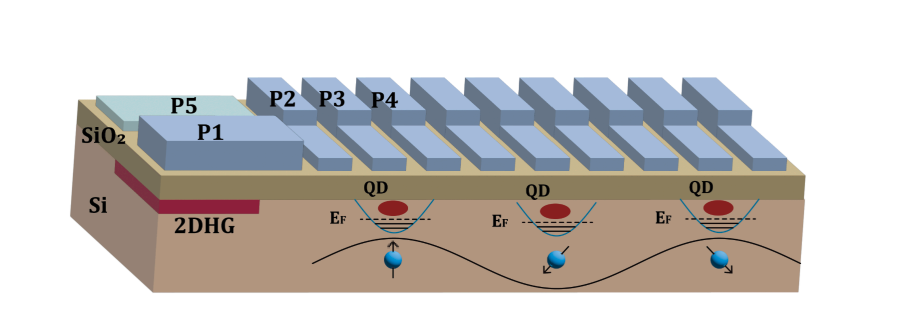
The search for dark matter receives a boost from new research exploring how to detect elusive particles known as axions, which are leading candidates to comprise this mysterious substance. Xiangjun Tang from Peking University and Zhanning Wang from the University of New South Wales, along with their colleagues, investigate the potential of semiconductor spin qubits as highly sensitive detectors for these weakly interacting particles. Their work addresses a critical challenge in axion detection, filtering out environmental noise that can obscure faint signals, by developing a targeted noise-reduction protocol specifically tailored to the characteristics of semiconductor qubits. This approach not only enhances the ability to identify potential axion signals, but also expands the feasible range of axion masses that can be investigated, promising significant advances in the ongoing quest to understand the composition of the universe.
Axion Detection via Silicon Qubit Coupling
Researchers are increasingly exploring the use of solid-state qubits, particularly those based on silicon, to detect axions, hypothetical particles considered strong candidates for dark matter. The core principle involves utilizing the qubit’s spin as a sensor to detect the extremely weak magnetic field induced by axions as they interact with electrons. This approach requires highly sensitive qubits and careful control of the surrounding environment to minimize interference from unwanted noise. Several qubit technologies are being investigated, including electron and hole spins confined within quantum dots, electrons bound to donor atoms in silicon, and defects engineered within the silicon material itself.
Material quality is critical, with isotopically purified silicon favored to reduce noise and extend qubit coherence. Overcoming noise and decoherence is the biggest challenge, as axion signals are expected to be incredibly faint. Researchers are actively investigating sources of noise, such as low-frequency fluctuations, charge traps, spin-orbit coupling, and interactions with nuclear spins. Strategies to mitigate these effects include material purification, surface passivation, device engineering, dynamic decoupling techniques, and quantum error correction. Advanced qubit control and measurement techniques, including microwave manipulation, direct current readout, parametric coupling, and quantum non-demolition measurements, are also being explored.
Integrating quantum dots with superconducting resonators, utilizing high-quality resonators to amplify signals, and employing techniques like dynamic nuclear polarization are also under investigation. Theoretical work focuses on optimizing qubit parameters and understanding the limits of detection, considering different axion models and comparing the solid-state qubit approach with traditional axion haloscope experiments. Current research directions include combining different types of qubits into hybrid systems, exploring new materials with improved qubit properties, developing scalable qubit architectures for large-scale experiments, and leveraging machine learning algorithms to analyze qubit data. Advancements in cryogenic electronics are also crucial for controlling and measuring qubits at extremely low temperatures. Ultimately, the goal is to create a highly sensitive and robust detector capable of definitively detecting axions and shedding light on the nature of dark matter.
Axion Detection Enhanced by Noise Reduction
Recent advances in quantum technologies present a pathway to significantly improve the detection of cosmological particles and weakly interacting massive particles. Researchers have focused on utilizing semiconductor dot spin qubits as a platform to search for chromodynamics axions and similar axion-like particles, addressing challenges related to environmental noise that previously limited precision. The team developed a filtering and noise-reduction protocol to explore feasible axion mass ranges, demonstrating promising results for enhancing the screening of various axion signals. The investigation began with deriving a model describing the interaction between electrons and axions, identifying an axion-induced magnetic field and determining the characteristic oscillation frequency.
Simulations, targeting an axion mass of 3 × 10⁻⁶ eV, predicted sidebands at ±720 MHz, indicative of axion presence. By analyzing the frequency modulation caused by axions, the researchers found that spectral lines appear at sum and difference frequencies, creating detectable sidebands. They demonstrated that with a qubit array possessing a magnetic sensitivity of 100 nT/√Hz, the lower boundary of detection could be reached, even with a small modulation index of approximately 10−21. Crucially, enhancing the experimental setup with high-Q resonant and entanglement techniques could improve the signal-to-noise ratio to 22.
5, aligning with previous theoretical calculations. This improvement allows for a search sensitivity capable of probing ALPs with electron couplings above a certain threshold, even those with suppressed photon couplings or masses outside the typical QCD axion window. Using parameters of Q = 106, N = 106, and T2 = 100 ms, the researchers project that future devices could extend sensitivity into, and beyond, the DFSZ parameter region, a key area for axion detection. The simulations, utilizing parameters such as an axion mass of 3 × 10⁻⁶ eV and a local dark matter density of 0. 3 GeV/cm3, predicted sidebands at frequencies of 14 ±0.
72 GHz and 14 ±2 × 0. 72 GHz. A band-pass filter, designed around the main qubit frequency, was employed to isolate the axion-induced signal from noise. The team anticipates that advancements in materials, spin control, and high-Q resonator designs will further enhance performance, potentially enabling detectors with N ≈ 108, 1010 spins and millisecond coherence times.
Qubit Sensitivity Boosts Axion Detection Prospects
This research explores the potential of using semiconductor dot spin qubits to detect chromodynamics axions and, more broadly, axion-like particles. The team demonstrates that by treating the interaction between axions and electrons as an effective magnetic field, a measurable modulation of the qubit’s spin can be predicted. Crucially, they developed a multi-stage filtering and bandwidth-engineering scheme designed to improve the signal-to-noise ratio in these qubit systems, paving the way for more sensitive detection of these elusive particles. The study focuses on optimizing the qubit environment and signal processing to overcome challenges posed by environmental noise, a significant hurdle in detecting faint particle interactions. By analyzing the charge noise spectrum and implementing dedicated filtering protocols, the researchers aim to enhance the ability of semiconductor dot spin qubit arrays to screen for various axion signals. This work suggests that this technology holds promise for advancing the search for these particles, which are candidates for solving mysteries in particle physics and cosmology.
🗞 Toward Axion Signal Extraction in Semiconductor Spin Qubits Via Spectral Engineering
🧠 ArXiv: https://arxiv.org/abs/2509.06791


