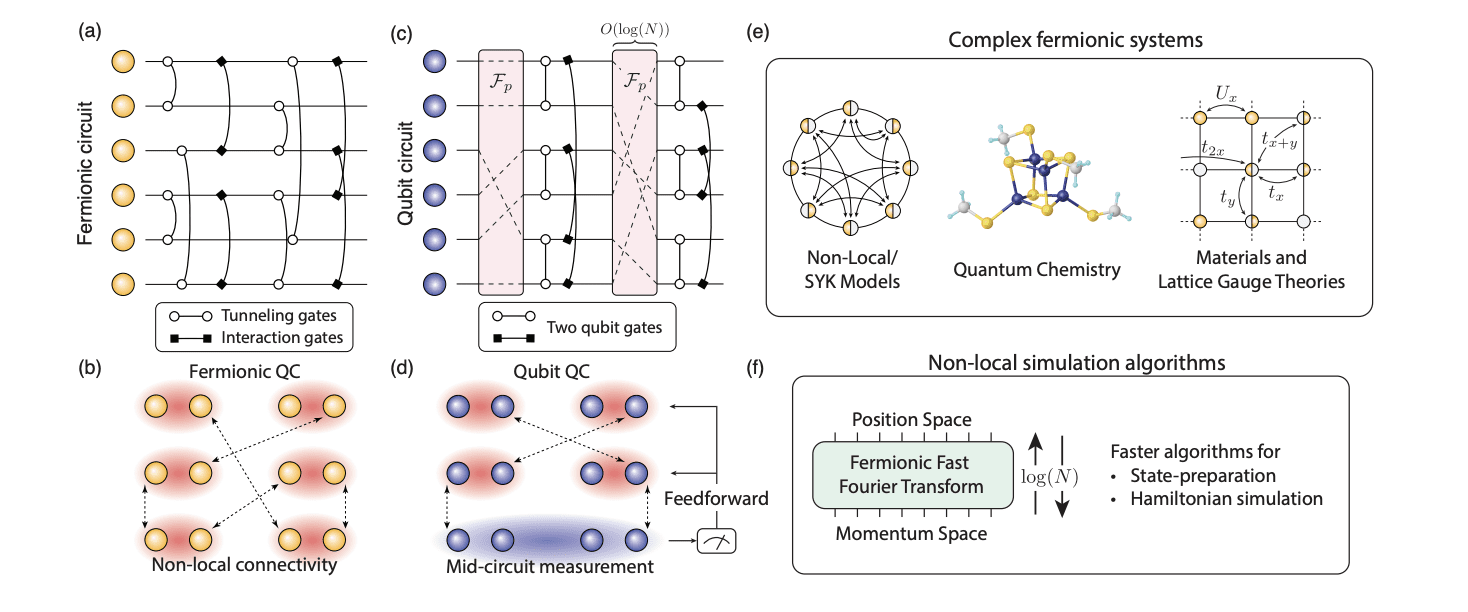
Simulating the behaviour of fermions, fundamental particles like electrons, presents a major hurdle in fields ranging from chemistry to high-energy physics, as accurately modelling many interacting fermions demands immense computational resources. Nishad Maskara, Marcin Kalinowski, and Daniel Gonzalez-Cuadra, alongside Mikhail Lukin, now demonstrate a significantly faster method for these simulations, reducing the computational burden from scaling linearly with the number of fermions to logarithmic, and even constant, in certain cases. The team achieves this breakthrough by dynamically mapping fermions onto qubits using reconfigurable quantum systems, incorporating mid-circuit measurements and classical feedback to optimise the process. This innovative approach dramatically lowers the number of quantum gates required for practical simulations, offering a pathway towards tackling complex problems with near-term, fault-tolerant quantum computers and fundamentally reshaping the landscape of quantum simulation algorithm design.
A significant challenge exists in quantum science, with applications in chemistry, materials, and high-energy physics. Despite considerable progress, simulating generic fermionic systems with qubit-based computers typically incurs substantial computational overhead, scaling proportionally to the number of fermionic modes. This work presents a method for faster fermionic simulation, achieving asymptotic space-time overhead of O(log(N)) in the worst case, and even constant scaling for certain structured circuits, including important subroutines like the fermionic fast Fourier transform. This exponential reduction stems from employing reconfigurable quantum systems with non-local connectivity, mid-circuit measurement, and classical feedforward to generate dynamic circuits.
Fermionic FFT with Dynamical Jordan-Wigner Encoding
This research details a significant optimization strategy for performing the Quantum Fourier Transform (QFT), specifically the Fast Fourier Transform (FFT), on a quantum computer. The core argument centers on a combination of Dynamical Jordan-Wigner (DJW) encoding and cascaded catalysis. DJW encoding cleverly maps fermionic degrees of freedom onto qubits, minimizing qubit requirements and circuit complexity. Cascaded catalysis efficiently generates the two-fermion gates needed for the FFT, reducing the number of complex, non-Clifford gates. This approach overcomes limitations of traditional methods, such as swap networks or static fermion-to-qubit encodings.
The FFT is a crucial algorithm in many scientific domains, and a quantum FFT offers exponential speedups over classical algorithms for certain tasks. This work focuses on implementing the FFT for fermionic systems, relevant to quantum chemistry, materials science, and other areas. Mapping fermions to qubits is a major source of complexity, and minimizing the number of quantum gates required is critical for reducing computation times and error rates. The proposed solution, DJW encoding combined with cascaded catalysis, significantly reduces gate complexity, especially for larger systems and higher dimensions.
DJW encoding dynamically changes qubit assignments during computation, reducing qubit requirements and minimizing long-range interactions. Cascaded catalysis efficiently generates two-fermion gates using a recursive approach. The research demonstrates a substantial reduction in gate complexity and provides detailed scaling analysis, comparing the new approach to traditional methods. The team extended the analysis to the 2D FFT, further reducing the gate count with a dynamic reflection operation.
Logarithmic Overhead for Fermionic Quantum Simulation
Scientists have developed a new method for simulating complex fermionic systems on qubit-based quantum computers, achieving a significant reduction in computational overhead. The research demonstrates a method that generates, at most, O(log(N)) overhead per fermionic operation, representing a substantial improvement over existing techniques. This approach utilizes a dynamic fermion-to-qubit mapping, modifying the encoding during computation to ensure local fermionic operations at each step. The team leveraged non-local connectivity, ancilla qubits, mid-circuit measurements, and classical feedforward to rapidly switch between different encodings, achieving full parallelism in the simulation.
This breakthrough delivers a conceptual and practical advance in simulating these systems, effectively closing the gap between fermionic and qubit models. Experiments reveal that the method can be applied to reduce the cost of simulating complex systems, including non-local Sachdev-Ye-Kitaev models, quantum chemistry in the plane-wave basis, and complex local lattice models. Furthermore, the fermionic fast Fourier transform can be implemented in qubits with a depth of O(log(N)), a factor of N/log(N) faster than existing implementations. These results tightly bound the computational gap between fermionic and qubit models and open new directions in quantum simulation algorithm design and implementation.
Fermion Simulation via Dynamic Qubit Mapping
This research presents a new method for simulating many-fermion systems, a significant challenge in fields like chemistry and materials science. The team demonstrates a technique that reduces the computational resources needed for these simulations, achieving logarithmic scaling with the number of fermionic modes in the worst case. This improvement stems from dynamically mapping fermions to qubits using reconfigurable systems, mid-circuit measurements, and classical feedback, effectively streamlining the simulation process. The results demonstrate a substantial reduction in the computational cost of key simulation tasks, including Hamiltonian simulation and state preparation, potentially enabling more complex systems to be modelled with existing quantum hardware.
The approach is particularly well-suited for early fault-tolerant devices due to its compatibility with current computational methods and its ability to lower gate counts. While the method relies on systems with non-local connectivity, the authors acknowledge that practical implementation requires careful consideration of the specific quantum computing architecture and co-design of hardware and algorithms. Future research directions include exploring improved state preparation techniques, developing methods for measuring fermionic observables, and investigating connections to measurement-based quantum computation. The team also suggests applying this technique to simulate complex materials, such as those exhibiting superconductivity or spin-liquid order, with increased efficiency.
👉 More information
🗞 Fast simulation of fermions with reconfigurable qubits
🧠 ArXiv: https://arxiv.org/abs/2509.08898