Qubit regularization, a method of regularization in quantum field theories (QFTs), is gaining interest due to its relevance in quantum simulations. Researchers from the Saha Institute of Nuclear Physics, Homi Bhabha National Institute, Duke University Department of Physics, and Institut für Theoretische Physik ETH Zürich have developed a novel regularization of the asymptotically free massive continuum QFT. This model, which emerges at the Berezenski-Kosterlitz-Thouless (BKT) transition, can reproduce the universal step-scaling function of the classical lattice XY model without fine-tuning. The team’s work suggests promising future directions for qubit regularization in the study of QFTs and quantum simulations.
What is Qubit Regularization and Why is it Important?
Qubit regularization is a growing area of interest in the field of quantum field theories (QFTs). This method of regularization explores lattice models with a strictly finite local Hilbert space, which is particularly relevant in the upcoming era of quantum simulations of QFTs. A key example of this is Euclidean qubit regularization, which provides a natural way to recover continuum QFTs that emerge via infrared fixed points of lattice theories.
The question then arises: can such regularizations also capture the physics of ultraviolet fixed points? A team of researchers from the Saha Institute of Nuclear Physics, Homi Bhabha National Institute, Duke University Department of Physics, and Institut für Theoretische Physik ETH Zürich have presented a novel regularization of the asymptotically free massive continuum QFT that emerges at the Berezenski-Kosterlitz-Thouless (BKT) transition through a hard core loop-gas model.
This model provides several advantages compared to traditional regularizations. Notably, it demonstrates that without the need for fine-tuning, it can reproduce the universal step-scaling function of the classical lattice XY model in the massive phase as we approach the phase transition.
How Does Qubit Regularization Work?
In Wilson’s non-perturbative regularization with the space-time lattice, a lattice Hamiltonian is constructed with a quantum critical point where the long-distance lattice physics can be argued to be the desired continuum quantum field theory (QFT) of interest. This is due to the Gaussian nature of the regularized theory. However, can the same be said for discretizations that are not inherently Gaussian?
Universality suggests that there is a lot of freedom in choosing the microscopic lattice model to study a particular QFT. One such model is the qubit regularization, which is the focus of this work. The researchers explored if qubit regularization can reproduce the massive physics of a specific two-dimensional asymptotically free quantum field theory.
What is the Significance of the Dimer Model in Qubit Regularization?
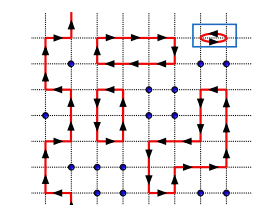
The researchers wrote the qubit-regularized Euclidean theory in terms of a dimer model. This can be viewed as a limiting case of a system with two flavors of staggered fermions, originally introduced to study the physics of symmetric mass generation. This model demonstrated that asymptotic freedom can emerge without fine-tuning due to an unconventional qubit regularised model they constructed for the corresponding QFT arising at the BKT fixed point.
This work in the Euclidean formulation of the non-linear O2 sigma model presented exponentially small mass gaps in the non-linear O3 model in Hamiltonian formulation and the Schwinger model.
How Does Qubit Regularization of QFTs Work?
The researchers were interested in the physics of the BKT phase transition, and there are many discretizations of the continuum theory to start from, which would eventually lead to the continuum QFT of interest. However, it is not clear whether the Gaussian nature of the UV theory can emerge from these alternative regularizations, especially qubit degrees of freedom, while the same theory then reproduces the massive physics in the IR.
For this, a special type of quantum criticality is needed where the UV and IR length scales emerge simultaneously, distinct from the lattice spacing. The interplay of these different scales and universality starts from a short lattice length scale 𝑎, where a variety of regularized models and non-universal physics depend on factors like the details of qubit regularization.
What is the Role of Loop Configurations in Qubit Regularization?
Loop configurations play a vital role in the O3 model and in the O2 model, where closed loops on single bonds are now allowed and key to recovering the BKT phase transition without fine-tuning. A sample loop configuration in the O3 model and in the O2 model illustrates this concept.
This is followed by an intermediate length scale where the continuum UV physics begins to dominate, giving rise to the required Gaussian theory. Eventually, at long length scales, a non-perturbative massive continuum quantum field theory emerges.
What is the Future of Qubit Regularization?
The research conducted by the team from the Saha Institute of Nuclear Physics, Homi Bhabha National Institute, Duke University Department of Physics, and Institut für Theoretische Physik ETH Zürich provides a promising direction for the future of qubit regularization.
Their novel regularization of the asymptotically free massive continuum QFT that emerges at the BKT transition through a hard-core loop-gas model demonstrates the potential of this method to capture the physics of ultraviolet fixed points without the need for fine-tuning. This opens up new possibilities for the study of quantum field theories and the development of quantum simulations.
Publication Date: 2024-05-02
Authors: Marina Marinkovic, Saurabh Maiti, Debasish Banerjee, Shailesh Chandrasekharan, et al.
Source:
DOI: https://doi.org/10.22323/1.453.0358