Qubit Pharmaceuticals has announced a breakthrough in drug discovery, achieving a 15-30x speedup in crucial Relative Binding Free Energy (RBFE) calculations. This leap forward addresses a long-standing challenge in in silico drug design, where accuracy traditionally degrades with even minor molecular modifications—leading to costly and unreliable simulations. The team’s new methodology, dubbed Dual-LAO, maintains state-of-the-art accuracy while dramatically shrinking simulation times from tens of nanoseconds to just a few. “This fresh approach is more robust and reliable when handling chemical transformations, allowing for widespread adoption,” explains Qubit Pharmaceuticals. This advancement promises to accelerate drug development by enabling faster iteration on design ideas and bolder explorations of chemical space.
Dual-LAO Method Overcomes RBFE Accuracy and Convergence Issues
In silico drug discovery relies heavily on accurately predicting the binding affinity of molecules, a process often spearheaded by Relative Binding Free Energy (RBFE) calculations; however, traditional RBFE methods have historically struggled with reliability when assessing significant molecular changes, hindering their widespread adoption. While simulation runtimes remained stable, accuracy diminished rapidly with larger modifications, resulting in poor convergence and questionable outputs—expensive computations often failing to justify the investment beyond minor adjustments. Now, a new methodology addresses these critical limitations, delivering a 15-30× speedup in calculations while maintaining state-of-the-art accuracy.
The team has dubbed this advancement Dual-LAO, with “Dual” referring to its dual-topology restraint system and LAO standing for Lambda-ABF-OPES. This approach tackles traditionally problematic molecular transformations like scaffold changes, buried water displacements, and even ring opening and closure, a major leap toward a dependable tool for researchers.
Lambda-ABF-OPES Accelerates Free Energy Calculations via Adaptive Bias
In silico molecular screening is increasingly vital for reducing the time and expense associated with drug discovery, with Relative Binding Free Energy (RBFE) calculations playing a crucial role in initial assessments. However, traditional RBFE methods have proven fragile when applied to due diligence projects, exhibiting rapidly decreasing accuracy as molecular modifications increase—a limitation hindering their widespread adoption. “RBFE has traditionally been problematic for challenging molecular transformations,” particularly with changes like scaffold shifts or alterations in charge, creating unreliable results and costly failures. Now, a new methodology, dubbed Dual-LAO (Lambda-ABF-OPES), directly addresses these shortcomings, delivering a significant computational advantage.
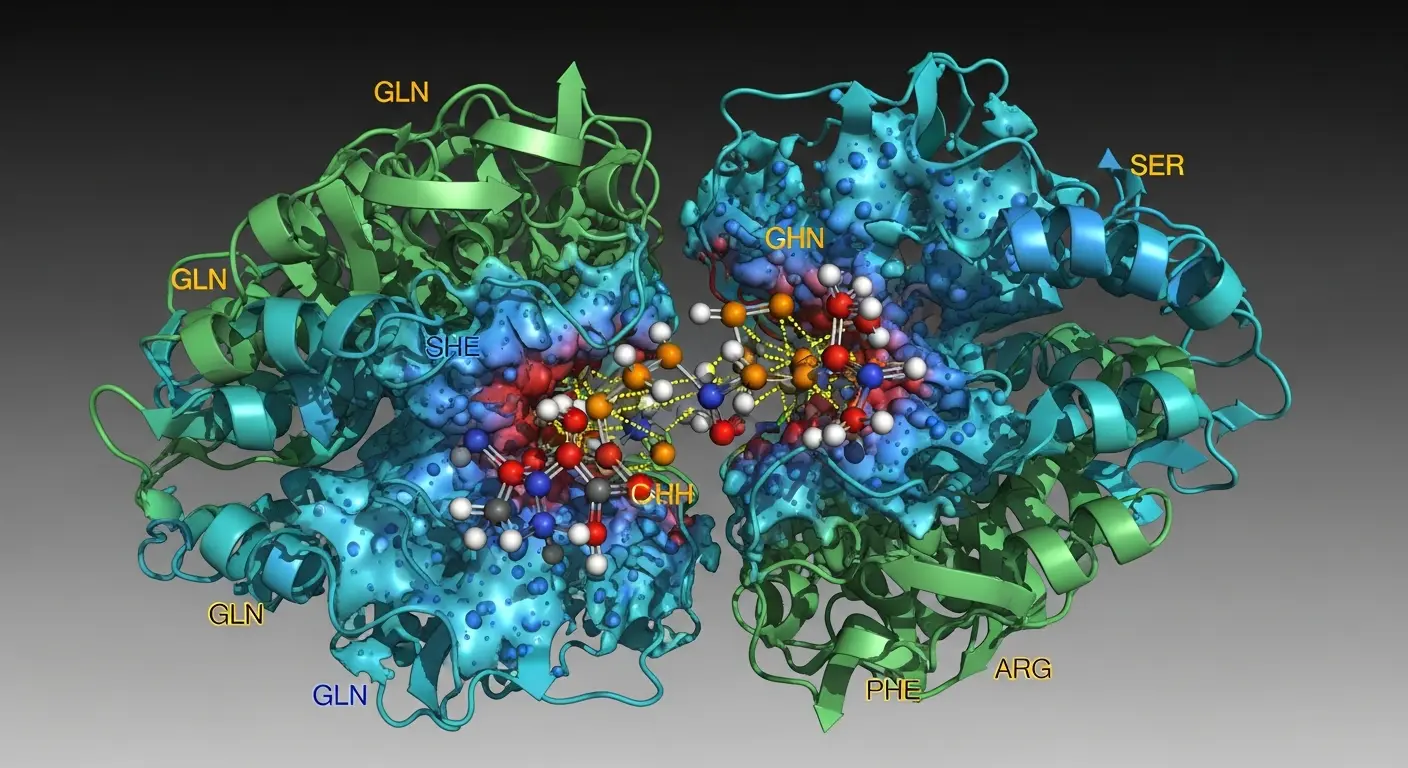
Across a range of tests, errors fall within 0.5–0.6 kcal/mol, comparable to established RBFE approaches. This acceleration is achieved through adaptive bias and metadynamics-based sampling, enabling systems to overcome free energy barriers more efficiently. Dual-LAO’s dual-topology setup, maintaining both starting and ending ligands throughout the simulation, circumvents the need for complex dummy-atom constructions. This advancement expands the scope of RBFE, offering greater confidence in go/no-go decisions for drug analogs and enabling exploration of previously inaccessible chemical space.
30x Speedup Streamlines Drug Discovery Workflows & Design Iteration
However, traditional RBFE methods have faced limitations, particularly when assessing significant molecular modifications—accuracy often degrades, leading to unreliable results and wasted computational resources. This has historically restricted their use in due diligence projects where robust data is critical. The team reports errors of roughly 0.5–0.6 kcal/mol, aligning with established RBFE standards. Crucially, Dual-LAO enables parallel evaluation of multiple ligand transformations, and “this could allow medicinal chemists to evaluate hosts of interactions in parallel, which further streamlines current workflows.” This acceleration means accurate computations can be completed within hours, fostering faster iteration on design ideas and bolder approaches to drug candidate selection.
In practice, this means expensive simulations that often fail to justify the time and compute invested once you move beyond small, incremental changes.