

Researchers demonstrate increased flexibility in qubit control by defining isoprobability classes, where differing pulse shapes yield identical probabilities of quantum states. This approach, validated on an IBM processor, utilises time-dependent field manipulation to emulate frequency control, simplifying implementation and enhancing potential for scalable, high-fidelity quantum operations.
The pursuit of precise control over quantum systems represents a central challenge in the development of quantum technologies, impacting fields ranging from computation to secure communication. Achieving high-fidelity manipulation of qubits, the fundamental units of quantum information, often necessitates complex pulse sequences that are difficult to implement in practice. Researchers are now exploring methods to broaden the range of accessible control strategies without compromising performance. In a recent study, Ivo S. Mihov and Nikolay V. Vitanov, both from the Center for Quantum Technologies and the Department of Physics at Sofia University, detail a novel approach utilising ‘isoprobability’ models to enhance qubit control. Their work, entitled “Isoprobability Models of Qubit Dynamics: Demonstration via Time-Dependent Phase Control on IBM Quantum”, demonstrates how manipulating the temporal evolution of control pulses can achieve equivalent probabilistic outcomes to more complex frequency shaping, offering a potentially more practical route to robust and scalable quantum operations and validating the concept on IBM quantum hardware.
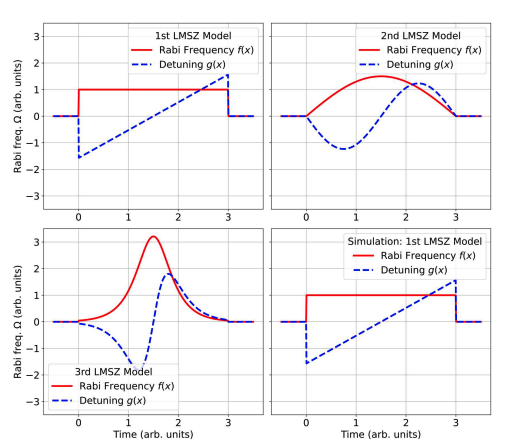
Quantum computation relies on the precise manipulation of qubits, the fundamental units of quantum information. Achieving high-fidelity control, however, presents a significant challenge, as optimal control algorithms frequently generate pulse sequences difficult to realise with existing quantum hardware. Recent research addresses this issue by demonstrating that multiple distinct pulse shapes can achieve identical transition probabilities between qubit states, a concept framed within the mathematical construct of ‘isoprobability classes’.
The core principle involves recognising that the desired
The core principle involves recognising that the desired quantum transformation – rotating the qubit’s state on the Bloch sphere – is not uniquely defined by a single pulse shape. Instead, a range of pulse sequences belonging to the same isoprobability class can yield the same outcome. This redundancy offers considerable flexibility in designing control signals, allowing researchers to prioritise implementability without compromising performance. The work builds upon established quantum control models, specifically the Landau-Majorana-Stückelberg-Zener (LMSZ) and Allen-Eberly-Hioe (AEH) frameworks, which describe the interaction between a qubit and a control field.
A key innovation lies in the ability to emulate detuning through temporal manipulation of the pulse. Detuning, in this context, refers to the precise frequency control required to drive transitions between qubit energy levels. Some quantum hardware platforms struggle with accurate and rapid frequency adjustments. This research demonstrates that equivalent effects can be achieved by carefully shaping the pulse in time, effectively trading frequency complexity for temporal complexity. This is achieved by altering the time dependence of the control pulse, rather than its frequency.
Researchers successfully validated this approach on an IBM quantum processor, demonstrating the practical viability of the technique. The results indicate that by exploiting isoprobability classes, it is possible to design control pulses that are more readily implemented on current hardware, while maintaining acceptable levels of fidelity. This offers a pathway towards more robust and scalable quantum control systems, addressing a critical bottleneck in the development of practical quantum computers. Further research will focus on extending these principles to more complex quantum systems and scenarios, potentially unlocking new avenues for quantum computation.
👉 More information🗞Isoprobability Models of Qubit Dynamics: Demonstration
🗞 Isoprobability Models of Qubit Dynamics: Demonstration via Time-Dependent Phase Control on IBM Quantum
🧠 DOI: https://doi.org/10.48550/arXiv.2506.19572


