Quantum thermalization, the process by which an isolated system reaches equilibrium, remains a fundamental challenge in physics, and a new approach tackles this problem using path integrals. Alexander Altland from the University of Cologne, Kun Woo Kim from Chung-Ang University, and Tobias Micklitz, along with their colleagues, present a theoretical framework that describes how systems evolve from initial states towards thermal equilibrium, even when interacting only with themselves. Their method combines established concepts from disordered systems and strong correlations, extending previous theoretical limitations by moving beyond approximations and allowing for a detailed understanding of thermalization dynamics across all timescales. This work provides a powerful, transferable tool for investigating complex quantum systems and offers insights into the behaviour of strongly entangled, chaotic systems, validated through comparisons with numerical simulations using the spectral form factor as a key observable.
Quantum systems frequently behave as if they constitute their own environment. The presented theory combines concepts from quantum many-body physics, notably models of disordered systems and Green’s function techniques, to describe a wide range of systems. This approach extends previous work by moving beyond approximations, allowing scientists to investigate thermalization dynamics across multiple timescales, from extremely short scattering times to much longer, macroscopic time scales.
Path Integrals and Many-Body Localization Theory
This document presents a theoretical framework for understanding the behavior of complex quantum systems, particularly those exhibiting chaotic behavior or many-body localization. It aims to develop tools, such as path integrals and field theory, to calculate properties and predict the behavior of these systems, connecting areas like quantum chaos, disordered systems, and many-body physics under a unified theoretical umbrella. Quantum chaos investigates systems whose classical counterparts exhibit chaotic behavior, a challenging area because classical hallmarks of chaos do not directly translate to the quantum realm. Many-body localization describes a phenomenon where strong disorder prevents a quantum system from reaching thermal equilibrium, instead remaining localized in a high-dimensional space.
Disordered systems, with random impurities, dramatically alter quantum system behavior, leading to phenomena like localization. Path integrals provide a powerful mathematical technique for calculating quantum mechanical amplitudes, while field theory offers a framework for describing physical systems in terms of fields. Supersymmetry, random matrix theory, and the Keldysh formalism are also employed to understand the statistical properties of quantum systems and describe systems far from equilibrium. The work progresses from an introduction outlining the problems of quantum chaos and localization, to developing the mathematical formalism with path integrals and field theory. Subsequent sections focus on disordered systems, quantum chaos, non-equilibrium dynamics, and applications to specific examples. Its density of information and focus on non-equilibrium dynamics make it a valuable resource for researchers in theoretical physics, condensed matter physics, and quantum information theory.
Quasiclassical Dynamics Capture Strong Interaction Thermalization
Scientists have developed a novel theoretical approach to describe the complex dynamics of strongly interacting quantum systems, effectively treating them as being coupled to their own environment. This framework combines concepts from several areas of theoretical physics, including Green’s function theory and models of disordered systems, to provide a comprehensive understanding of thermalization processes. The research extends previous theoretical limitations by moving beyond approximations, allowing for the description of dynamics from extremely short timescales through to much longer, macroscopic time scales. The team’s method focuses on ‘quasiclassical Green functions’, which represent slowly fluctuating variables that capture the late-stage evolution of chaotic systems.
These functions describe the behavior of individual quantum building blocks, termed ‘qudits’, and how they interact. Experiments reveal that these qudits, such as disordered quantum dots or systems evolving under random conditions, reach a state of ergodicity after very short times, meaning their internal states become rapidly randomized. The theory demonstrates that the collective variables describing these qudits evolve in a way that allows for the identification of slowly fluctuating effective variables, even as individual qudit amplitudes fluctuate rapidly. Results demonstrate that the spectral form factor, a key observable used to characterize chaotic systems, aligns well with numerical simulations, validating the accuracy of the theoretical framework.
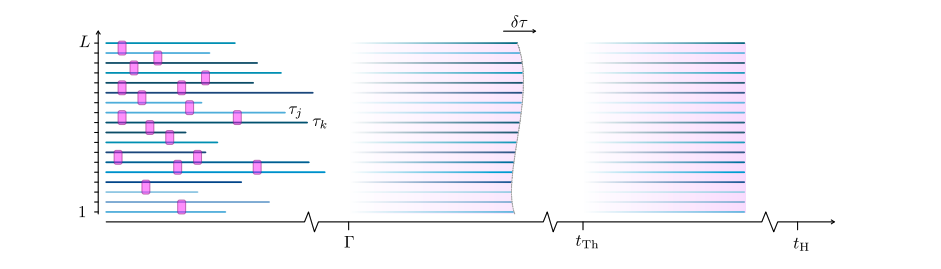
The research shows that at short timescales, the system supports numerous dynamical ‘zero modes’ representing differences in the propagation times of quantum amplitudes within each subsystem. However, as time scales increase beyond a characteristic ‘Thouless time’, these differences are damped out, and the system’s dynamics freeze to a single, common time set. This freezing effect, occurring at timescales exceeding approximately the natural logarithm of the number of subsystems, signifies a transition to a more stable, predictable state. The breakthrough delivers a powerful new tool for understanding and modeling complex quantum systems, with potential applications in diverse fields such as condensed matter physics and quantum information science.
Ergodicity and Dynamics in Chaotic Quantum Systems
This work introduces a theoretical framework for understanding the dynamics of complex quantum systems, particularly those exhibiting chaotic behaviour. The researchers developed a quasiclassical Green function approach that describes how these systems evolve over time, even when strongly interacting and disordered. This method extends existing theories by moving beyond approximations and allowing for the investigation of dynamics from very short timescales through to the point where the system reaches a state of thermal equilibrium. The approach was successfully tested against numerical simulations using models of coupled circuits and dots, demonstrating good agreement between theory and experiment.
A key finding is the understanding of ergodicity, the tendency of a system to explore all accessible states, as a consequence of broken symmetry. The theory reveals a symmetry between different ways of describing quantum evolution, which is broken when averaging over many possible system configurations. However, the authors demonstrate that fluctuations, particularly at longer timescales, restore this symmetry, suggesting a dynamic interplay between order and disorder. The framework provides a transferable toolbox for investigating strongly entangled, chaotic systems, offering a first-principles description of their behaviour. The authors acknowledge that the current model operates within an effectively zero-dimensional framework and that further research is needed to extend it to higher dimensions. They also suggest that future work could focus on exploring the behaviour of these systems at even longer timescales, where the effects of these fluctuations become more pronounced.
🗞 Path integral approach to quantum thermalization
🧠 ArXiv: https://arxiv.org/abs/2509.06028