The behaviour of energy within complex quantum systems receives detailed attention from Vansh Kaushik of SISSA, Sayan Choudhury from the Harish-Chandra Research Institute, and Tanay Nag of BITS Pilani-Hyderabad, who investigate how energy moves through a specially driven four-level quantum system. Their work explores a ‘temporal’ analogue of materials exhibiting complex electronic properties, effectively creating a synthetic landscape for energy to flow through time rather than space. The researchers demonstrate that, under specific driving conditions, this system can actively ‘pump’ energy, and importantly, they find that the rate of energy exchange reveals fundamental properties of the system’s quantum state, distinguishing between different types of insulating behaviour. This ability to control and characterise energy flow has implications for the development of novel quantum technologies and a deeper understanding of complex quantum materials.
Topological Materials, Qudits, and Non-Equilibrium Systems
This extensive list of references details advanced topics in condensed matter physics, quantum computing, and topological materials, with a strong emphasis on systems operating far from equilibrium, higher-order topology, and qudit-based quantum information processing. The collection highlights several core themes, notably topological materials, encompassing topological insulators, superconductors, and higher-order topological insulators, with studies covering fundamental properties and behavior in non-equilibrium conditions. A significant portion of the references focuses on using qudits, quantum systems with more than two levels, for quantum computation, including exploring physical platforms for realizing qudits and developing techniques for controlling and measuring qudit states. The bibliography also highlights non-equilibrium physics and Floquet engineering, using time-periodic driving to create novel quantum states and control material properties.
Foundational work in condensed matter physics, such as solid-state physics and basic topological concepts, is also included. The bibliography suggests a strong interest in the intersection of these fields, with researchers likely exploring the design of topological qubits and qudits protected from decoherence, using Floquet engineering to dynamically control topological phases for quantum information processing, and simulating topological materials with qudit-based quantum computers. Further research could involve leveraging higher-order topology for novel quantum devices, investigating non-equilibrium quantum computing, and combining different physical platforms for qudits to maximize their advantages. The collection emphasizes higher-order topology, covering a broad range of physical systems for both topological materials and qudits, with both theoretical and experimental papers indicating a rapidly evolving field. The inclusion of acoustic and photonic topological materials suggests an interest in exploring their potential for creating novel devices and technologies. In summary, this bibliography paints a picture of a vibrant and interdisciplinary research area at the forefront of condensed matter physics and quantum information science, seeking robust and controllable quantum systems for both fundamental research and technological applications.
Temporal Spin Hall Insulator Realized in Experiment
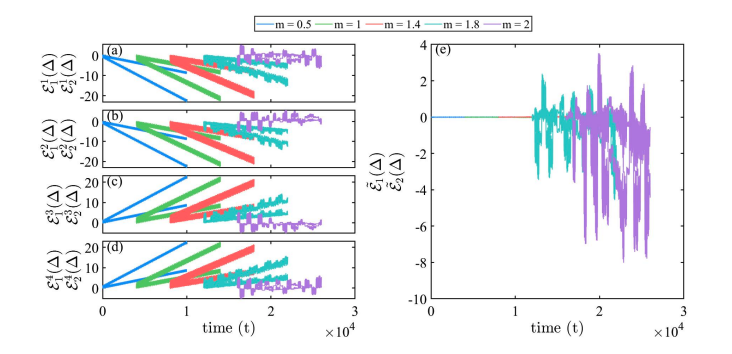
Scientists have discovered a novel method for controlling energy flow within a four-level system, revealing behaviors analogous to those found in materials with intertwined spin and orbital properties. By applying two precisely tuned drives to this system, researchers created a two-dimensional synthetic structure that facilitates energy pumping, the directed transfer of energy within the system. This research demonstrates the realization of a temporal spin Hall insulator, where energy exchange between the two drives exhibits quantized behavior, a direct consequence of propagating edge modes within the system. The team characterized these modes using a spin-Chern number, a topological property that describes their characteristics.
Interestingly, the team found that for a temporal higher-order insulator, a more complex topological state, energy exchange between the drives ceases entirely, suggesting the presence of localized corner modes, which were further characterized using mid-gap Wannier spectra. The research highlights that the fidelity of the system’s time evolution serves as a key indicator of its topological phase. Experiments revealed that within the topological phase, the work done by the first drive is exactly opposite to that of the second drive, signifying a continuous transfer of energy, and the total work done remains zero when both drives are considered. Further investigation revealed a distinct behavior in the temporal higher-order insulator, where both drives either release or absorb energy, unlike the opposing behavior observed in the spin Hall insulator, attributed to the breaking of symmetry. These findings demonstrate a new pathway for controlling energy flow and realizing novel topological states with potential applications in future technologies.
Driven System Mimics Topological Insulator Behaviour
This research investigates a system driven by multiple frequencies, revealing connections between time-based physics and established concepts in materials science. The team demonstrates that this periodically driven system can mimic the behaviour of quantum spin Hall insulators and higher-order topological insulators, exhibiting unique electronic properties. Specifically, they find that energy can be pumped through the system in a quantized manner, directly linked to the presence of propagating edge modes, and characterized by a spin-Chern number. Interestingly, for a higher-order insulator configuration, energy exchange ceases, indicating the existence of localized corner modes, which are identified using Wannier spectra. The study further establishes that the system’s stability during its time evolution serves as a reliable indicator of its topological phase. The authors acknowledge that their analysis operates under the assumption of a strong driving regime, and future research could explore the behaviour of this system under weaker driving conditions or investigate the potential for manipulating energy flow for technological applications, building on the demonstrated connection between temporal and spatial topological phases.
🗞 Topological energy pumping in a quasi-periodically driven four-level system
🧠 ArXiv: https://arxiv.org/abs/2509.06043