

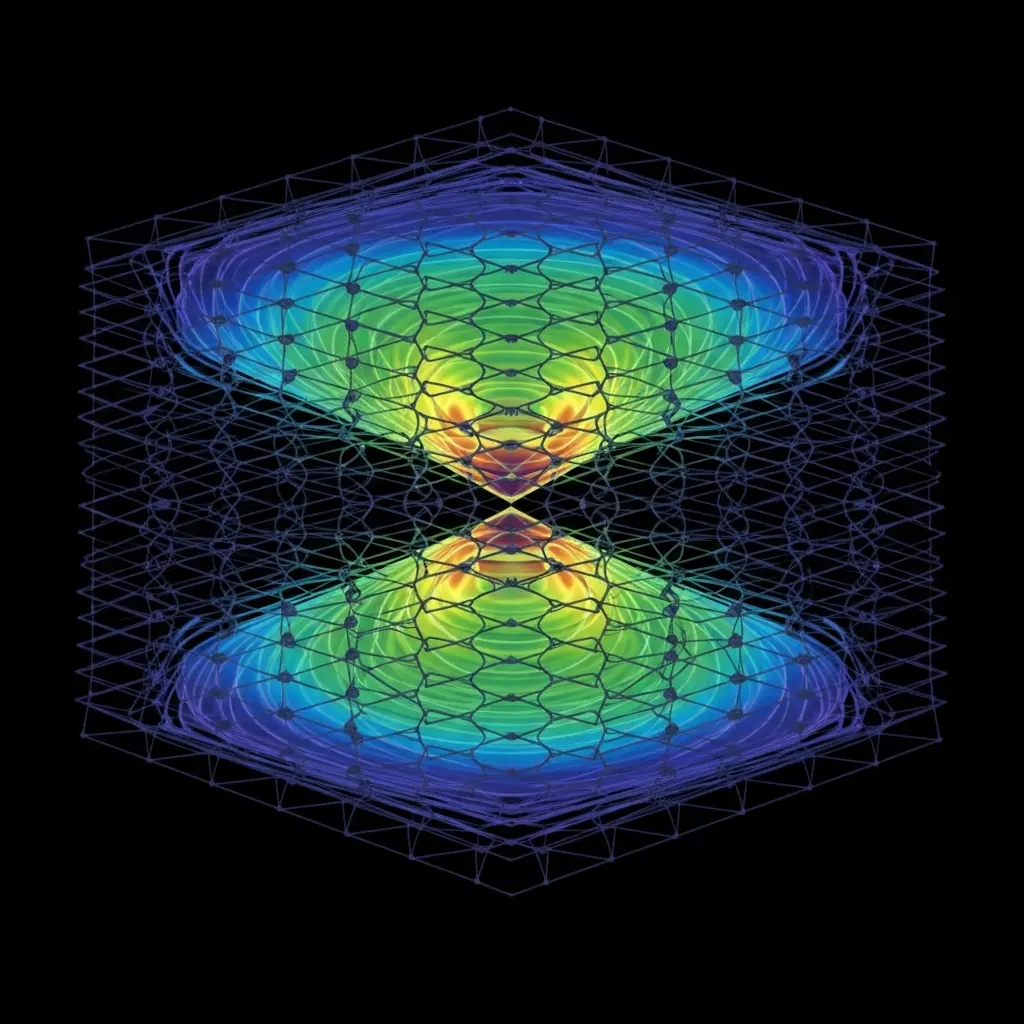
Researchers have uncovered a novel quantum state of matter , the quarter semimetal , within rhombohedral multilayer graphene, potentially revolutionising materials science. Jing Ding, Hanxiao Xiang, and Naitian Liu, alongside colleagues from Westlake University, demonstrate how introducing spin-orbit coupling dramatically alters the electronic properties of this material, leading to this unusual semimetallic phase. Their work, published today, reveals that this state exhibits a near-zero Hall resistance and a unique hysteretic anomalous Hall effect, signifying broken symmetries and fully polarised charge carriers. Significantly, applying a magnetic field can drive a transition to a Chern insulator, suggesting rhombohedral graphene could become a key platform for exploring correlated electron behaviour and topological physics , opening doors to future advancements in spintronics and quantum computing.
Graphene proximity to WSe2 induces quarter semimetals
The research team achieved this by carefully stacking rhombohedral pentalayer graphene on hexagonal boron nitride and then proximitizing it with WSe2, effectively inducing SOC on the meV scale. Strong correlations arising from the surface flat band induce spontaneous symmetry breaking, further enhancing the material’s unique properties. This transition is a direct consequence of the valley polarization and band inversion induced by the SOC and magnetic field. The team meticulously mapped the charge neutrality point using longitudinal resistance measurements, revealing a phase diagram consistent with intrinsic pentalayer graphene but significantly modified by the SOC.
Raman mapping confirmed the preservation of the rhombohedral domains after encapsulation, ensuring the integrity of the material’s structure. The researchers utilized dual-gate structures to independently control carrier density and displacement electric field, allowing for precise tuning of the material’s properties and observation of the insulating states. Furthermore, the work establishes rhombohedral multilayer graphene as an ideal platform for studying the interplay between strong correlations, topology, and SOC, potentially paving the way for novel quantum devices. This research opens exciting avenues for exploring exotic quantum phenomena and designing advanced electronic devices based on the unique properties of quarter semimetals and Chern insulators.
Rhombohedral Graphene’s Anomalous Hall Effect via Proximity Coupling
Researchers then quantified the remanent Hall resistance, ΔR௫௬, defining it as proportional to the magnetization of the system. However, below 10 K, ΔR௫௬ dramatically decreased, prompting the team to attribute this behaviour to a competition between thermal suppression of magnetic order and temperature-dependent magnetic moment density. To rule out domain wall effects, the study repetitively measured temperature dependence across several cooling processes, consistently observing the same behaviour, thus validating the intrinsic nature of the observed phenomenon. Scientists harnessed the spin-valley locking effect of Ising SOC to magnetically control valleys via the valley Zeeman effect. Applying an external magnetic field directly coupled to the orbital magnetic moments of Bloch electrons, enhancing band overlap and inverting bands in valley-polarized semi-metallic bands. This precise control resulted in a transition from a semimetal, where the Fermi level crosses a band, to a Chern insulator, where it lies within a gap, evidenced by a dramatic increase and quantization of R௫௬ to h/Ce at B 1.5 T, confirming a Chern number of C=5.
Rhombohedral Graphene Exhibits Broken Symmetries and Semimetallic Behaviour
Experiments revealed that strong correlations from surface flat bands lead to spontaneous symmetry breaking, a crucial step towards understanding complex electronic states. Detailed fitting procedures confirmed nearly linear Hall resistance at high temperatures, with pronounced nonlinearity emerging below 5 K and significantly enhancing as temperatures decreased. The Hall coefficient, defined as dR௫௬/dB, exhibited a sign change at 1 K at low field (B0 T) as the temperature decreased, and at fixed T0.3 K, the Hall coefficient also experienced sign reversal at B0.3 T. Data shows electron and hole densities, μ and μ, increase with decreasing temperature, reaching 10 cm2V-1s-1 at low temperatures, while n and n decrease, values at T0.3 K are in the order of 10cm-2.
Tests prove that the observed temperature evolution of carrier densities and mobilities is consistent with electrons and holes being thermally activated and scattered by phonons at high temperatures. Beyond this, researchers observed hysteretic loops in R௫௬ at low-field regimes (|B| ൏50 mT) when sweeping magnetic fields forward and backward, a phenomenon arising from the interplay of SOC, strong correlations, and topology. Scientists attribute this behaviour to a competition between thermal suppression of magnetic order and temperature-dependent magnetic moments density. Measurements confirm the absence of domain wall effects, with consistent temperature dependence observed across multiple cooling processes. The spin-valley locking effect of the Ising SOC allows for magnetic control of valleys through the valley Zeeman effect, coupling to orbital magnetic moments of Bloch electrons and enhancing band overlap, ultimately inverting the band in one valley and enlarging the gap in the other.
Rhombohedral Graphene Exhibits Quarter Semimetal to Chern Transition
Strong correlations originating from surface flat bands lead to spontaneous symmetry breaking within the material. These findings establish rhombohedral multilayer graphene as a promising platform for investigating strong correlations and topologies in semimetals. The research underscores the crucial role of SOC strength in determining various quantum states, contrasting with recent discoveries of zero-field quantum anomalous Hall insulators. Authors acknowledge that the strength of effective proximity-induced SOC depends on the rotational alignment between graphene and WSe2, with optimal effects occurring at approximately 15° to 20° misalignment.
Identified twist angles of ~18° and ~15° in the fabricated devices align with this predicted optimal range, suggesting material selection, specifically WSe2, plays a decisive role in observing the quarter-semimetal state. Future research should systematically investigate the phase diagram’s evolution with SOC strength, potentially through controlling twist angles or tuning interlayer coupling via hydrostatic pressure. Further studies could also explore proximate anisotropic SOC using low-symmetry two-dimensional materials, and investigate strongly correlated electron-hole states like excitonic insulators and viscous Dirac fluids within this system.
👉 More information
🗞 Spin-orbit-driven quarter semimetals in rhombohedral graphene
🧠 ArXiv: https://arxiv.org/abs/2601.14930


