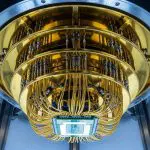
QuantWare has developed Crescendo-S, a state-of-the-art Josephson traveling wave parametric amplifier (J-TWPA) designed to enhance qubit readout in quantum computers. The device offers advanced gain and noise performance across a wide readout band, enabling cost-effective, multiplexed readout. It is designed to be scalable and user-friendly, making it suitable for various applications. Crescendo-S also reduces wiring complexity and cost per qubit, making it a future-proof solution for scalable qubit readout. The device is available in three models and is compatible with a wide range of qubit types.
Introduction to Crescendo-S
QuantWare’s Crescendo-S is a Josephson traveling wave parametric amplifier (J-TWPA) designed to enhance qubits (see our guide on what a qubit is) readout in quantum computers of varying sizes. The device boasts advanced gain and noise performance across a broad readout band, which allows for highly multiplexed and cost-effective readout. The Crescendo-S is designed to be adaptable, scalable, and user-friendly, making it a suitable readout amplifier for various applications.
Features of Crescendo-S
The Crescendo-S is optimized for multiplexed readout, offering advanced gain and noise performance over a wide 1 GHz readout bandwidth. This allows for the simultaneous readout of multiple qubits, significantly reducing the overhead required regarding wiring complexity, up-chain components, and cost per qubit compared to traditional narrow-band JPA-based readout solutions. This makes the Crescendo-S a future-proof solution for scalable qubit readout.
User-Friendly Design
The Crescendo-S is designed with user-friendliness in mind. Its current-pumped design is inherently simple to tune-up and requires minimal peripheral electronics. Each device comes with a device-specific characterisation report and expert support, making the TWPA easy to use for both experienced and novice researchers.
Scalability and Compatibility
The Crescendo-S is designed with scalability in mind, making it suitable for even the most ambitious scaling roadmaps. Its compact form factor, high-density packaging, and highly-automated production process make it a viable path to advanced readout at scale. The Crescendo-S is also a versatile amplifier, compatible with a wide range of qubit types and available in 1 GHz readout bands between 4 and 9 GHz.
Understanding the Role of a TWPA
In superconducting quantum computing, Dispersion-Engineered Josephson Travelling Wave Parametric Amplifiers (J-TWPA) play a crucial role in reading out qubit states. These states are stored in low-power radio frequency (RF) excitations. During readout, equally weak readout pulses are used which would drown in thermal noise at higher temperatures stages without proper amplification. The J-TWPA stands as the advanced solution for this task.