The Quantum Zeno Effect (QZE) and the Level Avoided Crossing (LAC) phenomenon are key aspects of quantum sensing, a technology that uses quantum coherence or entanglement to achieve superior sensitivity or resolution. The QZE can be used to enhance the information obtained from quantum sensors, particularly two-level systems or qubits, by controlling the transfer of magnetization between spins and amplifying the emitted signal. The LAC phenomenon, which occurs when the energy levels of a two-level system approach each other without crossing, is crucial for estimating interactions such as energy offset and coupling between states. Stroboscopic measurements, a type of incoherent control technique, can enhance information extraction about the coupling determined by the LAC.
What is the Quantum Zeno Effect and How Does it Enhance Quantum Sensing?
The Quantum Zeno Effect (QZE) is a phenomenon in quantum mechanics where a system’s development can be hindered by measuring it frequently. This effect is named after Zeno of Elea, a Greek philosopher who proposed several paradoxes related to infinity and divisibility. In the context of quantum sensing, the QZE can be used to maximize the information obtained from quantum sensors, particularly two-level systems or qubits.
Quantum sensors are devices that exploit quantum coherence or entanglement to achieve sensitivity or resolution beyond what is possible with classical systems. The simplest quantum sensor is a two-level system, also known as a qubit. These qubits are used to optimize estimation processes in quantum sensing technologies. The QZE can play a crucial role in estimating the coupling strength in these systems, which is essential for various applications, including improving spectroscopy techniques and developing quantum devices.
The QZE can also be used to control the transfer of magnetization between spins and significantly amplify the signal emitted by the spins. This manipulation has allowed experimental determination of interactions between spins in networks of many interacting spins. By inducing the QZE through stroboscopic measurements, the system dynamic is simplified from a complex behavior depending on several parameters to a simpler one based on a smaller number of parameters. This simplification allows for a more direct determination of coupling strengths.
How Does the Level Avoided Crossing Phenomenon Impact Quantum Sensing?
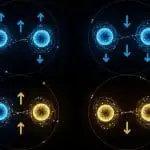
The Level Avoided Crossing (LAC) phenomenon is a critical aspect of quantum sensing. It occurs when the energy levels of a two-level system approach each other without actually crossing as a result of interactions. The most general Hamiltonian describing a two-level system includes a coupling interaction between the energy levels facilitating transitions between them and a longitudinal energy offset that creates the energy splitting between the levels.
When employing a two-level system for quantum sensing, it is essential to estimate the relevant interactions such as the energy offset and the coupling between the states. Accurately characterizing the corresponding LAC Hamiltonian is thus crucial for various applications. While the energy splitting of a two-level system has been extensively studied, the optimization of the estimation procedure for determining the coupling strength between the two energy levels still requires further exploration.
The coupling strength varies due to the qubit’s environment and serves as a crucial source of information in several applications, including characterizing spin-spin coupling network topologies and time-dependent magnetic fields. Quantum estimation tools can provide optimal strategies for efficiently maximizing and extracting information about these relevant parameters.
What is the Role of Stroboscopic Measurements in Quantum Sensing?
Stroboscopic measurements are a type of incoherent control technique used in quantum sensing. These measurements are capable of slowing down the decoherence process, known as the Quantum Zeno Effect (QZE). Depending on the specific parameters, different strategies may be most effective. For example, coherent control may be the optimal strategy for estimating some parameters, while incoherent control techniques such as stroboscopic measurements may be preferable for estimating other parameters.
Stroboscopic measurements can enhance the information extraction about the coupling determined by the level avoided crossing. Previous studies suggested limited utility of the QZE for estimating the coupling between states in a LAC Hamiltonian under resonant condition. However, recent findings demonstrate that incoherent control such as stroboscopic measurements can be particularly beneficial when the system is off-resonance.
The concept of information amplification by the QZE in a qubit sensor with an offset from resonance using quantum information tools has been introduced. This concept includes key elements relevant to more complex systems such as many-spin systems requiring the estimation of spin-spin couplings for Hamiltonian and molecular characterization.
How Does the General Hamiltonian Describe a Two-Level Spin System?
The general Hamiltonian describes a two-level spin system acting as a qubit-probe. This Hamiltonian provides a universal general form associated with a coupled two-level system, giving rise to a Level Avoided Crossing (LAC). The intrinsic energy splitting between the spin states is denoted by a specific component of the Hamiltonian, considering a certain constant.
For simplicity, we assume one component to be zero, so as the other component gives the coupling strength between the two qubit states. This Hamiltonian is crucial in understanding the dynamics of a two-level system and plays a significant role in quantum sensing technologies.
What are the Implications of These Findings for Quantum Sensing?
The findings of this study have significant implications for quantum sensing technologies. The Quantum Zeno Effect (QZE) and the Level Avoided Crossing (LAC) phenomenon are critical aspects of quantum sensing that can be leveraged for improved control and information extraction.
The introduction of the concept of information amplification by the QZE for a LAC system under off-resonant conditions has implications for AC magnetic field sensing and the characterization of complex systems, including many-spin systems requiring the estimation of spin-spin couplings. Overall, these findings contribute to the advancement of quantum sensing by leveraging the QZE for improved control and information extraction.
Zeno Effect”
Publication Date: 2024-03-17
Authors: Bruno Ronchi, Analia Zwick and Gonzalo Álvarez
Source: arXiv (Cornell University)
DOI: https://doi.org/10.48550/arxiv.2403.11339