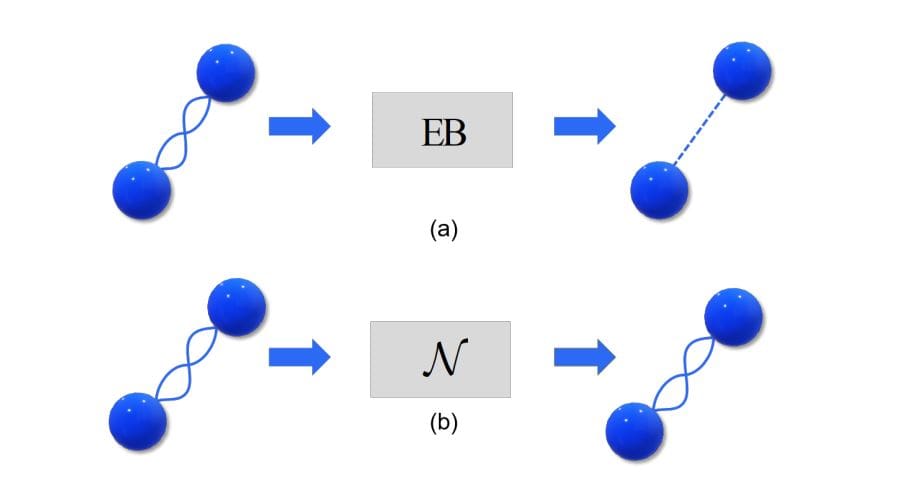
Quantum memory underpins many technologies, from secure communication to advanced computation, yet a consistent method for evaluating its performance has remained elusive. Jinghang Zhang from Shaanxi Normal University and Yu Luo address this challenge by proposing a new, weight-based measure that serves as a universal benchmark for quantum memory. This innovative approach establishes fundamental limits on how effectively memory enhances nonlocal exclusion tasks and, crucially, defines theoretical boundaries for converting standard communication channels into ideal memory systems. By applying this measure to a range of channels, including those experiencing noise and loss, the researchers demonstrate its broad applicability and provide a powerful tool for assessing and improving quantum memory performance.
This measure provides fundamental theoretical limits for transforming a general quantum channel into an ideal quantum memory. Scientists performed explicit calculations of this weight-based quantifier for various channels, including unitary, depolarizing, maximal replacement, stochastic damping, and erasure channels. Memory is a fundamental component of information processing, playing a vital role in both classical and quantum computing.
Mathematical Proofs for Quantum Information Theory
This appendix provides rigorous mathematical support for the claims made in the main research paper, detailing calculations, bounds, and relationships between different measures in quantum information theory. It ensures the validity and completeness of the research by providing detailed derivations and proofs. The appendix explores the weight-based measure of quantum memory, quantifying how well a quantum channel preserves quantum information. Researchers derived a dual formulation of this measure, a technique used to simplify complex optimization problems, relying on concepts from convex geometry and the Lagrangian method.
This dual formulation provides a practical way to calculate the weight-based measure and offers insights into the properties of quantum memory. The appendix also investigates the relationship between maximally entangled states and separable states, measuring the fidelity, or similarity, between them. Scientists determined the maximum fidelity between a maximally entangled state and a separable state, revealing the limits of entanglement and how closely separable states can approximate entangled states. Furthermore, the appendix proves a simple but important inequality involving the trace of two operators, a tool used in quantum information theory and linear algebra to bound the trace of a product of operators. These appendices are essential for validating the research claims, providing the mathematical rigor needed to support the theoretical results.
Quantum Memory Benchmarking via Weight Quantification
This work introduces a new method for benchmarking quantum memory, establishing a weight-based quantifier to evaluate its performance in nonlocal exclusion tasks. Scientists developed this measure to determine the advantage quantum memory offers over classical approaches, providing a fundamental theoretical tool for assessing memory capabilities. The research establishes a general lower bound for this weight-based measure, defining the minimum performance level for any quantum memory system. Crucially, the team demonstrates that this measure provides theoretical limits for transforming a general quantum channel into an ideal memory, offering a pathway to optimize memory design.
They performed explicit calculations of the weight-based quantifier for several standard quantum channels, including unitary, depolarizing, maximal replacement, stochastic damping, and erasure channels. These calculations reveal specific performance characteristics for each channel type, providing a detailed map of quantum memory capabilities across different systems. The results show that the weight-based quantifier effectively captures the resourcefulness of quantum memory, allowing for a precise comparison of different memory architectures. Experiments confirm that the measure accurately reflects the ability of a memory to store and retrieve quantum information, demonstrating its practical utility. The team’s findings deliver a new framework for understanding and improving quantum memory, with potential applications in quantum communication, computation, and sensing. This breakthrough establishes a rigorous benchmark for evaluating quantum memory performance and guides the development of more efficient and powerful quantum technologies.
Weight-Based Quantum Memory Quantification Reveals Limits
This research introduces a new approach to quantifying quantum memory, based on a weight-based measure derived from considering nonlocal exclusion tasks. The team established both general and tighter lower bounds for this measure, demonstrating its connection to transforming general channels into ideal memory configurations. Explicit calculations of the weight-based quantifier were then performed for several common types of quantum channels, including unitary, depolarizing, and erasure channels, revealing specific values for each. The findings demonstrate that the weight-based measure aligns with existing robustness measures for certain channels, and importantly, highlights a distinction between preserving quantum characteristics and achieving reliable quantum transmission.
Specifically, the researchers observed instances in depolarizing channels where the quantum memory measure remained positive, indicating a resistance to noise and preservation of quantum nature, even when the quantum capacity, the rate of reliable quantum information transfer, was zero. This suggests that a channel can retain its quantum properties without necessarily being suitable for effective quantum communication. The authors acknowledge that establishing a direct relationship between the weight-based measure and other quantum information metrics remains an open question, and future work could focus on exploring this connection further.
👉 More information
🗞 The weight-based measure of quantum memory as a universal and operational benchmark
🧠 ArXiv: https://arxiv.org/abs/2511.09417