The pursuit of reliable optimisation represents a significant challenge in quantum computation, particularly when utilising Variational Eigensolver methods subject to the inherent noise of real-world quantum hardware. Vojtěch Novák, Silvie Illésová, and Tomáš Bezděk, alongside Ivan Zelinka and Martin Beseda, investigate this problem by rigorously benchmarking a range of classical optimisation techniques, including gradient-based, gradient-free, and metaheuristic approaches. Their work reveals that standard optimisation methods often struggle with noisy data, leading to inaccurate results, while tracking the population mean effectively mitigates estimator bias. The team demonstrates that adaptive metaheuristics, such as CMA-ES and iL-SHADE, consistently outperform other strategies and offer robust performance across diverse quantum systems, ultimately providing practical guidelines for achieving reliable optimisation in noisy quantum computations.
Reliable VQA Optimization Amidst Noise and Plateaus
This research details investigations into reliable optimization within Variational Quantum Algorithms (VQAs), addressing challenges posed by noise and barren plateaus. Researchers explored various optimization algorithms and their performance on benchmark problems, including ground state energy calculations, simulations of the hydrogen molecule, and applications in biomedical studies. Key to VQAs is the use of quantum computers to evaluate parameterized quantum circuits, while classical optimizers adjust the parameters to minimize a cost function. The study examined a wide range of optimization algorithms, including the Simultaneous Perturbation Algorithm, Limited-memory BFGS, and several utilized in Python libraries such as Mealpy and PyADE.
Results reveal that no single optimizer consistently performs best, as performance depends on the specific problem, noise level, and circuit architecture. Metaheuristic algorithms demonstrate robustness to noise and can escape local minima, though they may converge slower than gradient-based methods. The importance of noise mitigation techniques and careful circuit design are also highlighted, with ensemble methods improving accuracy and robustness.
VQE Optimization Under Finite Sampling Noise
This study rigorously investigated the challenges of optimizing the Variational Quantum Eigensolver (VQE) under the influence of finite-shot sampling noise, a common limitation in quantum computing. Researchers benchmarked eight distinct classical optimizers across quantum chemistry Hamiltonians, including H2, H4, and LiH, analyzed in both full and active spaces. A key innovation involved correcting estimator bias by tracking the population mean, rather than relying on the potentially skewed best individual when employing population-based optimizers, directly addressing the “winner’s curse. ” Researchers identified and characterized the stochastic violation of the variational bound, where sampling noise creates false variational minima. The team demonstrated the effectiveness of adaptive metaheuristics, specifically CMA-ES and iL-SHADE, identifying them as the most resilient and effective strategies for reliable VQE optimization, consistently outperforming other approaches.
Sampling Noise Distorts Variational Eigensolver Optimization
This research investigated the challenges of optimizing Variational Eigensolver (VQE) algorithms due to noise arising from finite sampling. Experiments demonstrate that this sampling noise distorts the cost landscape, creating false minima and inducing the “winner’s curse,” which misleads optimization processes. The study benchmarked eight classical optimizers across quantum chemistry Hamiltonians, including H2, H4, and LiH, analyzed in both full and active spaces. Results show that gradient-based methods diverge or stagnate in noisy conditions when the cost curvature approaches the level of sampling noise.
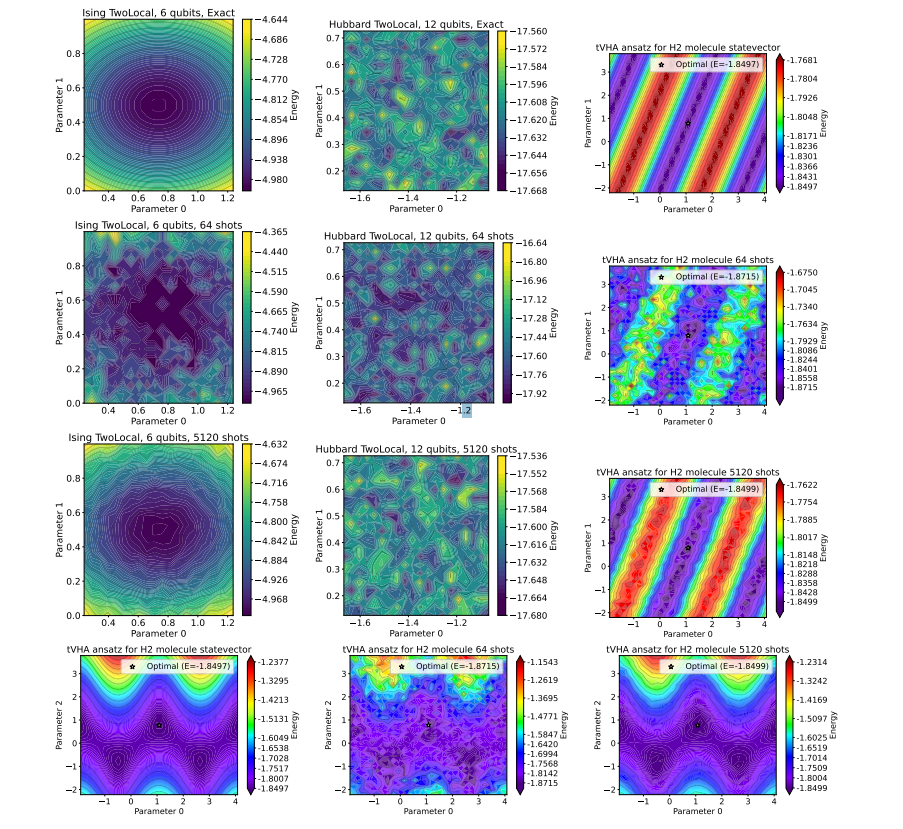
The team discovered that tracking the population mean effectively corrects the estimator bias when using population-based optimizers. Specifically, CMA-ES and iL-SHADE proved most effective and resilient, consistently outperforming other methods. Visualizations reveal how smooth, convex basins in the cost landscape deform into rugged, multimodal surfaces as noise increases. The study quantified these effects across both problem-inspired and hardware-efficient circuits, confirming findings with 1D Ising and Fermi-Hubbard models.
Noise Resilience in Variational Quantum Algorithms
This research establishes a clear connection between measurement noise and instability in variational quantum algorithms. By systematically benchmarking eight classical optimizers across molecular and condensed matter systems, scientists demonstrate that finite-shot sampling alone disrupts the structure of the variational landscape. They found that as noise increases, traditional gradient-based methods lose reliability because curvature signals become comparable to the noise amplitude. Crucially, the study identifies adaptive, population-based algorithms, specifically CMA-ES and iL-SHADE, as the most effective and resilient strategies for navigating this noisy environment.
These algorithms implicitly average noise, providing a general approach to achieving stochastic stability. Researchers also characterized the “winner’s curse,” where statistical minima can falsely appear below the true ground state energy, corrected by re-evaluating elite individuals or tracking population means. The findings reveal that apparent benefits from noise are often illusory, stemming from estimator variance rather than genuine physical effects. The authors acknowledge that the study focuses on the impact of sampling noise and does not include analysis of gate errors or decoherence, suggesting future work should investigate strategies for mitigating these combined sources of error.
🗞 Reliable Optimization Under Noise in Quantum Variational Algorithms
🧠 ArXiv: https://arxiv.org/abs/2511.08289