Determining the energy and properties of molecules presents a significant challenge in quantum chemistry, particularly with the limitations of current quantum computers. Dibyendu Mondal from the Indian Institute of Technology Bombay, Debaarjun Mukherjee from ETH Zürich, and Rahul Maitra, also from the Indian Institute of Technology Bombay, and their colleagues have developed a new strategy to construct more efficient and stable quantum algorithms for these calculations. Their approach systematically builds quantum algorithms by first identifying the most important components through a process of ‘commutativity screening’ and then progressively adding complexity in a controlled manner. This method achieves accurate results with fewer computational steps, importantly avoiding the common problem of algorithms getting stuck in inefficient configurations, and successfully models complex molecular behaviour where existing techniques often struggle, representing a substantial advance in the field of quantum simulations.
In the field of quantum chemistry, the variational quantum eigensolver (VQE) has emerged as a highly promising approach to determine molecular energies and properties within the noisy intermediate-scale quantum (NISQ) era. A central challenge lies in designing an expressive ansatz, a trial wavefunction, capable of accurately representing the ground state while remaining computationally manageable. Current quantum hardware demands compact ansatze to avoid numerical instabilities during optimisation. To address this, scientists propose a systematic dynamical ansatz construction strategy, leveraging the adaptive variational quantum eigensolver (AVQE) framework to iteratively refine the ansatz based on the evolving understanding of the system’s electronic structure. This method involves a sequence of quantum computations and classical optimisations, guided by a cost function that balances ansatz expressibility and computational efficiency, ultimately leading to a more accurate and robust determination of molecular ground state energies.
VQE Optimisation, Reduced Gates and Scalability
This research details improvements to the Variational Quantum Eigensolver (VQE) algorithm, a key tool in quantum chemistry for finding the ground state energy of molecules. The core challenge addressed is overcoming limitations of VQE, specifically the issues of barren plateaus and rough parameter landscapes, which hinder optimisation, and the need to reduce the number of quantum gates and qubits required for accurate results. The researchers are exploring novel approaches to construct more efficient ansatze, aiming for a balance between accuracy and computational cost. They emphasize dynamic construction, meaning the wavefunction is built adaptively during the optimisation process, rather than being fixed beforehand.
This involves operator commutativity screening to remove redundant operators, subspace optimisation to focus on relevant areas of the calculation, and non-iterative auxiliary subspace corrections to improve the wavefunction without extensive calculations. They also focus on developing compact ansatze with a minimal number of parameters while maintaining accuracy. Scientists leverage concepts from traditional quantum chemistry, such as advanced coupled-cluster theory, to guide the construction of more accurate and efficient ansatze. They have developed variations of coupled-cluster theory with implicit triple excitations and employ and adapt optimisation algorithms to navigate the energy landscape more effectively. Machine learning assists in the construction of ansatze and identifies relevant operators, while pruning techniques remove irrelevant operators to reduce computational cost and amplitude reordering optimises the order of operations within the ansatz to improve performance.
Compact Quantum Ansätze via Operator Block Ordering
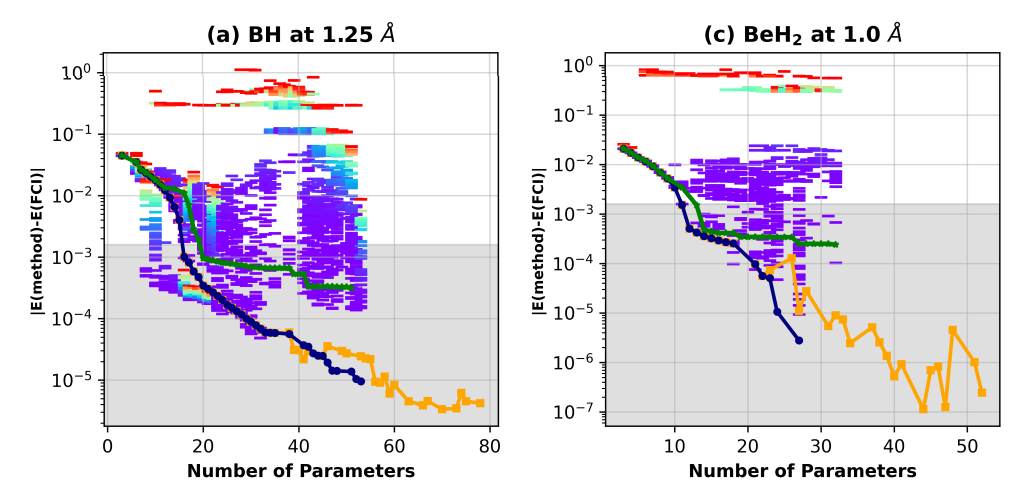
Scientists have developed a new strategy for constructing quantum ansatze, achieving accurate molecular energies with significantly fewer parameters than existing methods. This work addresses a critical challenge in quantum chemistry, designing compact yet expressive quantum circuits for use on noisy intermediate-scale quantum (NISQ) devices. The team’s approach, termed COMPASS with Progressive block ReOrdering (COMPASS-PRO), begins by identifying dominant operator blocks through a commutativity-based screening process, combined with an energy-sorting procedure requiring minimal quantum measurements. Each operator block consists of either a two-body excitation operator with associated scatterers, or a single-excitation operator, collectively forming a pool from which the ansatz is dynamically constructed.
Instead of selecting individual operators based on gradients, COMPASS-PRO employs a local VQE micro-cycle to guide optimisation along the steepest pathway, maximising energy stabilisation at each step. This block-wise construction demonstrably improves both accuracy and robustness compared to previous methods. The incorporation of scatterers within each block allows the ansatz to effectively capture higher-order correlation effects, crucial for accurately representing complex molecular systems. Experiments reveal that COMPASS-PRO successfully reproduces ground state energies, even in strongly correlated regions such as bond dissociation, where contemporary approaches often fail. The method bypasses local traps and mitigates numerical instabilities, overcoming challenges associated with barren plateaus and local minima that plague traditional variational quantum eigensolver (VQE) optimisation. This stability-driven construction delivers a more accurate and highly robust ansatz, paving the way for more efficient and reliable quantum simulations of molecular systems.
Efficient Variational Ansätze for Molecular Energies
This research presents a new strategy, termed COMPASS-PRO, for constructing variational quantum eigensolver ansatze, which are essential for calculating molecular energies on near-term quantum computers. The team systematically builds the ansatz by prioritising operator blocks based on their contribution to the ground state and progressively expanding it, while employing a technique to reduce computational demands. This approach balances the need for expressive power with the limitations of current quantum hardware, resulting in a more efficient and robust method for molecular simulations. Results demonstrate that COMPASS-PRO achieves accurate molecular energies with fewer parameters than existing methods and successfully navigates challenging scenarios like bond dissociation where other approaches often fail.
The method’s ability to avoid local traps in the optimisation process stems from its construction, which guides the calculation towards the true ground state energy. Furthermore, the researchers showed that reducing the complexity of the excitation operators within the ansatz can further decrease the computational cost, enhancing its suitability for near-term devices. The authors acknowledge that the ansatz-building process requires additional quantum measurements, but emphasise that this effort improves the robustness of the calculation. Future work will focus on extending this methodology to calculate excited-state energies, broadening its applicability to a wider range of molecular simulations. With its compact structure, resource efficiency, and flexibility, COMPASS-PRO represents a significant step towards realising the potential of quantum computing for accurate molecular modelling.
🗞 Operator Commutativity Screening and Progressive Operator Block Reordering toward Many-body Inspired Quantum State Preparation
🧠 ArXiv: https://arxiv.org/abs/2510.15806