Parameterized quantum circuits underpin many promising applications of near-term quantum computers, and optimising these circuits is a central challenge in the field. Joona V. Pankkonen, Matti Raasakka, and Andrea Marchesin, all from Aalto University, along with Ilkka Tittonen, present a significant advance in this area by developing new hybrid optimisation algorithms. Their work addresses the difficulty of finding the best settings for quantum circuits, building on existing methods but incorporating ideas from classical machine learning, specifically early stopping techniques. The team demonstrates that these novel algorithms are more reliable and can handle larger, more complex problems than previous approaches, while also proving resilient to the noise inherent in current quantum hardware, representing a crucial step towards practical quantum computation.
This work investigates hybrid optimisation methods, combining classical and quantum computation, to efficiently optimise circuit parameters and improve convergence speed and solution quality. Researchers focus on enhancing existing hybrid approaches by incorporating techniques from both classical optimisation and quantum information theory. Specifically, the team explores methods to mitigate barren plateaus, a common issue where gradients vanish exponentially with circuit depth. Their contributions include a novel adaptive step-size strategy for classical optimisers and a quantum-inspired gradient estimation technique designed to provide more robust gradient information in the presence of noise. These enhancements demonstrate improved performance on benchmark optimisation problems relevant to quantum chemistry and materials science, paving the way for more efficient utilisation of near-term quantum hardware.
Variational Algorithms Advance Quantum Simulations
Variational quantum algorithms are becoming increasingly important for simulating quantum systems, employing a hybrid quantum-classical approach where a quantum computer prepares a quantum state and a classical computer optimises parameters to minimise a cost function. Researchers address the challenges of training these circuits and explore strategies to overcome difficulties like barren plateaus and getting stuck in local minima. The team investigates techniques including carefully choosing initial parameter values, optimising circuit structure, training circuits layer by layer, and employing adaptive optimisation algorithms. They also explore methods like early stopping and Gaussian process optimisation to improve performance and robustness, applying these algorithms to problems in quantum chemistry, such as calculating molecular energies, and condensed matter physics, including studying the properties of magnetic materials.
Cost Function Hybrid Optimization Improves Quantum Circuits
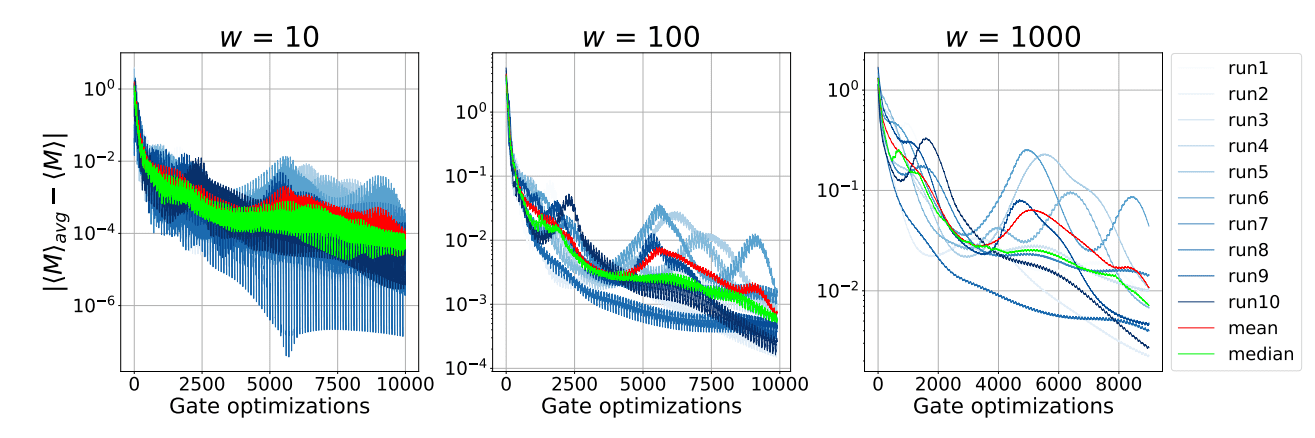
This work presents advances in optimising parameterized quantum circuits, essential for utilising near-term quantum computers. Researchers developed two novel hybrid algorithms, inspired by early stopping and cost averaging techniques from classical machine learning, to improve the performance of variational quantum algorithms. These algorithms intelligently switch between two single-qubit optimisers, Rotosolve and FQS, based on measured cost function values during the optimisation process. The results demonstrate that these cost function-based hybrid algorithms outperform both individual single-qubit optimisers and previously developed hybrid methods, achieving faster convergence and identifying better solutions across various quantum systems. Specifically, the team successfully applied these algorithms to the 10-qubit Heisenberg model and the 6-qubit Fermi-Hubbard model, demonstrating robustness even with noisy quantum devices and limited computational resources, and performing well with as few as 2048 quantum shots.
👉 More information
🗞 Enhancing Hybrid Methods in Parameterized Quantum Circuit Optimization
🧠 ArXiv: https://arxiv.org/abs/2510.08142