The behaviour of chaotic systems remains a fundamental question in physics, and researchers continually seek to understand the statistical properties of quantum chaos. Laura Shou, alongside colleagues, investigates this phenomenon using Walsh-quantized baker’s maps, models that represent chaos on a torus, and reveals crucial insights into the distribution of fluctuations within these systems. The team demonstrates that, for nearly all scaling factors, the fluctuations of matrix elements in a random eigenbasis converge to a Gaussian distribution as the system becomes increasingly large, a result that precisely defines the rate of convergence in a key mathematical theorem. This work establishes a version of the Eigenstate Thermalization Hypothesis for these eigenstates, showing they possess subtle microscopic correlations that distinguish them from purely random states, and highlights the importance of classical correlations in understanding quantum chaos.
Quantum Variance in the Baker’s Map
This research investigates the quantum behavior of chaotic systems, specifically focusing on the quantized Baker’s map and its implications for understanding quantum chaos. Scientists meticulously analyzed the distribution of matrix elements, which describe how quantum states evolve, and determined how the fluctuations of these elements scale with system size. The results provide valuable insights into the fundamental principles governing chaotic systems at the quantum level. Quantum chaos explores how systems that behave chaotically in classical physics manifest their properties in the quantum realm.
Classical chaos is characterized by extreme sensitivity to initial conditions, but quantum mechanics introduces unique constraints. Researchers study how the signatures of classical chaos appear in quantum systems, seeking to understand the interplay between these seemingly contradictory behaviors. The Baker’s map serves as a crucial model for studying this interplay, offering a simplified yet insightful representation of chaotic dynamics. The team focused on the quantum variance, a measure of the fluctuations in the matrix elements of the quantum evolution operator. Understanding how this variance scales with system size is crucial for determining whether the system exhibits quantum ergodicity, the quantum analogue of ergodicity in classical mechanics.
The research establishes a precise scaling law, demonstrating that the quantum variance grows logarithmically with the system size, a hallmark of quantum ergodicity. Beyond this basic scaling, the team identified specific corrections, providing a more refined understanding of the rate of quantum ergodicity. Remarkably, the research also revealed a connection between the quantum variance and arithmetic properties of the Baker’s map, specifically the prime factorization of the stretching factor, a novel and exciting result. By comparing the scaling of the quantum variance to that observed in random matrix theory, scientists gained further insight into the differences between truly random systems and those with underlying structure. This work contributes to a deeper understanding of how classical chaos manifests in quantum systems and opens up new avenues for research. The connection between quantum properties and number theory suggests that quantum systems can be used to study problems in mathematics.
Quantum Chaos via Walsh-Quantized Baker’s Maps
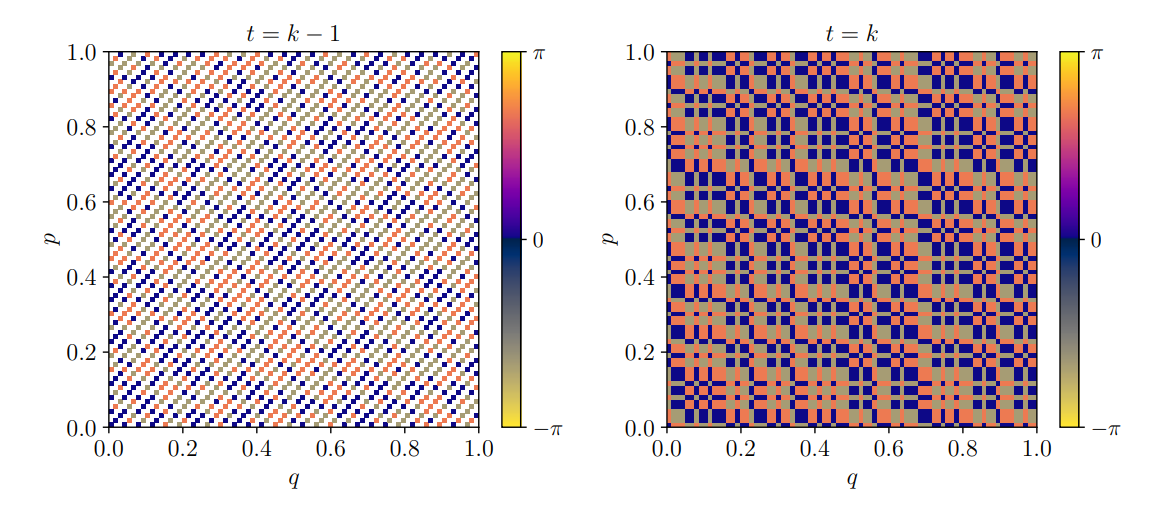
Researchers have developed a sophisticated approach to studying chaotic systems using Walsh-quantized baker’s maps, models for chaos on a torus. This method builds upon a foundation of symbolic dynamics, representing positions and momenta in a base D system. By subjecting these representations to a map that shifts digits, mirroring the classical Baker’s map, scientists can analyze chaotic behavior within a quantum framework. To explore the quantum properties of these maps, scientists defined the Walsh-quantized baker’s map as a unitary operator acting on tensor product states. This operator effectively implements a left shift and applies a discrete Fourier transform, providing a quantum analogue to the classical map’s digit-shifting action.
Researchers then introduced coherent state bases, constructed from tensor products of basis vectors and discrete Fourier transforms, to represent quantum observables. The team developed a specific notation for these coherent states, arranging indices in descending order to simplify calculations of long-time evolution. By analyzing the fluctuations of matrix elements in these eigenbases, the study demonstrates that, as the system size increases, these fluctuations follow a Gaussian distribution. The variance of these fluctuations is directly linked to classical correlations within the chaotic map, revealing a subtle interplay between quantum and classical behavior. This detailed analysis provides a precise rate of convergence for the ergodic theorem, confirming the system’s chaotic nature and establishing a connection between quantum and classical dynamics.
Gaussian Fluctuations in Chaotic Quantum Systems
Scientists have achieved a detailed understanding of quantum fluctuations within the Walsh-quantized baker’s map, a model for chaotic systems on the torus. The research demonstrates that, for most scaling factors, the distribution of fluctuations in scaled matrix elements, when averaged over random eigenbases, converges to a Gaussian distribution as the system size increases. This convergence is quantified by a precise variance, directly linked to classical correlations within the chaotic map. The team measured that the scaled quantum variance converges in probability to a classical value, confirming the connection between quantum behavior and underlying classical chaos.
However, for a specific case, D=4, the team discovered a deviation from this Gaussian behavior. Measurements show that the convergence in probability still occurs, but the resulting distribution is a mixture of two Gaussian distributions. This difference arises from an observable-dependent term, linked to the average value of the observable on a fractal subset of the torus. The team precisely quantified this fractal average, demonstrating its influence on the distribution of quantum fluctuations. The research establishes a clear link between the system’s parameters, classical correlations, and the resulting quantum fluctuations, providing a detailed understanding of chaotic behavior at the quantum level.
Eigenstate Fluctuations Mirror Classical Correlations
The research demonstrates that fluctuations in the matrix elements of eigenstates for the Walsh-quantized baker’s map behave predictably as the system becomes increasingly complex. Specifically, the team established that these fluctuations are typically Gaussian, meaning they follow a normal distribution, and that the variance of these fluctuations is directly linked to classical correlations within the system. The team’s work extends beyond simply demonstrating Gaussian behavior; they pinpointed a single case where this Gaussianity breaks down, revealing that fluctuations depend on the values of a classical observable on a fractal subset of the system.
Furthermore, the research provides a precise rate of convergence for the ergodic theorem, confirming the system’s chaotic nature and establishing a connection between quantum and classical dynamics. Future research directions include exploring the breakdown of Gaussianity in more detail and investigating how these findings apply to other chaotic systems. The team also intends to refine their understanding of the subtle correlations between eigenstates and classical dynamics, potentially leading to a more complete picture of thermalization in quantum chaotic systems.
🗞 Quantum variance and fluctuations for Walsh-quantized baker’s maps
🧠 ArXiv: https://arxiv.org/abs/2510.08321