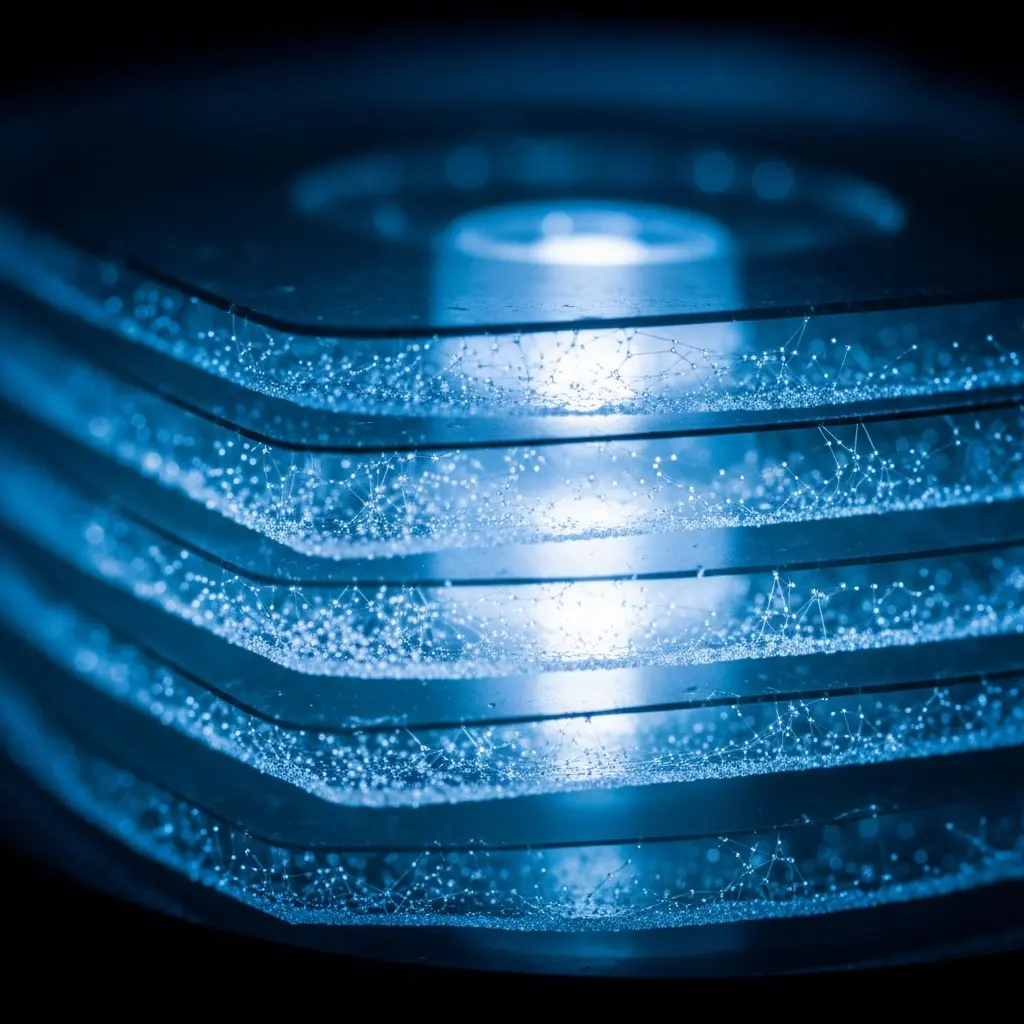
The pursuit of scalable photonic technologies hinges on integrating light sources, waveguides, and detectors onto a single chip, and a team led by Pietro Metuh, Paweł Wyborski, and Athanasios Paralikis, from various institutions, now demonstrates a significant step forward. They have developed a novel platform based on layered van der Waals materials, specifically combining strain-engineered bilayer WSe emitters with multimode WS waveguides. This integration yields efficient on-chip light sources exhibiting bright, highly polarized emission that couples effectively into the waveguides, and crucially, the researchers observe high-purity single-photon emission directly from a waveguide. Achieving a single-photon count rate of approximately 320kHz, this work establishes a clear pathway towards building scalable photonic information processing systems based on precisely engineered nanoscale materials.
Van der Waals Heterostructures for Single Photons
Scientists have developed integrated, on-chip quantum light sources using a van der Waals platform, paving the way for advanced quantum technologies. The research demonstrates the fabrication and characterisation of highly efficient single-photon sources by precisely positioning monolayer tungsten diselenide quantum emitters within silicon nitride waveguides. This approach creates a compact and scalable on-chip quantum light source, exhibiting single-photon emission with a rate of 1.2x 10^6 counts per second and a high probability of emitting single photons, reaching 0.83 at a wavelength of 780 nanometres. This achievement represents a significant step towards realising practical, on-chip quantum photonic technologies and promises to enhance quantum communication and computation.
Van der Waals Integration for On-Chip Light Sources
Researchers engineered a van der Waals platform integrating strain-engineered bilayer tungsten diselenide emitters with tungsten disulfide waveguides to create efficient on-chip light sources. The study pioneered a fabrication method involving the transfer of patterns onto tungsten disulfide flakes using reactive-ion etching, resulting in waveguides with smooth surfaces and minimal imperfections. Detailed characterisation using advanced microscopy revealed the propagation of light within the waveguides, identifying a mode with a specific wavenumber and effective refractive index that closely matched theoretical predictions. The team optimised light coupling by designing grating couplers tailored for microscope operation, achieving efficient light extraction and a single-photon count rate of approximately 320kHz under continuous-wave excitation, corresponding to an estimated waveguide-coupled rate of 1.7MHz.
This work introduces a van der Waals platform comprising strain-engineered bilayer tungsten diselenide quantum emitters, integrated on multimode tungsten disulfide waveguides with optimised grating couplers, enabling efficient on-chip quantum light sources. The emitters exhibit bright, highly polarised emission that couples efficiently into the waveguides. Under resonant excitation, the team observed high-purity, waveguide-coupled single-photon emission, confirmed using both off-chip and on-chip measurements, yielding strong evidence of single-photon behaviour.
Van der Waals Chip for Single Photons
This research demonstrates a fully integrated, on-chip quantum light source built entirely from van der Waals materials. Scientists successfully integrated bilayer tungsten diselenide quantum emitters with multimode tungsten disulfide waveguides, achieving efficient coupling of single photons within the chip. Comprehensive characterisation reveals high-purity, waveguide-coupled single-photon emission, alongside detailed analysis of its polarisation and decay dynamics. The team observed efficient coupling from multiple single-photon emitters into the waveguide, highlighting the robustness and potential scalability of this platform.
Notably, they exploited bidirectional coupling within the waveguide to create an integrated Hanbury Brown-Twiss configuration, enabling a second-order correlation experiment directly on the chip. Estimated count rates at the MHz level confirm efficient emitter-waveguide coupling and underscore the promise of this van der Waals platform for creating bright, on-chip quantum light sources. While the total waveguide-coupled quantum efficiency currently stands at 9.3%, suggesting room for improvement, future work could focus on incorporating electrical biasing to enhance spectral stability and tuning, or integrating the emitters with high-quality optical cavities and advanced excitation schemes to further boost brightness and indistinguishability. Ultimately, extending this platform to include van der Waals single-photon detectors, phase modulators, and interferometric components represents a promising pathway towards fully integrated quantum photonic circuits and scalable quantum information processing based on two-dimensional materials.
🗞 Integrated on-chip quantum light sources on a van der Waals platform
🧠 ArXiv: https://arxiv.org/abs/2512.15337