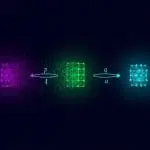
Synchronization, a fundamental phenomenon in nonlinear dynamics, underpins self-organized behaviour across diverse fields from astronomy to chemistry, and scientists have long sought to observe it in quantum systems. Jiarui Liu, Qiming Wu, and Joel E. Moore, alongside Hartmut Haeffner and Christopher W. Wächtler from the University of California, Berkeley and Lawrence Berkeley National Laboratory, now report the first experimental observation of synchronization between two quantum van der Pol oscillators. This achievement, realised using trapped ions, demonstrates a stable relative phase between the oscillators, even though their individual phases remain hidden from direct measurement. The team’s results not only establish limit-cycle synchronization in this quantum regime, but also open exciting possibilities for investigating more complex synchronized dynamics in larger networks, a crucial step towards realising advanced quantum technologies.
The van der Pol oscillator, among the simplest of these systems, captures the essence of limit-cycle behaviour and forms the basis for diverse physical and biological models. While mutual synchronization has long been established in classical systems, it has yet to be experimentally observed in quantum limit-cycle oscillators, despite a decade of theoretical exploration. This work demonstrates synchronization between two quantum van der Pol oscillators using trapped ions.
Quantum Synchronization in Trapped Ion Systems
This research collection focuses on quantum synchronization, open quantum systems, and their experimental realization with trapped ions. The central theme is understanding and observing synchronization phenomena in quantum systems, which differs from classical synchronization through the involvement of entanglement and non-classical correlations. Researchers explore how quantum systems can maintain coherent behaviour despite environmental noise, acknowledging that real-world quantum devices are never perfectly isolated and that controlling these interactions is essential for practical quantum technologies. Trapped ions serve as a leading platform for quantum simulation and computation, offering excellent control, long coherence times, and the ability to create highly entangled states.
The research leverages these advantages to explore quantum synchronization and open quantum system dynamics. A surprising and increasingly important theme is that dissipation isn’t always detrimental; carefully engineered dissipation can drive quantum synchronization, create novel quantum states, and even enhance quantum computation. The ability to precisely control and measure quantum systems opens up possibilities for new types of sensors and metrology devices, potentially enhancing their sensitivity and precision.
Quantum Oscillators Synchronize Via Controlled Dissipation
Scientists have experimentally demonstrated synchronization between two quantum van der Pol oscillators using trapped ions, establishing limit-cycle synchronization in the quantum regime. The work reveals a stable relative phase between the oscillators, a key characteristic of synchronization, while the individual oscillator phases remain inaccessible to direct measurement. Researchers engineered this synchronization through precisely controlled dissipation, applying negative and nonlinear damping to the motional states of the ions. This involved driving specific motional sidebands with laser light and resetting the qubit state after each step to achieve effective damping in both individual modes.
The team achieved synchronization by manipulating the motional dissipation, confirming it through reconstruction of the joint probability distribution of the two-mode quantum states and supporting numerical simulations. Measurements demonstrate that the synchronized state is robust even with detuning between the effective frequencies of the oscillators. Further investigation into phase diffusion involved locking one oscillator to an external drive, and subsequent Wigner function analysis of both modes at varying detunings. This work paves the way for exploring synchronized dynamics in larger networks of quantum limit cycles and harnessing engineered dissipation as a resource for complex quantum dynamics, with potential applications in quantum metrology.
Quantum Oscillators Synchronize and Sense External Fields
This research demonstrates, for the first time, synchronization between two quantum van der Pol oscillators, achieved using a trapped-ion platform. The work reveals a stable relative phase between the oscillators, a key characteristic of synchronization, while the individual oscillator phases remain inaccessible to direct measurement. Researchers engineered this synchronization through precisely controlled dissipation, applying negative and nonlinear damping to the motional states of the ions. This involved driving specific motional sidebands with laser light and resetting the qubit state after each step to achieve effective damping in both individual modes.
The team successfully encoded synchronized dynamics in a correlated measurement signal, a uniquely quantum aspect of this synchronization. By dissipatively linking the oscillators, they established a stable relative phase, confirming the synchronization effect. Beyond this fundamental demonstration, the researchers investigated the system’s response to an external field, revealing the potential for sensing applications, such as detecting electric field noise. The work establishes a practical and versatile building block for exploring richer collective phenomena, paving the way for investigations into larger networks of coupled oscillators.
🗞 Observation of synchronization between two quantum van der Pol oscillators in trapped ions
🧠 ArXiv: https://arxiv.org/abs/2509.18423