
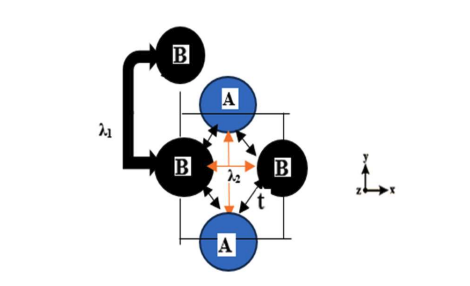
Insulating materials known as altermagnets, such as manganese telluride, display unusual magnetic arrangements where opposing spins align at an angle to each other, a phenomenon related to antiferromagnetism. Partha Goswami and colleagues investigate the underlying physics of these materials using a model that incorporates crucial interactions and relativistic effects, and importantly, introduces non-Hermitian dynamics to simulate energy changes within the system. This research explores how these dynamics influence the quantum geometric tensor and the potential emergence of the quantum anomalous Hall effect in topologically insulating altermagnets, extending the investigation to include metallic versions of these materials. By broadening the understanding of symmetry-breaking order parameters, this work offers new insights into the behaviour of these complex magnetic materials and could contribute to the development of novel spintronic devices.
Altermagnetism, Topology and Magnetic Materials
This collection of research explores cutting-edge topics in condensed matter physics, with a strong focus on altermagnetism and its potential for realizing novel quantum phenomena. The bibliography covers topological materials, non-Hermitian physics, and strongly correlated electron systems, highlighting the interplay between these fields. Researchers are investigating how these concepts connect to create materials with unusual and potentially useful properties, including new forms of magnetism and enhanced electronic behaviour. A central theme is the study of topological materials, which exhibit unique surface states protected by their topology.
This research also delves into the behaviour of electrons in materials where interactions between them are significant, leading to emergent phenomena. Furthermore, investigations address the effects of disorder on electronic properties and the use of external strain to tune material characteristics. This demonstrates a vibrant and rapidly evolving field with significant implications for future technologies.
Altermagnetic Materials, Spinless Fermions, and Band Structure
Researchers developed a detailed theoretical approach to investigate altermagnetic materials, beginning with a simplified two-dimensional model describing spinless fermions. This model forms the foundation for understanding the essential physics of these materials. The team constructed a four-band structure to represent the behaviour of electrons, accounting for their location on the material’s lattice and their spin, allowing for detailed analysis of the electronic structure. The method incorporates key parameters to accurately model the altermagnet, including electron movement between lattice sites. Researchers also introduced a term creating asymmetry and simulated the influence of external magnetic fields. By carefully controlling these parameters, scientists can explore the interplay between spin-orbit coupling and non-Hermiticity, revealing the emergence of the quantum anomalous Hall effect and other topological properties, paving the way for potential applications in novel electronic devices.
Altermagnets Reveal Novel Magnetic Phase and Symmetry
Researchers have discovered a novel magnetic phase in altermagnets, revealing a distinct magnetic state reconciling seemingly contradictory properties. These materials exhibit robust time-reversal symmetry-breaking and spin polarization, while simultaneously displaying antiferromagnet-like behaviour with antiparallel magnetic order. Investigations demonstrate that these altermagnets possess a unique symmetry, maintaining combined symmetry even when individual symmetries are broken. The team explored the behaviour of these materials using complex models, revealing gaps in the energy landscape at specific points.
Analysis of electrons on a square lattice shows that energy levels double due to time-reversal symmetry, depending on the magnetic order. Despite disruptions to symmetry caused by magnetization, the system retains rotational symmetry, allowing for the determination of weak topological indices. Notably, these insulating altermagnets exhibit topologically nontrivial features such as the anomalous Nernst effect and quantized anomalous Hall conductance, even without conventional magnetic ordering, demonstrating the potential of non-Hermitian topological systems to advance condensed matter physics and related technologies.
Altermagnetism, Topology and G-wave Superconductivity
This study investigates the behaviour of altermagnetic materials, focusing on systems exhibiting unusual spin arrangements and the emergence of topological properties. Researchers modelled these materials, incorporating interactions allowing for complex magnetic order and exploring the impact of non-Hermitian dynamics, which simulate energy gain and loss. The results demonstrate the possibility of achieving the quantum anomalous Hall effect within these topologically insulating systems, suggesting potential applications in spintronics. Furthermore, the study extends this analysis to non-Hermitian metallic altermagnets, revealing distinct phases characterized by broken symmetry. The research details how pairing between electrons leads to g-wave superconductivity, a less common form than traditional superconductivity. By analysing the single-particle excitation spectrum, the team mapped out the energy levels of electrons within these materials, revealing key features and degeneracies at specific points in momentum space, providing insight into the electronic structure and the conditions necessary for observing these exotic states.
👉 More information
🗞 Investigation of non-Hermitian and Hermitian models of Altermagnets
🧠 ArXiv: https://arxiv.org/abs/2509.03320