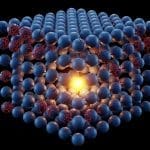
Controlling thermal radiation represents a significant challenge with implications for diverse fields, from quantum technologies to energy efficiency, and now researchers are demonstrating new ways to manipulate this fundamental process. Chih-Wei Wang, Jhih-Sheng Wu, and colleagues at National Yang Ming Chiao Tung University investigate how quantum interactions within specially designed materials, called photonic crystals containing two-level atoms, affect the emission of heat. Their work moves beyond traditional models of thermal radiation by incorporating the quantum behaviour of these atoms, allowing for precise control over the spectrum of emitted light, and revealing that strong light-matter interaction can produce Planckian radiation even outside of equilibrium. This ability to shape thermal emission opens possibilities for minimising unwanted thermal noise in sensitive quantum devices and maximising the efficiency of radiative cooling systems, representing a step towards engineering materials with tailored thermal properties.
The study reveals how manipulating light-matter interactions and photon loss allows for unprecedented control over thermal emissions. Core Research Question: How can we manipulate thermal emissions by controlling light-matter interactions and photon loss in a quantum photonic system? Key Findings: The strength of light-matter interaction and photon loss significantly impacts thermal emission characteristics, allowing researchers to move beyond traditional blackbody radiation behavior. Under strong light-matter interaction, the suppression of thermal emission typically caused by photonic bandgaps can disappear, a novel finding.
In the non-equilibrium regime, the interplay between light-matter interaction and photon loss leads to elevated electron populations and the potential for super-Planckian emission, exceeding that of a blackbody at the same temperature. Active pumping allows for manipulation of the system, leading to enhanced control over thermal radiation. Key Concepts and Methods: The research focuses on a system where quantum effects play a role in the emission of thermal radiation. Energy is actively supplied to the system to control its emission properties. The strength of the interaction between light and the material within the photonic system is a crucial parameter.
The rate at which photons are lost from the system also influences emission. Photonic bandgaps are ranges of frequencies where light cannot propagate within the photonic structure. Planckian radiation is the characteristic thermal emission of a blackbody, while super-Planckian emission exceeds this theoretical limit at a given temperature. Implications and Potential Applications: The research opens up possibilities for designing materials that efficiently radiate heat away from a surface, precisely controlling the direction and frequency of emitted thermal radiation, and improving the efficiency of solar energy collection. This work could also lead to the creation of novel thermal devices. In essence, this paper demonstrates that thermal emission is not a fixed property of a material but can be actively controlled through quantum engineering, paving the way for advanced thermal management and energy technologies.
Strong Light-Matter Coupling Controls Thermal Emission
Researchers have demonstrated a new level of control over thermal radiation using specially designed materials containing two-level atoms, offering potential benefits for both reducing unwanted heat and enhancing radiative cooling technologies. This work moves beyond traditional models of thermal emission by incorporating quantum effects, specifically how light interacts with the material’s atomic structure. The team investigated a one-dimensional crystal where the interaction between light and these embedded atoms modulates the emitted thermal radiation, revealing complex dynamics. The research shows that strong interaction between light and matter can lead to thermal emission that closely resembles the ideal spectrum predicted by Planck’s law, regardless of whether the light’s frequency falls within or outside the material’s band gaps.
Surprisingly, even when light is within these band gaps, emission isn’t necessarily suppressed if the light-matter interaction is strong, defying conventional expectations. This suggests a pathway to engineer materials that emit heat in a more controlled and predictable manner. The study reveals that the speed at which photons reach a steady state within the material differs significantly depending on their frequency, with photons outside the band gap reaching stability much faster than those inside. Furthermore, increasing photon loss effectively suppresses emission within the band gaps, providing another avenue for controlling thermal radiation.
These findings highlight the interplay between light-matter interaction, photon loss, and the resulting thermal emission characteristics. Importantly, the team observed that the steady-state emission deviates from the standard Fermi-Dirac distribution, indicating that the material’s atoms are not in thermal equilibrium with the surrounding environment. This deviation results in “super-Planckian” emission, meaning the material emits more energy than predicted by traditional thermal models. This discovery opens possibilities for designing materials that not only control the spectrum of emitted radiation but also enhance the overall amount of energy radiated, potentially leading to more efficient cooling technologies. The research provides a foundation for future work focused on tailoring materials to optimize thermal emission for specific applications, ranging from reducing heat in electronic devices to improving the efficiency of solar energy harvesting.
Strong Interaction Overcomes Thermal Emission Suppression
This research investigates the behaviour of light emitted from a system combining quantum properties with thermal radiation, specifically focusing on a crystal containing two-level atoms. The study demonstrates that manipulating the strength of interaction between light and matter, alongside controlling photon loss, significantly alters the emitted thermal radiation, even when pumping and thermal relaxation rates remain constant. In equilibrium, strong light-matter interaction can overcome the usual suppression of thermal emission caused by band gaps within the crystal, leading to a novel regime where these gaps have minimal effect. Furthermore, in non-equilibrium conditions, the interplay between light-matter interaction and photon loss governs both the population of electrons within the atoms and the degree to which emission exceeds the standard Planckian blackbody limit, resulting in super-Planckian emission.
These findings offer a pathway towards controlling thermal radiation, with potential applications in areas like radiative cooling, thermal management, and solar energy harvesting. The authors acknowledge that simulations were performed with specific parameters and that further investigation may be needed to explore the full range of behaviours within the system. Future work could focus on extending these findings to more complex materials and configurations to optimise performance for specific applications.
👉 More information
🗞 Quantum Control of Thermal Emission from Photonic Crystals with Two-Level Atoms
🧠 ArXiv: https://arxiv.org/abs/2508.11191