

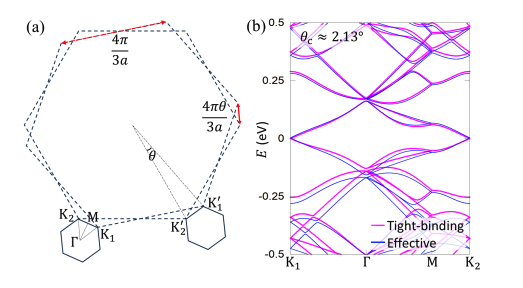
The fundamental nature of electrons, and specifically how their internal structure influences material properties, remains a central question in physics. Researchers D. ‑H. ‑Minh Nguyen, Francisco Guinea, and Dario Bercioux, from the Donostia International Physics Center and IMDEA Nanoscience, now demonstrate a method for glimpsing this elusive electron form factor through the study of twisted bilayer graphene. Their work reveals that quasiparticle interference, a phenomenon arising from the interaction of electrons within the material, exhibits a distinct chiral structure that directly reflects the electron’s internal form. This achievement provides microscopic insights into the electronic behaviour of twisted bilayer graphene and establishes quasiparticle interference as a powerful technique for probing the quantum geometry and many-body states that govern the properties of advanced materials.
Electron Form Factor via Quasiparticle Interference
Researchers have revealed how to observe the internal structure of electrons in two-dimensional materials by examining quasiparticle interference patterns. Studying twisted bilayer graphene, the team demonstrates that these interference patterns directly reflect the electron’s form factor, which describes its spatial distribution. This approach provides a new way to determine the electron’s form factor without relying on high-energy scattering experiments, opening avenues to investigate fundamental electron properties in condensed matter systems.
The investigation of quantum interference patterns in twisted bilayer graphene, conducted using advanced computational methods, closely matches predicted form factor norms. The observed chiral structure in the interference signals arises from interactions between electronic states near the Dirac points, offering microscopic insights into electron behaviour within the material. This detailed understanding of electron interactions and interference enhances knowledge of the unique electronic properties of this complex system.
TBG FT-LDOS Links Theory to Experiment
This research establishes a strong connection between theoretical calculations and experimental observations in twisted bilayer graphene. Scientists have analysed the interplay between electronic structure, disorder, and interference patterns, focusing on how these factors manifest in the Fourier Transform of Local Density of States (FT-LDOS). The goal is to connect calculations of band structure and atomic arrangement with patterns observed in scanning tunneling spectroscopy experiments. The study investigates both periodically arranged and non-periodically arranged graphene layers, and the effects of imperfections within the material.
Detailed analysis of the overlap matrix, which describes how electron wavefunctions interact, reveals a chiral structure related to the stacking order and twist angle of the graphene layers. This chirality reverses between the top and bottom layers and becomes less pronounced at specific twist angles. Analysis of FT-LDOS patterns for periodically arranged graphene reveals interference signals dependent on the twist angle and the location of imperfections, with circular patterns related to the material’s electronic band structure.
Researchers found that the intensity of interference signals is stronger when imperfections are located in specific stacking regions, and the chirality of the patterns can be reversed by changing the location of these imperfections. Even in non-periodically arranged graphene, circular patterns related to the material’s electronic band structure are still observed. These findings provide insights into the electronic structure of twisted bilayer graphene at specific twist angles, where the material exhibits strong interactions between electrons.
This work provides a theoretical framework for interpreting experimental scanning tunneling spectroscopy data on twisted bilayer graphene, allowing direct comparison between calculations and observations. The study highlights the importance of imperfections in the material and how they affect the electronic structure and interference patterns. The research emphasizes the role of chirality and symmetry in twisted bilayer graphene and how these properties are manifested in the observed interference patterns.
Form Factor Dictates Quasiparticle Interference Patterns
Scientists have established a clear link between the form factor of electrons in two-dimensional materials and the patterns observed in quasiparticle interference (QPI) spectroscopy. Through detailed calculations combining computational methods, the team demonstrated that QPI signals accurately reflect the electron’s form factor in twisted bilayer graphene. These calculations successfully reproduce predictions from a different theoretical model, confirming the validity of the approach.
The research reveals that the observed chiral structure in QPI signals arises from distinct interference processes between electronic states near the Dirac points, and these processes are explained by the arrangement of electron wavefunctions within the material. Specifically, interference within a single layer exhibits patterns similar to those in single-layer graphene, while interference between layers displays unique characteristics. This work provides microscopic insight into the electronic wave structure of twisted bilayer graphene and proposes QPI as a valuable method for probing the form factor, offering a pathway to examine the quantum geometry and many-body states of materials.
🗞 Glimpsing at Electron’s Form Factor through Quasiparticle Interference in Twisted Bilayer Graphene
🧠 ArXiv: https://arxiv.org/abs/2509.11223


