

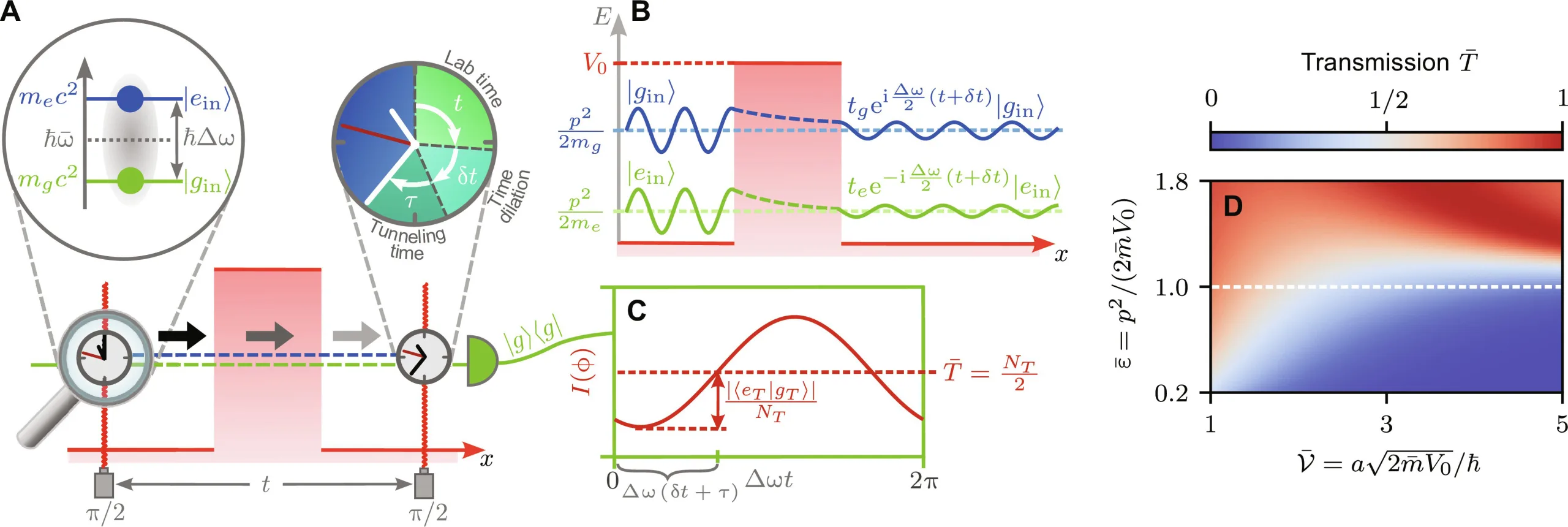
Scientists Patrik Schach and Enno Giese have proposed a new method to measure quantum tunneling times using a Ramsey clock, a type of atomic clock. The researchers suggest that the clock can measure the time it takes for a quantum particle to tunnel through a barrier, a phenomenon that is still not fully understood. The clock measures the phase difference between two internal states of a quantum particle after it has tunneled through a barrier. The researchers believe this method could provide new insights into quantum mechanics and general relativity.
Quantum Tunneling and Time Measurement
Quantum tunneling, a phenomenon where particles pass through a potential barrier that they should not be able to according to classical physics, has been a subject of intense study and debate. One of the key questions in this field is the time it takes for a particle to tunnel through a barrier. This article discusses a study by Patrik Schach and Enno Giese, which proposes a new approach to measure this elusive tunneling time using a Ramsey clock, a type of atomic clock.
The Quantum Conundrum of Tunneling Time
The concept of time in quantum mechanics is fundamentally different from that in classical physics. In quantum mechanics, particles can exist in a superposition of states and can tunnel through barriers, a phenomenon not possible in classical physics. This leads to the question of how to define and measure the time it takes for a particle to tunnel through a barrier.
Previous attempts to measure tunneling time have resulted in a wide range of predictions, from instantaneous to finite durations. These measurements often rely on the motion of atoms, which is inherently quantum in nature and thus does not follow classical trajectories. This makes the definition and measurement of tunneling time a complex task.
A New Approach to Measuring Tunneling Time
Schach and Giese propose a new approach to measure tunneling time using a Ramsey clock. This clock is prepared in a superposition of internal states and the time is read off after the tunneling process. The authors argue that this approach unifies definitions of tunneling delay, connects the
DOI: https://www.science.org/doi/10.1126/sciadv.adl6078


