

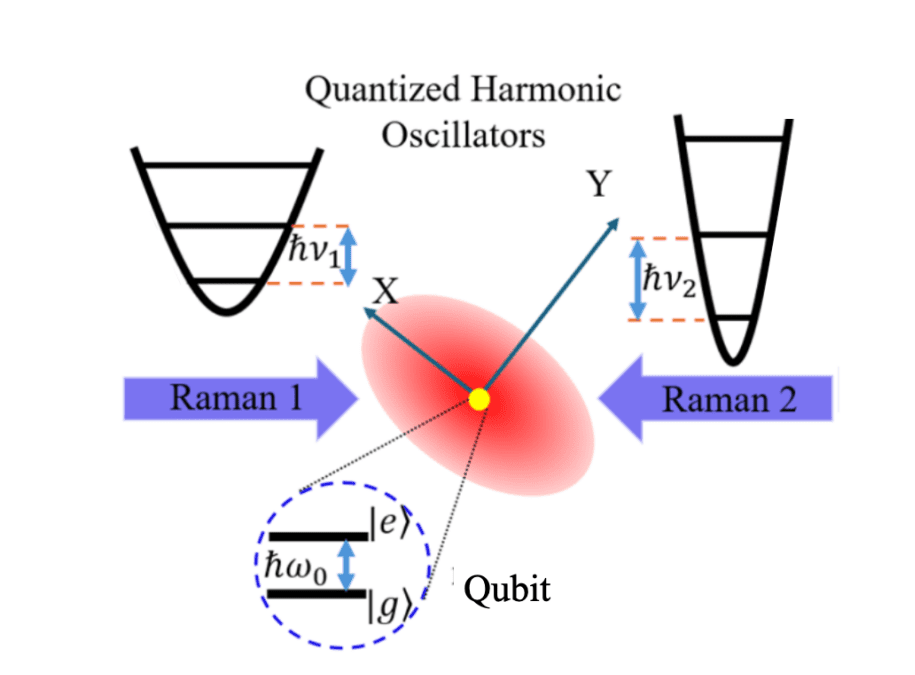
Investigating quantum behaviour in intensely driven systems represents a crucial step towards building more powerful and reliable quantum technologies. Kamran Rehan, Hengchao Tu, and Menglin Zou, alongside Zihan Yin, Jing-Ning Zhang, and Kihwan Kim, now demonstrate a new level of control over trapped ions, pushing these systems into a strong-field regime where quantum dynamics become markedly complex. The team experimentally probes how a trapped ion responds when driven by intense fields, revealing significant memory effects and non-Markovian behaviour, a departure from the standard assumptions of predictable quantum evolution. This research establishes a pathway for exploring fundamental aspects of open quantum systems and coherent control, uncovering previously unseen features in strong-field quantum dynamics and paving the way for advanced quantum technologies based on trapped-ion platforms.
Strong Field Ion Dynamics and Non-Markovianity
Scientists are exploring the behaviour of trapped ions when subjected to strong driving fields, with a particular focus on identifying and characterizing non-Markovian behaviour, which represents a system’s memory of past states. Researchers experimentally realized and analysed the dynamics of a single trapped ion driven by a strong, time-dependent electric field, allowing for precise control and observation of its quantum state. By carefully manipulating the driving field, they induced transitions between energy levels and monitored the resulting evolution of the ion’s quantum state using advanced detection techniques, examining the ion’s fluorescence signal to reconstruct its quantum trajectory. Analysis of the fluorescence signal revealed key parameters characterizing the ion’s dynamics, including the decoherence rate and the memory time. The results demonstrate a clear deviation from Markovian behaviour, indicating that the ion’s dynamics are influenced by long-range correlations in its environment. This research provides a novel experimental realization of strong-field driven trapped ion dynamics and offers direct evidence of non-Markovianity in a well-controlled quantum system, offering valuable insights into the role of environmental correlations in quantum dynamics with implications for quantum computation and quantum sensing.
Rabi Frequency Approaches Vibrational Mode Frequency
Investigating controlled quantum systems and developing robust quantum technologies requires understanding the behaviour of systems in the strong-field regime. This work experimentally investigates the dynamics of a trapped ion where the Rabi frequency, a measure of the driving field strength, approaches the vibrational mode frequency, pushing the system beyond the weak-field regime where complex quantum correlations emerge. The experiment sets the ion into a superposition state using a precisely timed pulse, initiating the dynamics and allowing the quantum correlations to develop over a variable duration determined by subsequent pulses. The final state of the ion is then measured using state-dependent fluorescence, a technique which distinguishes between different quantum states based on the emitted photons. By repeating this process for a range of evolution times and Rabi frequencies, the researchers reconstruct the time evolution of the quantum state and characterise the emerging correlations, validating the understanding of strong-field dynamics in trapped-ion systems.
Trapped Ions Reveal Quantum Memory Effects
This research investigates how trapped ions interact with their environment, focusing on the presence of non-Markovianity, or memory effects, which influence quantum behaviour. The work explores open quantum systems, where interactions with the environment lead to decoherence and dissipation, major challenges in building quantum technologies. A key distinction is made between Markovian and non-Markovian dynamics: Markovian systems depend only on their present state, while non-Markovian systems retain memory of their past, influenced by environmental correlations. The research utilizes measures such as the divisibility of the quantum channel and trace distance to assess non-Markovianity, modelling the environment with varying degrees of complexity.
The analysis considers the specific characteristics of trapped ion systems, such as their energy levels, coupling to phonons, and susceptibility to noise, employing the framework of quantum channels to describe the evolution of quantum states under environmental influence. Understanding the role of non-Markovianity can help optimize experimental parameters and develop strategies for mitigating its effects. This research is important because understanding and mitigating the effects of non-Markovianity is crucial for building more robust and reliable quantum computers and other quantum devices, contributing to our fundamental understanding of open quantum systems and the interplay between quantum systems and their environment.
Driving Fields Reveal Complex Non-Markovianity
This research demonstrates a detailed investigation of quantum dynamics in a trapped ion subjected to strong driving fields. Scientists successfully probed the system’s behaviour as the strength of the driving field approached the frequency of its vibrational modes, moving beyond the typically studied weak-field regime. Through careful manipulation and measurement of the ion’s quantum state, they tracked the evolution of non-Markovianity, a measure of memory effects arising from the interplay between the ion’s internal and motional degrees of freedom. The findings reveal that non-Markovianity does not simply increase with driving field strength, but instead exhibits a more complex dependence on system parameters, reaching maxima at specific frequencies.
Notably, when a particular relationship between the driving field strength and detuning is met, non-Markovianity displays a striking circular pattern, indicative of a transformed interaction resembling the well-known Jaynes-Cummings model. These observations extend understanding beyond conventional regimes, uncovering new features of strong-field quantum dynamics and offering deeper insight into quantum behaviour under strong driving. This work establishes a pathway for using trapped-ion platforms to investigate non-Markovianity, coherent control, and the fundamental behaviour of open quantum systems in extreme regimes.
👉 More information
🗞 Realization of Trapped Ion Dynamics in the Strong-Field Regime and Non-Markovianity
🧠 ArXiv: https://arxiv.org/abs/2510.20444


