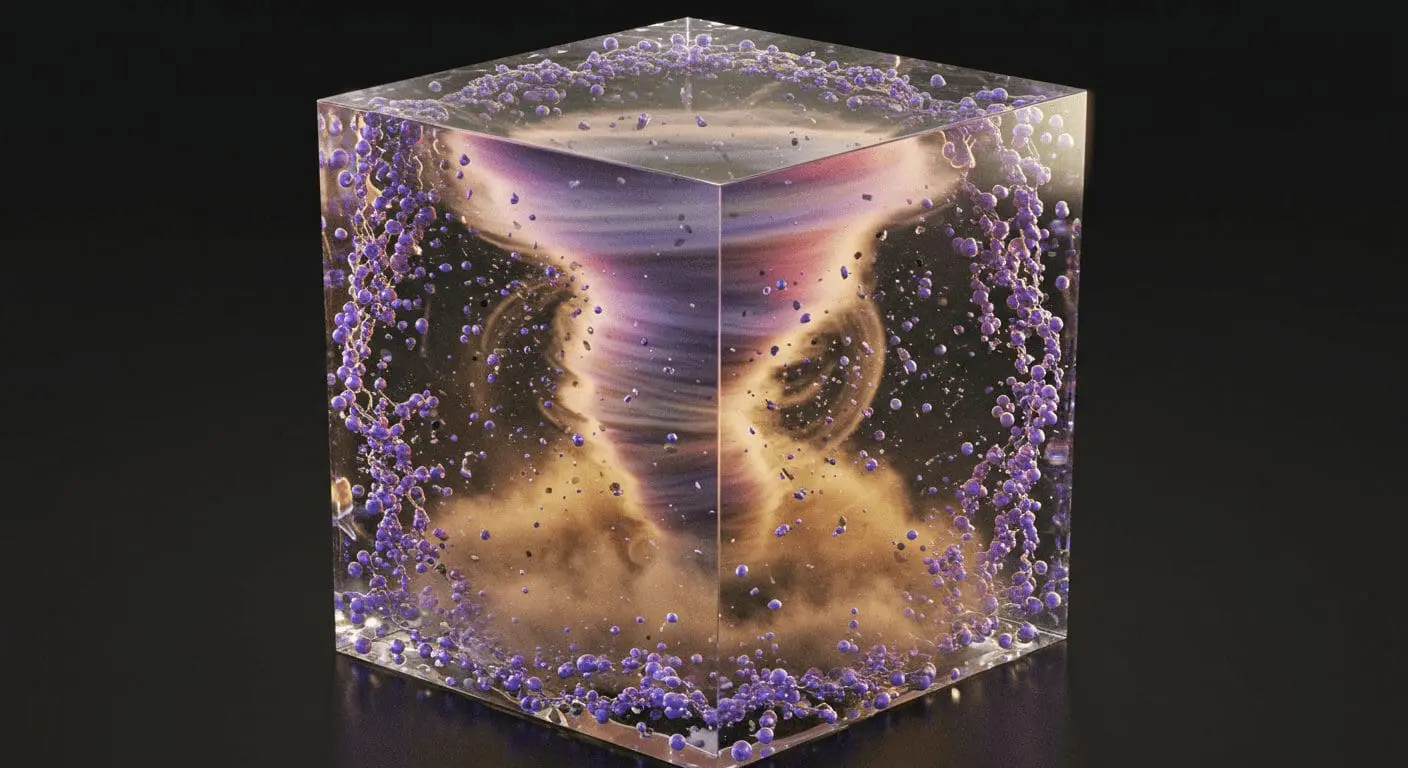
A team led by Dr. Maximilian Unzelmann at ct.qmat has experimentally demonstrated quantum tornadoes in momentum space using electrons in the quantum semi-metal tantalum arsenide. This discovery, achieved through enhanced angle-resolved photoemission spectroscopy (ARPES) with quantum tomography, marks the first observation of such vortices in momentum space rather than position space. The findings could advance quantum technologies like orbitronics, which utilize electrons’ orbital torque for energy-efficient information transmission.
Quantum Tornadoes in Momentum Space Discovered
A team led by Dr. Maximilian Unzelmann at the University of Würzburg has made a significant discovery in quantum physics: the observation of quantum tornadoes in momentum space within a quantum semi-mental called tantalum arsenide. This marks the first time such structures have been detected in momentum space, as opposed to position space, where quantum vortices were previously known.
The researchers utilized an advanced technique based on angle-resolved photoemission spectroscopy (ARPES), enhanced with quantum tomography. This method enabled them to reconstruct a three-dimensional visualization of orbital angular momentum, confirming the existence of these intricate vortex structures in momentum space.
The project was a collaborative effort involving scientists across multiple countries and institutions, including the United States, China, Norway, and Germany. The tantalum arsenide sample was synthesized in the U.S. and analyzed at PETRA III, a state-of-the-art facility at DESY in Hamburg.
This discovery advances understanding of topological quantum materials and opens new possibilities for quantum technology applications. The researchers are exploring how tantalum arsenide could be used to develop orbitronics, which aim to harness electrons’ orbital torque for more efficient electronic devices. Such innovations could reduce energy losses compared to traditional charge-based systems.
The findings were published in *Physical Review X*, with Dr. Maximilian Unzelmann and his team leading the experimental efforts.
More information
External Link: Click Here For More