

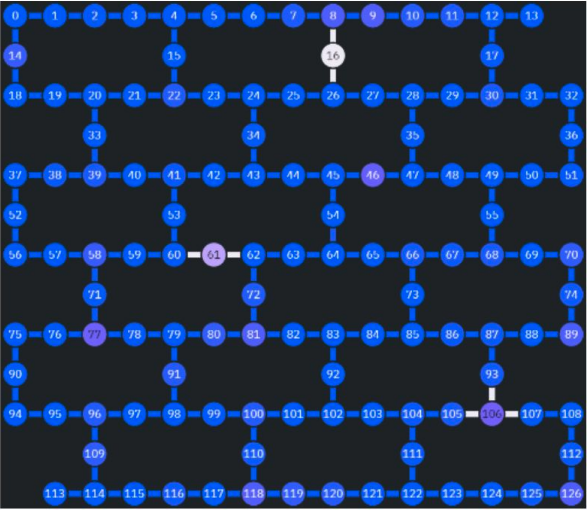
Researchers demonstrate a three-qubit state tomography scheme using 17 measurements, a substantial reduction from the standard 63 Pauli measurements required for this task. Experiments on the Osaka processor reconstruct a three-qubit W state and its two-qubit marginals, achieving higher fidelity than full three-qubit tomography, validating subsystem-based approaches.
Quantum state tomography, the process of reconstructing an unknown quantum state, presents a significant challenge in realising the full potential of quantum technologies. The experimental demands of full-state reconstruction increase rapidly with the number of qubits, necessitating innovative approaches to reduce measurement overhead. H. Talath, B. P. Govindaraja, and colleagues detail a novel three-qubit state tomography scheme in their article, ‘Three-qubit W state tomography via full and marginal state reconstructions on ibm_osaka’. They demonstrate a reduction in required measurements to 17, compared to the standard 63 Pauli measurements, utilising the 127-qubit processor ibm_osaka. The research further validates the theoretical advantage of reconstructing states from their constituent subsystems, achieving higher fidelity through two-qubit marginal reconstructions than conventional full tomography.
Quantum state tomography, the process of reconstructing the quantum state of a system from experimental measurements, achieves enhanced efficiency with a newly developed three-qubit scheme, reducing experimental demands and facilitating more detailed characterisation of complex quantum systems. Researchers demonstrate a streamlined protocol requiring only 17 measurements to reconstruct a three-qubit state, a considerable reduction from the standard 63 Pauli measurements conventionally needed for complete tomography. The team implements this protocol utilising the 127-qubit ‘osaka’ processor, an openly accessible quantum computing platform, and prepares a three-qubit W state for reconstruction.
The core innovation centres on the theoretical prediction that a carefully selected set of partial measurements contains sufficient information to characterise the majority of three-qubit pure states. A pure state in quantum mechanics describes a system where the quantum state is known with certainty, unlike a mixed state, which represents a probabilistic combination of pure states. This contrasts with conventional tomography, which aims to determine the full density matrix, a mathematical representation of the quantum state, requiring a significantly larger number of measurements.
Results indicate that fidelity, a measure of how closely the reconstructed state matches the original, of the reconstructed W state, derived from its two-qubit subsystems, consistently surpasses that obtained through conventional, full three-qubit tomography. This highlights the practical advantages of this subsystem-based approach, particularly within the constraints of noisy intermediate-scale quantum (NISQ) devices. NISQ devices are current quantum computers that are limited in the number of qubits and susceptible to errors. Minimising measurement counts is crucial in these environments to reduce the accumulation of errors and improve the reliability of results. Researchers demonstrate that concentrating on pertinent subsystems circumvents the necessity for exhaustive measurements, enabling more frequent and detailed analysis. The observed improvement in fidelity further validates the effectiveness of this approach, suggesting it can yield more dependable and precise results, especially when dealing with noisy quantum systems.
👉 More information
🗞 Three-qubit W state tomography via full and marginal state reconstructions on ibm_osaka
🧠 DOI: https://doi.org/10.48550/arXiv.2507.02849


