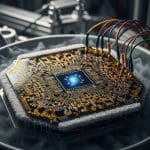
Scientists are tackling a critical challenge in the advancement of quantum technologies: creating robust, wafer-scale vacuum cells essential for practical atomic clocks and information processing systems. Megan Lauree Kelleher, Konrad Ziegler, and Jeremy Robin, all from HRL Laboratories, alongside Lianxin Huang, Mitchel Button, and Liam Mauck et al., present a novel approach utilising plastic deformation ‘micro-knife’ bonding of selectively etched fused silica wafers to fabricate both evacuated atomic beam cells and atomic vapour cells. This research is significant because it demonstrates mechanically robust cells with exceptionally low leak rates and long lifetimes, greatly simplifying fabrication and paving the way for future chip-scale cold atom devices and improved atomic clocks.
Wafer-scale bonding creates durable vacuum cells for prolonged quantum device operation and stability
Researchers have developed a new wafer-scale micro-knife bonding technique to create robust, ultra-high-vacuum cells essential for advancing quantum technologies. This breakthrough addresses a critical challenge in the field: fabricating compact, reliable devices for quantum sensors, atomic clocks, and quantum information processing without performance degradation from environmental factors.
The work centres on a novel method for sealing vacuum cells at the chip level, utilising plastic deformation of micro-fabricated “knives” on selectively etched fused silica wafers. These newly created cells demonstrate exceptional mechanical strength, exceeding 15 MPa, and exhibit lifetimes surpassing one year.
Characterisation of the fabricated vapor cells using saturated absorption spectroscopy and fluorescence measurements confirms their superior performance. Crucially, the cells exhibit low residual gas pressures, measuring less than 10−3 mbar, and leak rates below the sensitivity of fine-leak testing, specifically below 2.8×10⁻¹⁰ mBar·L s.
This micro-knife bonding process significantly simplifies the fabrication of complex chip-scale devices, reducing the number of bonding interfaces required and improving overall yield. The research demonstrates the fabrication of both evacuated atomic beam cells and atomic vapor cells, paving the way for future chip-scale cold atom devices.
This innovative approach moves beyond conventional sealing methods, which often struggle to achieve the ultra-high-vacuum levels necessary for advanced quantum sensors and clocks. By employing fused silica, a material offering both optical transparency and helium impermeability, the team has overcome limitations associated with traditional materials like glass and silicon dioxide.
The resulting all-glass vacuum cells provide a high degree of optical access, enabling background-free fluorescence measurements and precise spectroscopic analysis, as evidenced by the clear saturated absorption spectra of the D1 line at 895nm. The demonstrated technique not only enhances the performance of existing devices but also unlocks possibilities for dissipation-dilution-limited optomechanics and improved coherence in superconducting qubits.
Fused silica wafer etching and micro-knife deformation bonding for hermetic cell fabrication offer promising results
Selective laser etching of fused silica wafers initiates the fabrication of chip-scale atomic vapor cells and evacuated atom-beam cells described in this work. These wafers are etched to form both cavities and micro-capillaries, essential for containing the atomic vapor or beam. Titanium knives are then deposited to create high-pressure contact points, subsequently bonded to a thick compliant metal layer to facilitate the sealing process.
Two prototype all-glass chip designs were fabricated, one housing three evacuated vapor cells and the other an evacuated atom-beam cell. The core innovation lies in micro-knife deformation bonding, a technique directly analogous to macro-scale vacuum seals but adapted for micro-fabrication. This process plastically deforms and diffusion bonds metals together, creating an intimate contact between the knife and the bonding surface.
By utilising fused silica as the substrate, the research circumvents limitations associated with traditional materials like silicon, which can exhibit excessive shearing forces during glass micro-machining. The all-glass construction enables side excitation and vertical collection, providing background-free fluorescence measurements crucial for accurate analysis.
Characterisation of the fabricated cells involved saturated absorption spectroscopy and fluorescence measurements, performed using distinct experimental setups. Saturated absorption spectra of the D1 line (895nm) from evacuated Cs vapor cells revealed narrow sub-Doppler peaks, typically between ∼10, 20MHz wide.
Slight broadening, approximately ∼10MHz, was observed in some simple cells, attributed to residual gas, insufficient getter capacity, or source outgassing. Atom-beam spectra, taken in both the source and drift regions, demonstrated Cs collimation with a fitted spectral FWHM of ∼115MHz. Leak rates, measured using Kr-85 fine leak testing, were found to be measurement-limited to ≪2.8 × 10⁻¹⁰ mBar·L s, demonstrating the effectiveness of the bonding technique. This single-interface bonding process simplifies fabrication, reducing the number of required bonds from four to one for complex atom-beam devices, and achieving a 85% yield at wafer-scale.
Vacuum performance, spectral resolution and atom beam characteristics are all critical factors
Leak rates were measured at less than 2.8 × 10⁻¹⁰ mBar·L s, a measurement-limited value demonstrating exceptional vacuum integrity. Vapor cells exhibited sheer-force strength of MPa and demonstrated lifetimes exceeding one year, indicating robust mechanical performance and long-term stability. Saturated absorption spectroscopy of evacuated cells revealed narrow sub-Doppler peaks with widths ranging from ∼10, 20MHz, confirming high spectral resolution.
Residual gas broadening in simple cells was observed at approximately ∼10MHz, attributed to getter limitations and source outgassing. Evacuated atom beams displayed sub-Doppler peaks post-activation, alongside fluorescence spectra confirming atomic beam collimation. Empirical fitting of the atom beam spectral shape yielded a collimated beam width (HWHM) of γ ∼57MHz in the central region of the fluorescence peak.
The residual gas pressure within the atom beam was inferred to be ≪10−3 mbar, supporting atomic collimation at ∼10mm, based on mean free path calculations. Plastic deformation bonding using micro-knife edges achieved ultra-high pressure (GPa) contact points at approximately ∼200 MPa. Fabrication of internal cavities and micro-capillary arrays (50μm × 75μm × 2mm) was achieved through selective laser etching of fused silica wafers.
A coating of Al2O3 was deposited to reduce helium permeation, followed by a compliant metal layer for sealing surfaces. Diffusion at grain boundaries between layers created a hermetic seal and provided mechanical strength, enabling wafer-scale fabrication with a yield exceeding 85% for Cs devices, limited primarily by the Cs pill source. This process utilizes a single bonding interface, reducing fabrication complexity compared to conventional methods requiring two or four bonds.
Wafer bonding yields robust hermetic seals for advanced atomic and photonic devices, enabling high performance and reliability
Researchers have demonstrated a novel wafer-scale bonding process for creating evacuated atomic vapour cells, significantly advancing the development of chip-scale atomic devices and information technologies. This process utilises plastic deformation micro-knife bonding of selectively etched fused silica wafers to achieve hermetic seals, enabling the fabrication of both evacuated atomic beam cells and atomic vapour cells with robust mechanical properties and extended lifetimes.
The fabricated cells exhibit low residual gas pressures and leak rates below detectable limits, showcasing the potential for improved chip-scale atomic clocks and fieldable optomechanical systems. While acknowledging that ultra-low temperature bonding requires further refinement to ensure hermeticity, the authors highlight the simplicity and versatility of their technique, extending beyond atomic vapour cells to include the hermetic sealing of photonic integrated circuits and their 3D integration. Future work could focus on bonding single-crystalline transparent materials to realise ultra-high vacuum cells for laser cooling of atoms and the development of dissipation-dilution-limited optomechanical devices, paving the way for more compact and reliable quantum technologies.
👉 More information
🗞 Wafer-Scale Micro-Knife Sealed Vacuum Cells for Quantum Devices
🧠 ArXiv: https://arxiv.org/abs/2602.00390