

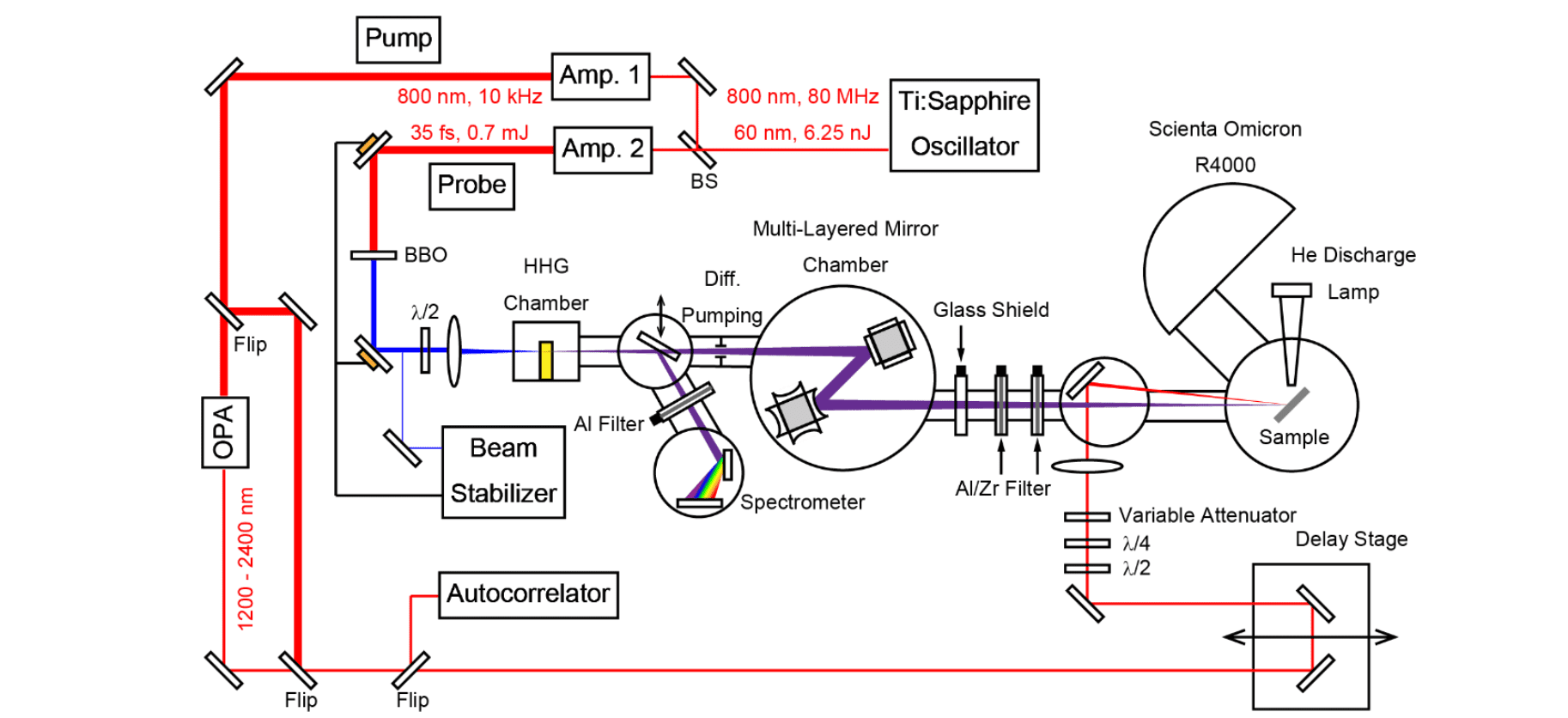
Understanding how electrons and atomic vibrations interact within advanced materials is crucial for developing next-generation technologies, and recent progress now allows scientists to observe these interactions with unprecedented precision. Takeshi Suzuki and Kozo Okazaki, both from the Institute for Solid State Physics at The University of Tokyo, lead a study demonstrating how a new combination of ultrafast lasers and a technique called high harmonic generation enables time-resolved photoemission spectroscopy on incredibly short timescales. This achievement allows researchers to directly observe electron-phonon interactions and the behaviour of materials far from equilibrium, revealing fundamental details about how these materials respond to external stimuli and potentially unlocking new functionalities. The work provides a powerful new tool for probing the dynamic properties of quantum materials and promises to accelerate the discovery of novel electronic and optical properties.
Kagome Superconductor, Electronic Structure and Correlations
CsV3Sb5, a fascinating Kagome superconductor, exhibits unique electronic properties stemming from its distinctive two-dimensional lattice structure and strong electronic interactions. Research reveals the material’s electronic band structure contains Dirac-like bands and prominent Van Hove singularities, critical features influencing its behavior. Angle-resolved photoemission spectroscopy and Fermi surface mapping demonstrate complex electronic structures with multiple energy scales and anisotropic energy gaps, suggesting enhanced electron-electron interactions that potentially drive unconventional superconductivity. Theoretical calculations support the presence of flat bands near the Fermi level, further indicating strong electronic correlations.
CsV3Sb5 undergoes a charge density wave (CDW) transition at a relatively high temperature, distorting its Kagome lattice. The CDW order is complex, displaying multiple possible modulations and symmetry breaking, with interlayer modulation observed. The relationship between this CDW order and superconductivity remains a central question, with studies suggesting competition or a more complex interplay. Significant CDW fluctuations exist even above the transition temperature, and the CDW order can be influenced by light, inducing lattice symmetry changes. Superconductivity emerges in CsV3Sb5 at relatively low temperatures, characterized by a complex and anisotropic superconducting gap, potentially indicating unconventional pairing mechanisms.
Researchers employ techniques such as angle-resolved photoemission spectroscopy, scanning tunneling microscopy, transport measurements, and x-ray diffraction to probe these properties. Raman spectroscopy, optical spectroscopy, and time-resolved spectroscopy provide further insights into lattice vibrations, electronic excitations, and the dynamics of the CDW order. Recent research demonstrates the ability to observe Dirac currents on subcycle timescales using lightwave-driven excitation, revealing ultrafast dynamics. Ultrafast spectroscopy reveals the dynamics of the CDW order and electronic excitations, and strong laser fields can create Floquet-Bloch bands, modifying the electronic structure and potentially inducing new phases. This research highlights CsV3Sb5 as a fascinating material with complex electronic properties and a rich interplay between different ordered phases.
Extracting Electron Dynamics via Frequency-Domain ARPES
Advances in ultrafast laser technology and high harmonic generation now enable time-resolved photoemission spectroscopy with femtosecond resolution, opening new avenues for exploring materials in both time and momentum space. Researchers developed a novel analysis method, frequency-domain ARPES, to investigate photo-induced phenomena, initially applied to tantalum diselenide and tungsten ditelluride. This technique captures differential images before and after laser excitation, pinpointing peak positions to analyze changes in electron-phonon coupling. Scientists meticulously extracted oscillatory components from time-dependent intensity data by fitting carrier dynamics with a double-exponential function and subsequent Fourier transforms.
This revealed distinct peak structures corresponding to specific electron-phonon interactions within each energy and momentum region. They constructed frequency-domain ARPES maps at 1, 2, and 3 terahertz, each highlighting a specific coherent phonon mode. The 2-terahertz map exhibited the strongest signal around the Fermi level, indicating that the corresponding phonon mode is most relevant to the observed insulator-to-metal transition. By comparing frequency-domain ARPES maps with band dispersions obtained from time-resolved ARPES, researchers determined that the 1-terahertz mode couples to semimetallic bands, while the 3-terahertz mode couples to semiconducting bands. This demonstrates that frequency-domain ARPES can selectively detect electron-phonon coupling to different electronic states in a frequency-resolved manner. Investigations extended to charge density wave materials, specifically 1T-TaS2 and CsV3Sb5, where time-resolved ARPES was employed to observe CDW gap dynamics and insulator-to-metal transitions.
Electron-Phonon Scattering Dominates Graphene Energy Loss
Recent advances in laser technology and photoemission spectroscopy have enabled scientists to probe the behavior of materials on incredibly short timescales, revealing fundamental details of electron dynamics. Researchers successfully measured time-dependent electron temperatures in graphene, providing quantitative insight into how energy dissipates within the material following excitation. Detailed calculations based on a two-temperature model determined that scattering between electrons and phonons accounts for the dominant mechanism of energy loss, responsible for 98. 9±0. 1% of the total energy dissipation in high-mobility graphene.
Investigations into quasi-crystalline twisted bilayer graphene revealed a striking carrier imbalance between the two layers following optical excitation. Time-resolved photoemission spectroscopy showed that the upper layer Dirac cone undergoes a negative chemical potential shift, while the lower layer Dirac cone experiences a positive shift, a behavior distinctly different from that observed in non-twisted bilayer graphene. Analysis using a set of rate equations revealed that carrier transfer between the graphene layers is more frequent than transfer between the graphene and the substrate. This ratio is consistent with a model of carrier transport involving exponential decay with distance. Furthermore, studies of iron-based high-temperature superconductors have expanded our understanding of these complex materials, utilizing time-resolved techniques to investigate phenomena such as spin-density wave melting and nematic-orbital excitations.
Ultrafast Spectroscopy Reveals Electron-Phonon Dynamics
Recent advances in time- and angle-resolved photoemission spectroscopy, driven by developments in ultrafast laser systems and high harmonic generation techniques, now enable the study of materials with unprecedented temporal and momentum resolution. This work reviews how these techniques have been applied to investigate electron-phonon interactions and non-equilibrium dynamics in a variety of materials, revealing information inaccessible through traditional equilibrium measurements. Investigations across graphene, iron-based superconductors, excitonic insulators, and charge density wave materials demonstrate the power of this approach to characterize specific time scales and phonon modes. The research highlights the three-dimensional nature of charge density wave order in CsV3Sb5, demonstrating strong coupling between 1. 3 terahertz coherent phonons and both antimony and vanadium orbitals.
👉 More information
🗞 Time-Resolved Photoemission Spectroscopy of Quantum Materials Using High Harmonic Generation: Probing Electron-Phonon Interactions and Non-Equilibrium Dynamics
🧠 ArXiv: https://arxiv.org/abs/2510.27089

