

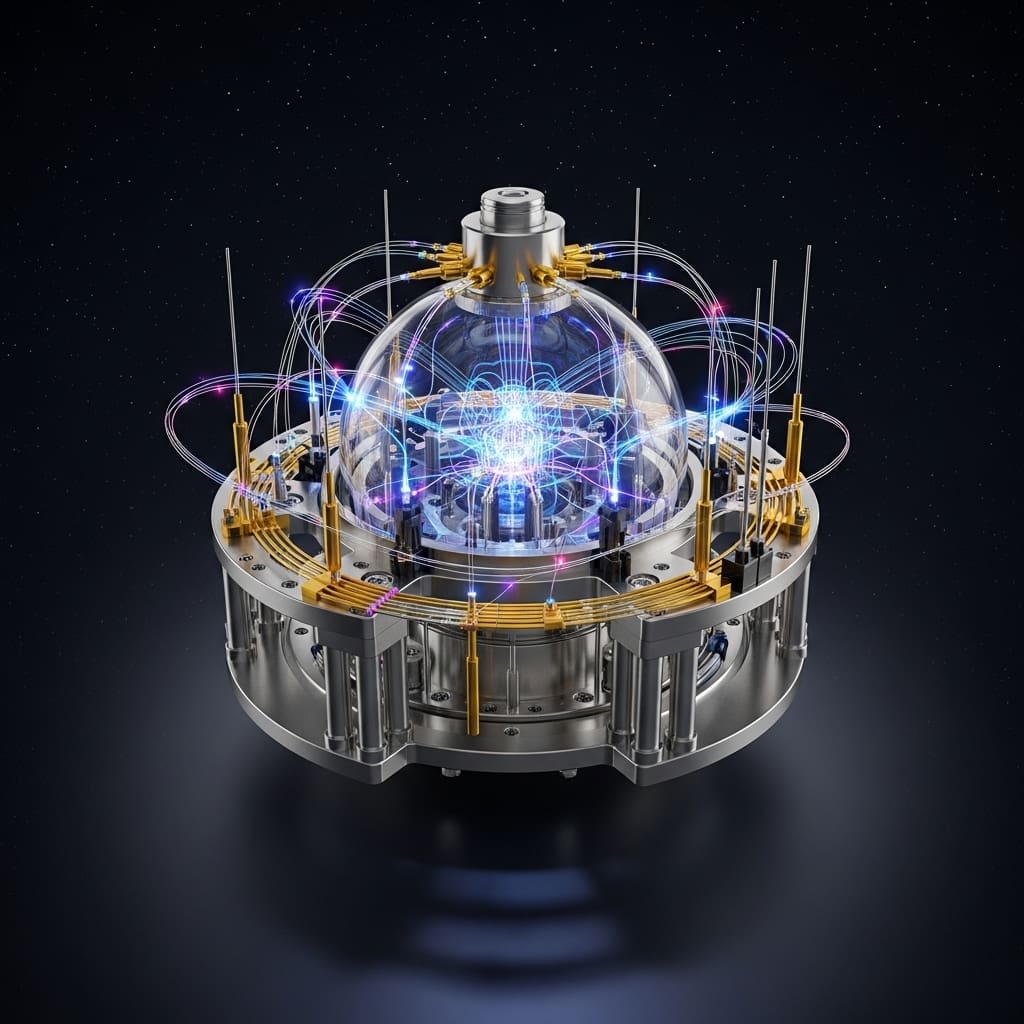
Scientists are developing a novel quantum blackbody thermometer poised to revolutionise on-orbit thermometry with unprecedented long-term accuracy. Peter J. Beierle from ERT and the University of Maryland, alongside Denis Tremblay from ERT and Noah Schlossberger et al. from the National Institute of Standards and Technology, detail a thermometer capable of achieving stability of 30 mK, surpassing the performance of current space-based instruments. This innovative device measures fluorescence ratios from optically excited rubidium atoms within microfabricated vapour cells, offering an intrinsically calibrated system where long-term stability stems from the immutable physical properties of rubidium itself. Unlike traditional platinum thermometers prone to temporal drift and calibration issues, this quantum approach promises a significantly more reliable and robust solution for primary on-orbit temperature measurements.
This innovative thermometer achieves long-term stability of 30 mK, surpassing the performance of existing resistance-based thermometers currently used in space. The research details a roadmap for a deployable, intrinsically calibrated thermometer based on measuring fluorescence ratios from optically excited rubidium atoms within microfabricated vapor cells.
A key advantage of this quantum blackbody thermometer lies in its reliance on the immutable physical properties of rubidium atoms, guaranteeing fluorescence ratio stability over extended periods. This contrasts sharply with conventional platinum resistance thermometers, which, despite achieving high initial accuracy, are prone to temporal drift and calibration shifts resulting from handling.
The newly developed thermometer addresses a critical need for improved radiometric accuracy in Earth-observing radiance instruments, particularly for long-term climate records. Current inter-satellite comparisons of infrared sensors reveal uncertainties and biases of approximately 100 mK, highlighting the limitations of existing calibration methods.
Reducing these uncertainties requires a robust, on-orbit absolute radiometric reference, and this research offers a pathway to achieve that goal. The core of the innovation is a primary temperature measurement, independent of external calibration standards. By utilizing the inherent properties of rubidium atoms, the quantum blackbody thermometer provides an intrinsically accurate temperature reading between 250 K and 400 K.
The design incorporates a microfabricated atomic vapor cell interfaced with a fiber optic system, delivering excitation light and collecting fluorescence signals via photon counting detectors. This self-calibrating system has the potential to replace or complement existing thermometers in remote sensing applications and other inaccessible systems.
Table I illustrates the error budget for on-orbit infrared and microwave sounders, demonstrating that the internal calibration target temperature is often the leading contributor to overall radiometric uncertainty. The research highlights the potential for a single on-board blackbody reference monitored by the quantum blackbody thermometer to significantly improve radiometric calibration and enhance the long-term consistency of climate data. This advancement aims to exceed the absolute accuracy requirement of 30 mK over a five-year mission, as exemplified by the CLARREO instrument, while offering improved stability and reduced size compared to phase change temperature sensors.
Rubidium Fluorescence Ratios Enable Self-Calibrating Temperature Determination in microfluidic devices
A microfabricated alkali vapor cell forms the core of a quantum blackbody thermometer (QBT) designed for accurate temperature measurement. This thermometer operates by measuring fluorescence ratios of optically excited rubidium atoms within the cell, achieving a long-term accuracy of 30 mK. The research utilizes double excitation, employing both laser light and thermal radiation to induce fluorescence at multiple wavelengths with calculable, temperature-dependent rates.
By monitoring these fluorescence ratios, the device leverages immutable physical properties of rubidium atoms for inherent self-calibration and long-term stability. The QBT’s design incorporates a vapor cell constructed from glass transparent to ultraviolet and visible light, but opaque to longer wavelengths, approximating an ideal blackbody radiation spectrum for infrared wavelengths.
Thermal radiation emitted from the vapor cell glass drives transitions between excited atomic states, and temperature is determined by monitoring optical fluorescence induced by these transitions. A rate equation model, incorporating 59 states of rubidium and transition dipole matrix elements, simulates the atomic system and determines steady-state populations using singular value decomposition of a matrix comprising spontaneous decay and stimulated transition rates.
Specifically, the study demonstrates a temperature sensing modality where 421nm laser light excites rubidium atoms to the 62P3/2 state. Subsequent thermal radiation stimulates transitions to both 72S1/2 and 52D3/2 states at rates dependent on temperature. The relative populations of these states are then determined by measuring fluorescence at 741nm and 762nm, respectively.
Calculated ratios of 741nm to 762nm fluorescence, such as r(62P3/2)741,762, exhibit a temperature dependence as shown in simulations, enabling accurate temperature determination. A separate calibration procedure, using 359nm laser excitation to the 72P3/2 state, establishes the ratio of detection efficiencies at 741nm and 762nm, ensuring the thermometer’s accuracy and stability.
Radiometric Uncertainty Budgets for CrIS and ATMS utilising a Quantum Blackbody Thermometer are presented here
Scientists have developed a quantum blackbody thermometer (QBT) demonstrating long-term accuracy of 30 mK, exceeding the performance of existing on-orbit thermometers. This blackbody thermometer operates by measuring fluorescence ratios from optically excited rubidium atoms within microfabricated vapor cells.
The inherent stability of these fluorescence ratios stems from the immutable physical properties, specifically, the transition strengths, of the rubidium atom itself. The research details uncertainty contributions for instruments like the JPSS CrIS and ATMS, revealing that internal calibration target (ICT) temperature is a leading contributor to total radiometric uncertainty, measured at 0.033 K for CrIS and 0.1 K for ATMS.
ICT emissivity contributes 0.023 K to 0.03 K for CrIS and 0.03 K for ATMS, while measured ICT reflection temperature introduces an uncertainty of 0.01 K. Space target temperature uncertainty ranges from 0.08 K to 0.20 K for CrIS and is below 0.01 K for ATMS. The QBT design incorporates a microfabricated atomic vapor cell, measuring approximately 3x3x3 mm3, coupled with a fiber optic bundle.
This sensor package utilizes three fibers: one for excitation light from alternating thermometer and calibration lasers, and two for collecting atomic fluorescence detected by photomultiplier assemblies. The system achieves a precision of δT/T = 3×10⁻⁷ on second timescales with platinum resistance thermometers, while the QBT aims for accuracy at the 1 × 10⁻⁴ level on minute timescales.
This technology relies on measuring temperature through optical fluorescence ratios of laser-excited rubidium atoms in steady state, induced by both laser light and thermal radiation. By monitoring fluorescence ratios across different atomic transitions, the device self-calibrates using known atomic transition dipole matrix elements, providing intrinsic long-term stability.
The vapor cell is designed to be transparent to ultraviolet and visible light, but opaque to longer wavelengths, approximating an ideal blackbody radiation spectrum for infrared wavelengths. Modeling the rubidium atomic system involves solving a system of rate equations, incorporating spontaneous decay rates and blackbody-stimulated transition rates to determine steady-state populations.
Rubidium fluorescence enables stable spaceborne temperature calibration with high accuracy
Scientists have developed a self-calibrating thermometer with the potential to significantly improve the accuracy of temperature measurements for spaceborne instruments. This blackbody thermometer operates by measuring the ratios of fluorescence emitted by optically excited rubidium atoms within microfabricated vapor cells, achieving a long-term accuracy of 30 millikelvin.
Unlike traditional platinum thermometers, which are prone to drift and require recalibration, this thermometer’s stability is intrinsically linked to the immutable physical properties of rubidium atoms. The prototype device demonstrated a sensitivity approaching the targeted temperature resolution, with potential for further improvement through enhancements in light collection and background reduction.
Accurate temperature monitoring is crucial for the reliable operation and longevity of various components in space-based instruments, including cameras, motors, and mirrors. This new thermometer promises to reduce uncertainties in instruments like On-Board Radiometric Calibration Sources, which currently contribute significantly to error budgets in on-orbit sensors.
Furthermore, the technology will support more accurate weather prediction models and ensure precise temperature measurements during long-duration planetary missions, aiding investigations into the history and habitability of our solar system. The authors acknowledge limitations related to current fiber optic collection efficiency and background noise, indicating areas for future development. Ongoing research will focus on optimising these aspects to achieve even greater sensitivity and refine the device for practical implementation in space-based remote sensing applications.
👉 More information
🗞 Development of a Quantum Blackbody Thermometer toward Primary On-orbit Thermometry
🧠 ArXiv: https://arxiv.org/abs/2601.20607


