

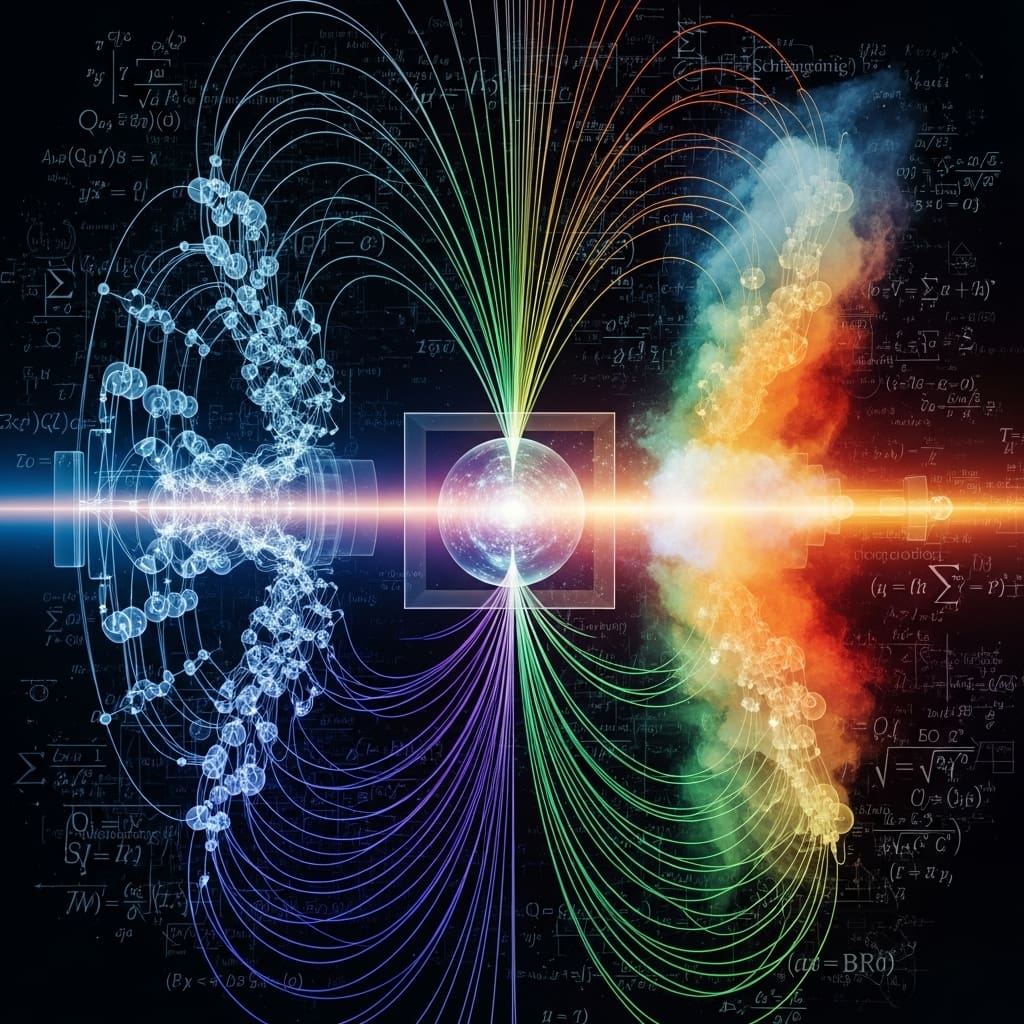
The interplay of energy, entropy, and geometry receives a unified theoretical treatment in new research led by Mohammad Mehdi Sadeghi of Jahrom University, alongside colleagues. This work introduces Quantum Thermodynamic Transformation Optics, a framework that extends traditional geometric transformations to coherently manipulate energy and entropy distributions alongside electromagnetic fields. The team demonstrates how compressing or expanding geometry directly influences local energy and entropy densities, all while upholding fundamental thermodynamic laws, and successfully applies this concept to reformulate the Casimir effect. This achievement establishes a continuous pressure law linking quantum and classical regimes through a thermal weighting function, revealing the combined influence of geometry and temperature on pressure, and provides a powerful platform for controlling thermal processes and field fluctuations within complex materials.
This approach embeds thermofield quantization within an optical metric, demonstrating that geometry itself functions as a thermodynamic transformation. This framework governs not only the spatial distribution of electromagnetic energy but also the local generation of entropy and the flow of heat, establishing a fundamental link between spatial manipulation and thermodynamic processes. The study pioneered a method for deriving explicit transformation laws for energy, dissipation, and entropy, revealing that compression amplifies local quantum energy while expansion enhances entropy production, all while maintaining overall thermodynamic balance.
To validate this theoretical construct, researchers applied QTTO to the Casimir effect, producing an analytical pressure law that bridges the quantum-vacuum and classical-thermal limits through a temperature-dependent weighting function. This result is not merely an empirical interpolation, but a derivation grounded in first principles and consistent with the fluctuation-dissipation theorem, further validated by numerical agreement with comprehensive Lifshitz-Matsubara theory. The authors acknowledge that while the current work focuses on specific examples, the framework’s potential extends to more complex scenarios involving nonequilibrium quantum electrodynamics and thermal management in metamaterials. This work establishes a unified approach to understanding how geometry influences energy, entropy, and electromagnetic fields in dissipative materials, going beyond traditional coordinate transformations. The core of QTTO lies in extending the concept of optical metrics to incorporate thermodynamic degrees of freedom, allowing for a consistent treatment of energy, work, and entropy within metamaterials. Researchers employed thermofield dynamics, quantizing the electromagnetic field within a doubled Hilbert space, to preserve canonical commutation relations at finite temperature.
This allows for the study of quantum electrodynamics in lossy and curved optical environments. The derived transformation laws demonstrate that compression of geometry amplifies local energy and entropy densities, while expansion reduces them, all while adhering to the fundamental laws of thermodynamics and conservation of energy. By integrating thermofield quantization with an optical metric, researchers demonstrate that geometry functions as a thermodynamic transformation, governing both the spatial distribution of electromagnetic energy and the local generation of entropy, as well as influencing the flow of heat. The framework yields explicit transformation laws for energy, dissipation, and entropy, revealing that compression amplifies local quantum energy while expansion enhances entropy production, all while maintaining overall thermodynamic balance.
👉 More information
🗞 Quantum Thermodynamic Transformation Optics: A Unified Framework for Energy and Entropy with Application to the Casimir Force in Dissipative Metamaterials
🧠 ArXiv: https://arxiv.org/abs/2511.07037

