The merging of black holes generates ripples in spacetime, known as gravitational waves, which now offer a unique window into testing the fundamental laws of physics. Marco Danilo Claudio Torri, Fulvio Ricci, and Marco Giammarchi, alongside their colleagues Lino Miramonti, Valerio Toso, and Chiara Sigala, investigate how these waves can probe the very nature of gravity itself. Their work focuses on the ‘ringdown’ phase immediately following a black hole merger, a period where the newly formed black hole settles into a stable state, emitting characteristic gravitational waves. By analysing these waves, the researchers aim to test predictions of quantum gravity, exploring whether the structure of spacetime at the event horizon exhibits the quantum properties expected by theoretical models, and potentially revealing clues about the quantization of black hole entropy. This research represents a significant step towards bridging the gap between Einstein’s theory of general relativity and the quantum world, paving the way for a deeper understanding of the universe’s most extreme environments.
Gravitational waves, ripples in spacetime, provide a unique tool for probing extreme astrophysical environments and testing the predictions of general relativity. Black holes, regions of spacetime with immense gravity, serve as primary sources of these waves, particularly during mergers. A central focus is the quest for quantum gravity, a theoretical framework reconciling general relativity with quantum mechanics. Investigations explore approaches to quantum gravity, including loop quantum gravity and string theory, and consider how quantum effects might manifest in gravitational wave signals.
Researchers are particularly interested in identifying deviations from classical predictions, such as echoes following black hole mergers, or modifications to the propagation of gravitational waves. Detailed analyses of gravitational wave data, combined with theoretical modeling, aim to constrain these potential effects and shed light on the underlying nature of spacetime. Current and future gravitational wave detectors, including LIGO, Virgo, KAGRA, and the planned Einstein Telescope, are crucial for achieving the necessary sensitivity to detect these subtle signals. Researchers are also developing sophisticated population statistics of black holes, analyzing observed mergers to understand their formation channels and properties. This research represents a cutting-edge effort to unravel the mysteries of gravity and the universe at its most extreme.
Quasi-Normal Mode Frequencies Reveal Quantum Effects
Scientists are investigating whether gravitational waves can reveal quantum properties of black holes, focusing on the ringdown phase following the merger of binary black hole systems. This phase involves characteristic vibrations, known as quasi-normal modes (QNMs), emitted as the newly formed black hole settles down. Researchers employ analytical techniques to model these QNMs and explore their connection to potential quantum behavior. The research team examines models proposing quantized black hole surfaces, linking black hole entropy to a discrete quantum structure. Calculations reveal the energy associated with quantized mass transitions, predicting that each transition would emit energy proportional to the inverse of the black hole’s mass.
However, calculations reveal a significant discrepancy with the Bekenstein “black hole atom” picture, which suggests single-graviton emission during transitions, indicating that the model requires an implausibly large number of quantized jumps to emit the observed energy. Further analysis calculates the ratio between the energy of a single graviton in the Bekenstein scenario and the classical QNM energy, finding it to be a small percentage. This result disfavors single-graviton emission, suggesting a scenario involving the coherent and collective emission of many quantum states during each quantized mass jump. Researchers also consider alternative theoretical frameworks, such as string theory and loop quantum gravity, which predict a degeneracy of microstates for a given entropy value, potentially leading to a broader energy spectrum and a more realistic representation of quantum behavior. This detailed analysis provides a framework for interpreting future gravitational wave observations and potentially uncovering the quantum nature of black holes.
Quantized Ringdown Signals Probe Black Hole Spacetime
Scientists are achieving unprecedented precision in testing General Relativity by observing gravitational waves emitted from merging compact binary objects. This work investigates how these observations can probe the nature of spacetime near black hole event horizons and potentially reveal a quantized structure. Researchers focus on the ringdown phase, the final stage of a black hole merger, to search for subtle signatures of quantum gravity. The research demonstrates that modifications to the predicted frequencies of quasi-normal modes (QNMs), the characteristic “tones” emitted during ringdown, could indicate quantum effects.
The team models scenarios where QNM frequencies are quantized, leading to a discrete energy spectrum, and finds that this could alter the observed gravitational wave signal. Analyses demonstrate that a remnant black hole with a mass of 100 solar masses, observed at a distance of 100 megaparsecs, would exhibit measurable shifts in its ringdown spectrum if quantum effects are present. Calculations show that correcting for redshift introduces a frequency shift for observations at this distance. Further research explores how effective field theory approaches to quantum gravity can modify the near geometry of black holes, influencing QNM frequencies.
Scientists model corrections to the Schwarzschild spacetime metric, incorporating higher-curvature terms and non-local effects, and find that even small perturbations can amplify changes in the tortoise coordinate, impacting the predicted frequencies. Results demonstrate that a modified Teukolsky potential, incorporating quantum gravity corrections, can measurably alter the effective potential and, consequently, the associated QNM frequencies. These induced modifications amount to a few percent in the effective potential, potentially detectable in future gravitational wave observations.
Quantum Ringdown Reveals Black Hole Structure
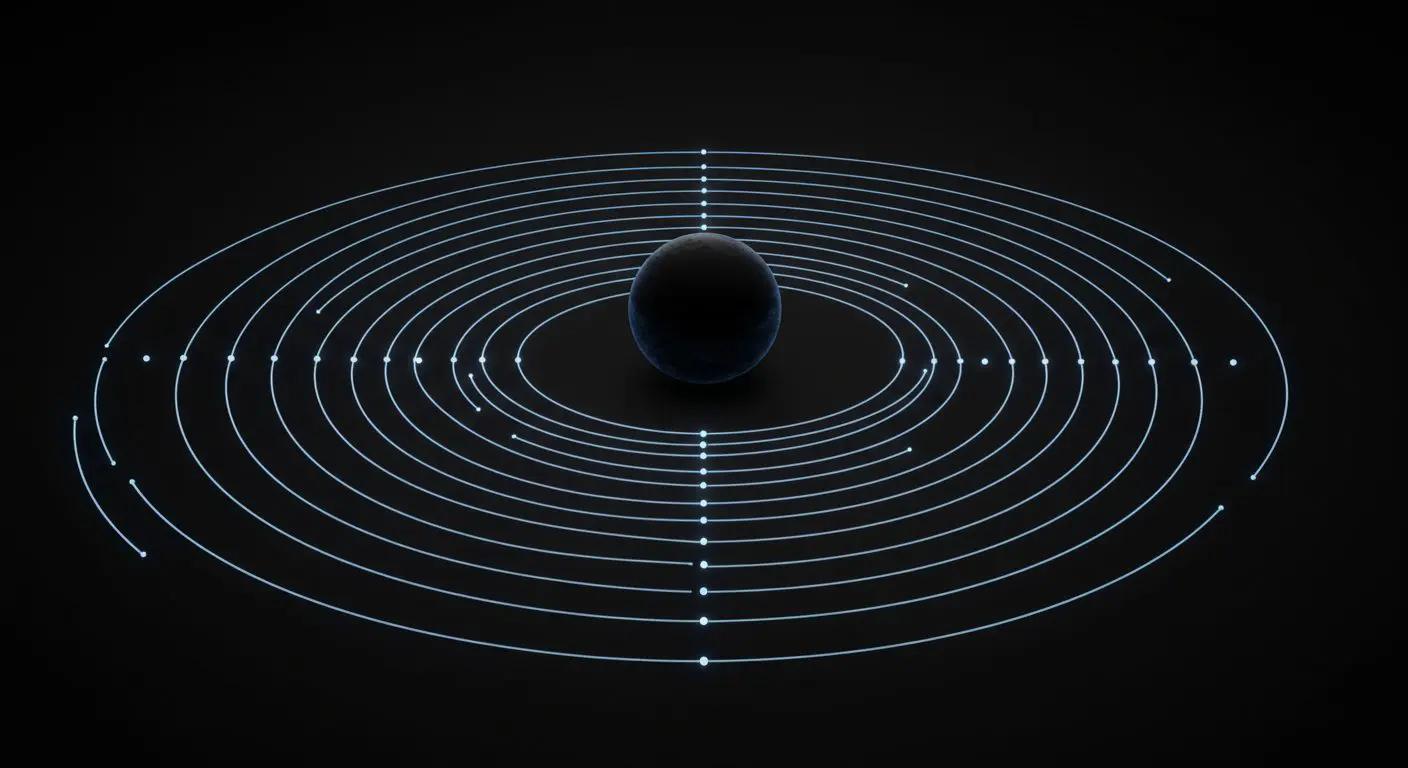
This research demonstrates how gravitational wave observations offer a novel pathway to investigate the quantum structure of black holes. By meticulously examining the ringdown phase of black hole mergers, the period immediately following the collision, scientists are able to probe the fundamental properties of these enigmatic objects with unprecedented precision. The team focuses on quasi-normal modes (QNMs), which represent the characteristic ‘tones’ emitted as the newly formed black hole settles into a stable state, and explores how these frequencies might deviate from classical predictions due to quantum effects. The study establishes a theoretical framework linking black hole entropy, area quantization, and the discrete energy levels of mass eigenstates, drawing parallels with the Bohr model of atomic structure.
This approach suggests that gravitational wave emission during ringdown could reveal transitions between these quantized energy levels, offering a direct observational window into the quantum nature of black holes. Importantly, the research highlights the potential to distinguish between different theoretical models, including string theory and loop quantum gravity, based on subtle variations in the observed QNM frequencies. The authors acknowledge that detecting these quantum signatures requires extremely precise measurements of the ringdown signal, pushing the limits of current gravitational wave detectors. Future research will benefit from the increased sensitivity of next-generation interferometers, such as the Einstein Telescope and Cosmic Explorer, which will be crucial for confirming or refuting the predicted deviations from classical general relativity. This work represents a significant step towards bridging the gap between general relativity and quantum mechanics, and opens exciting new avenues for exploring the most extreme environments in the universe.
🗞 Testing Quantum Gravity with Gravitational Waves from the ringdown of binary Black Holes coalescences: A New Frontier in Fundamental Physics
🧠 ArXiv: https://arxiv.org/abs/2511.02056