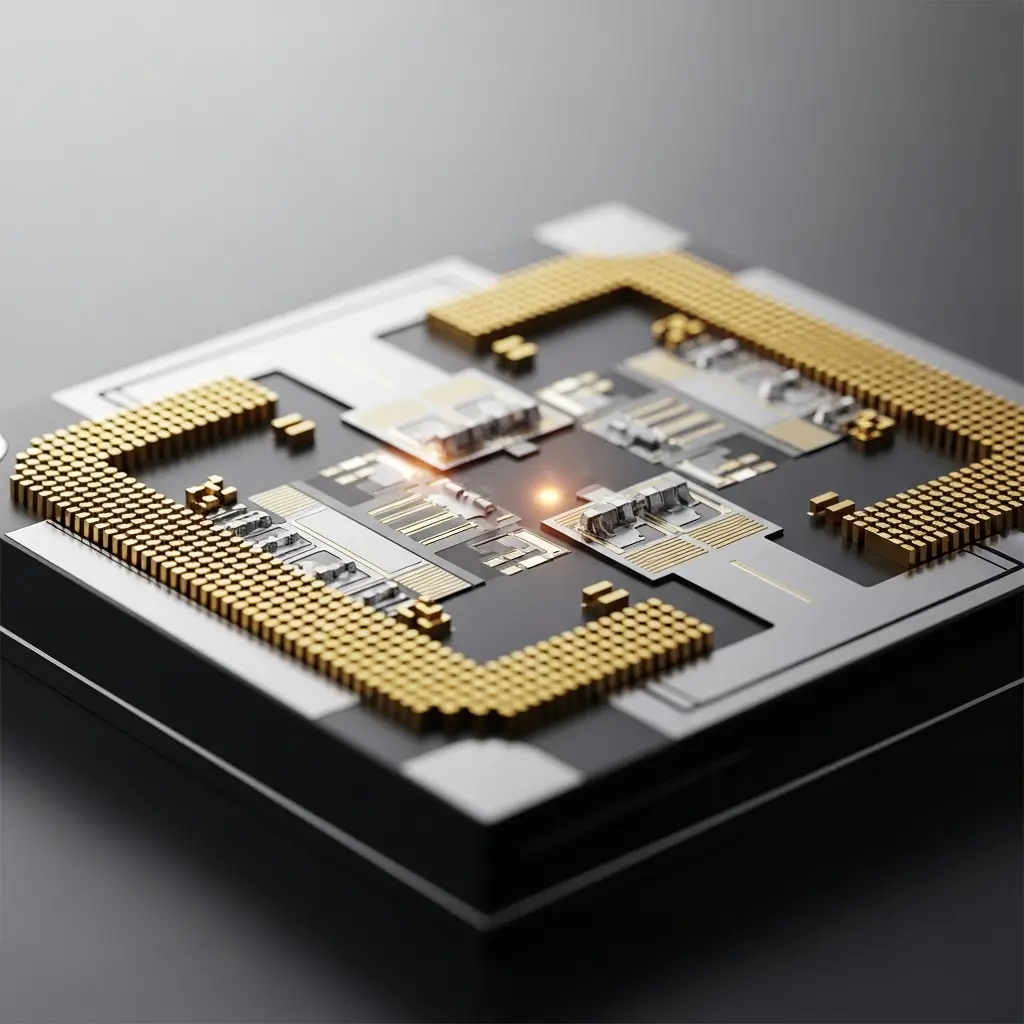
Terahertz quantum cascade lasers, typically considered remarkably stable sources of light, exhibit surprisingly complex behaviour when subjected to optical feedback, according to research led by Xiaoqiong Qi and Carlo Silvestri from The University of Sydney, alongside Thomas Taimre from The University of Queensland, and Aleksandar D. Rakic. The team systematically investigates how external optical feedback influences the operation of these lasers, revealing a clear progression from stable frequency comb states to increasingly complex oscillations and, ultimately, to chaotic emission. This work represents the first detailed report of chaotic dynamics in terahertz quantum cascade lasers, demonstrating that feedback can induce instability even at high operating currents, and significantly expands understanding of nonlinear dynamics within these devices. These findings not only deepen the fundamental knowledge of terahertz laser physics but also pave the way for innovative applications of chaotic light in areas such as sensing, imaging, and secure communications.
They modelled the laser comb as a set of coupled rate equations, incorporating the effects of delayed feedback, to explore the conditions where instabilities arise. The analysis reveals that even weak feedback can significantly change the comb spectrum, transitioning from stable multi-mode oscillation to a broadened and irregular spectrum indicative of chaotic dynamics. The strength of the feedback and the delay time critically determine the nature of the observed instabilities, with specific combinations leading to predictable changes in oscillation patterns and ultimately, chaotic regimes. This research provides valuable insights into the fundamental dynamics of terahertz QCL combs under feedback conditions and has implications for applications requiring precise frequency control and stability.
Terahertz Comb Dynamics Under Optical Feedback
Scientists investigated the optical feedback dynamics of terahertz (THz) frequency combs generated from quantum cascade lasers (QCLs) using detailed semiconductor models. Starting from a stable comb state, they identified transitions as the external feedback increased. In the weak-feedback regime, the comb operation remained largely unaffected, but as the feedback strength increased, a series of bifurcations occurred, leading to complex comb dynamics. These bifurcations involved both frequency shifts and changes in the laser’s oscillation modes, resulting in significant changes to the comb spectrum.
Researchers observed that the comb spectrum broadened and new modes appeared as the feedback strength increased, indicating a transition to a more complex comb state. Further increases in feedback strength led to the emergence of multiple stable comb states, with the system exhibiting hysteresis between them. They characterised these transitions and stable states using a combination of numerical simulations and experimental measurements, validating the model and providing a deeper understanding of the system’s behaviour.
Terahertz Laser Chaos via Optical Feedback
This research investigates the generation and characteristics of chaos in terahertz (THz) semiconductor lasers subjected to optical feedback. Key findings demonstrate that researchers successfully generated chaotic behaviour in a THz QCL by introducing optical feedback, opening up possibilities for utilizing THz lasers in applications that benefit from chaotic signals. The characteristics of the chaos, such as its complexity and bandwidth, are strongly dependent on the strength and characteristics of the optical feedback. The optical feedback induced the formation of optical frequency combs, contributing to the complexity of the chaotic signal.
Researchers used Lyapunov exponent analysis to confirm the chaotic nature of the generated signals, a positive exponent being a hallmark of chaotic systems. The generated chaos could be beneficial in applications such as secure communications, random number generation, THz imaging and sensing, and LiDAR. The methodology involved using a THz QCL and introducing optical feedback using a mirror, then analysing the output signal using a spectrum analyser and time-domain measurements. This research demonstrates the feasibility of generating chaos in THz lasers, which are increasingly important for a wide range of applications, and the ability to control and utilize chaos in THz systems could lead to significant advancements in areas such as security, sensing, and imaging.
Terahertz Laser Chaos via Optical Feedback
This work presents a detailed investigation of how optical feedback influences the behaviour of terahertz quantum cascade lasers. Researchers systematically explored the laser’s response to increasing levels of feedback, revealing a series of transitions from stable frequency comb operation to more complex dynamics. At low power and weak feedback, the laser underwent bifurcations, progressing through various oscillation patterns as feedback strength increased. Importantly, the team observed that increasing the power and feedback reflectivity induced chaotic emission, a previously unreported phenomenon in these types of terahertz lasers.
Calculations of the largest Lyapunov exponent confirmed the increasing complexity of the laser’s output alongside increases in the bandwidth of the emitted light and the linewidth enhancement factor. Simulations demonstrated that achieving chaos requires multi-mode emission at relatively high power, or a low linewidth enhancement factor. These findings deepen understanding of nonlinear dynamics within terahertz quantum cascade lasers and open new avenues for exploiting chaotic light in applications such as LiDAR systems and secure communications, potentially offering improved performance compared to existing near- and mid-infrared technologies.
🗞 Optical feedback induced irregular and chaotic dynamics in terahertz quantum cascade laser combs
🧠 ArXiv: https://arxiv.org/abs/2512.03344