Predicting how quantum systems evolve over time presents a significant hurdle in developing advanced technologies. Tianchu Li, Pranay Venkatesh from University of Colorado Boulder, Nanako Shitara from University of Toronto, and Andrés Montoya-Castillo now demonstrate a new, numerically exact method for simulating these complex dynamics. Their approach, based on a matrix product state representation, accurately predicts the loss of quantum coherence, a critical factor limiting the performance of qubits and memories, in interacting spin systems. This achievement provides reliable results for a range of materials, including molecular magnets and solid-state semiconductors, and promises to guide the development of more efficient simulation techniques and a deeper understanding of decoherence mechanisms.
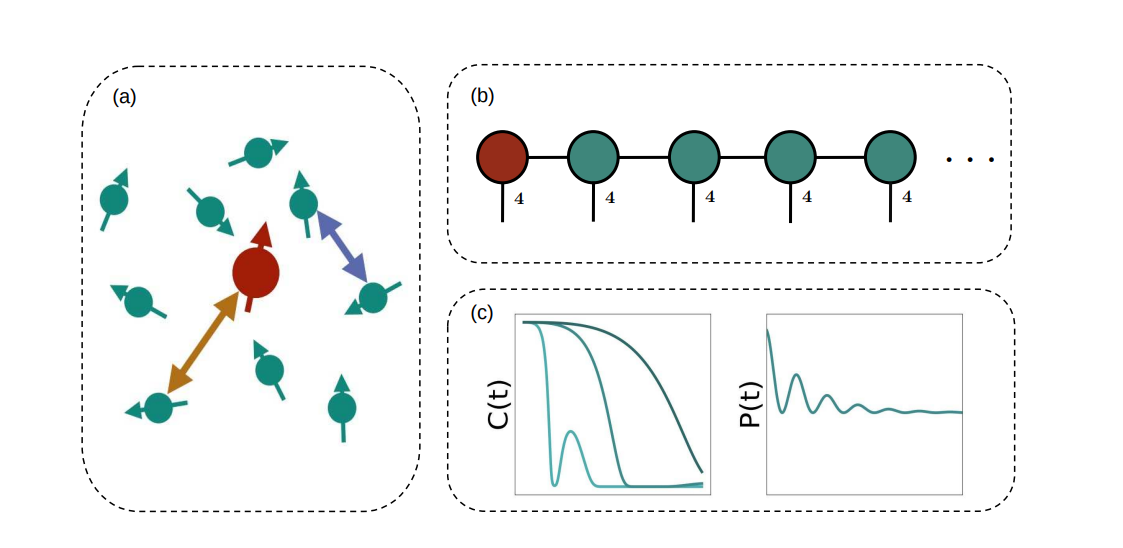
Scientists confront a formidable challenge in understanding and controlling decoherence, the loss of quantum information, yet accessing the underlying dynamics is key to designing better qubits, sensors, and memories. Researchers have introduced a new, numerically exact and scalable method, leveraging a matrix product state representation, to address this challenge. Their method accurately predicts the coherence and population dynamics of spin networks across a wide range of parameters, encompassing nuclear spin sensors and qubits found in solid-state semiconductors and molecular magnets. Furthermore, the method predicts spin dynamics under the influence of repeated light pulses, commonly used to mitigate decoherence and perform quantum sensing experiments.
Cluster Correlation Expansion for Qubit Dynamics
This work details computational methods for simulating the dynamics of qubits interacting with their environment, known as spin baths. Scientists employ a cluster correlation expansion (CCE) to calculate environmental effects on the qubit, implemented in the Python package PyCCE. Matrix product states (MPS) provide a powerful technique for efficiently representing the quantum state of many-body systems, particularly those that are one-dimensional or quasi-one-dimensional. The combination of CCE and MPS proves complementary, with CCE modelling the environment and MPS simulating the qubit and its surroundings. Accurate truncation using singular value decomposition (SVD) is crucial for feasibility, though careful parameter selection is essential. The computational cost grows with system size, but the team achieves linear scaling with the number of bath spins, a significant advantage over other methods.
Spin System Dynamics via Truncated Matrix Products
Researchers have developed Spin Bath-Truncated Matrix Product States (SB-tMPS), a new method for accurately simulating the complex dynamics of interacting spin systems, crucial for advancing quantum technologies. This work addresses a significant challenge in predicting the behaviour of promising solid-state and molecular materials used in qubits, quantum memories, and sensors. Simulations currently achieve systems of up to approximately 100 spins within a few hours using a NVIDIA V100 GPU. Unlike existing methods like cluster-correlation expansion (CCE), SB-tMPS consistently achieves numerical convergence and remains stable even in strongly interacting spin baths where CCE fails. The team successfully applied SB-tMPS to realistic systems, including a 31P defect in silicon functioning as a nuclear spin qubit and a derivative of Benzoseleno[3,2-b]benzoselenophene (BSBS) molecule investigated for information storage and spintronics. This advancement provides a powerful tool for guiding the design of quantum materials and enabling principled inquiry into decoherence mechanisms, paving the way for next-generation quantum technologies.
Spin System Dynamics Predicted with Matrix Products
Researchers have developed a new computational method for accurately predicting the dynamic behaviour of complex spin systems, crucial components in emerging quantum technologies. This method, based on a matrix product state representation, allows for the scalable and numerically exact modelling of coherence and population dynamics within networks of interacting spins, found in both solid-state semiconductors and molecular magnets. The technique successfully predicts how these systems evolve over time, even when subjected to repeated light pulses commonly used to improve coherence or perform sensing experiments. This achievement provides a reliable means of simulating moderately-sized spin platforms, offering valuable insights into the mechanisms governing decoherence, the loss of quantum information. The method’s accuracy allows researchers to validate and refine existing approximations used in modelling these systems, and ultimately guide the design of improved qubits and memory devices.
🗞 Numerically exact quantum dynamics with tensor networks: Predicting the decoherence of interacting spin systems
🧠 ArXiv: https://arxiv.org/abs/2509.20604