
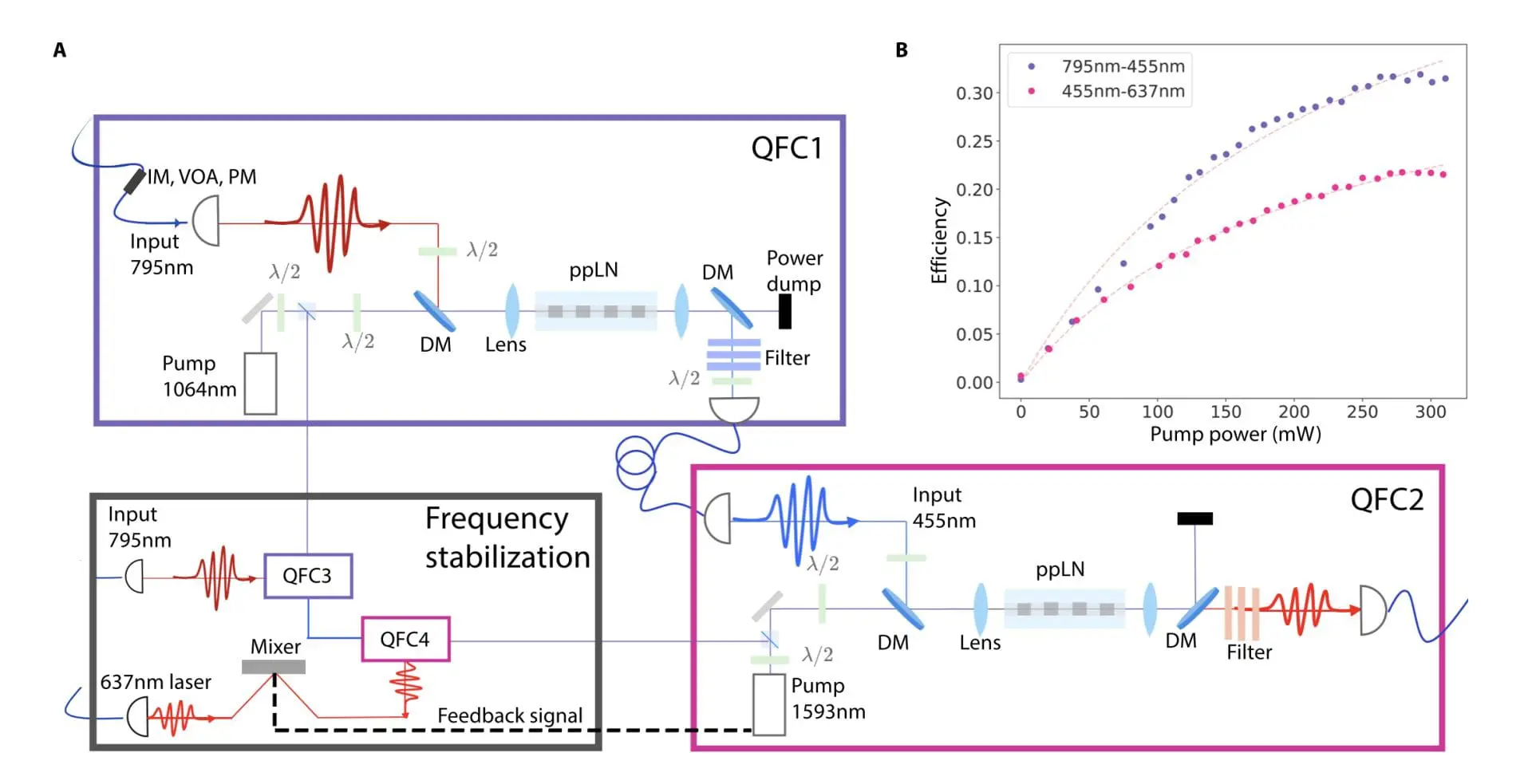
Quantum teleportation, the process of transmitting quantum information from one location to another, has taken a significant step forward. Researchers from the QuTech Kavli Institute of Nanoscience, the University of Geneva, and Constructor University Bremen GmbH have successfully demonstrated a quantum interface linking a diamond NV center quantum network node and 795nm photonic time-bin qubits.
The experiment achieved a teleportation fidelity of 75.5 ± 1.0%, proving the feasibility of interconnecting different quantum network hardware. This breakthrough could pave the way for a future quantum internet, offering ultra-secure communication, enhanced sensing, and distributed quantum computing.
What is Quantum Teleportation and How Does it Work?
Quantum teleportation is a process in which quantum information can be transmitted from one location to another, with the help of classical communication and previously shared quantum entanglement between the sending and receiving location. It’s not about transporting physical objects but rather about transferring the information contained in a quantum state. In essence, it’s about making a distant quantum system take on the identity of another system in a way that the two become indistinguishable.
The process of quantum teleportation involves three main steps. First, the sender (often referred to as Alice) and the receiver (Bob) share a pair of entangled particles. Alice then performs a measurement on her particle and the one she wants to teleport, producing two classical bits of information. She sends these bits to Bob, who uses them to perform a specific operation on his entangled particle. This operation transforms Bob’s particle into an exact replica of the original quantum state Alice wanted to teleport.
What is the Significance of the Recent Quantum Teleportation Experiment?
A team of researchers from the QuTech Kavli Institute of Nanoscience at Delft University of Technology in the Netherlands, the Department of Applied Physics at the University of Geneva in Switzerland, and Constructor University Bremen GmbH in Germany have reported a significant breakthrough in quantum teleportation. They have successfully demonstrated a quantum interface linking a diamond NV (Nitrogen-Vacancy) center quantum network node and 795nm photonic time-bin qubits compatible with Thulium and Rubidium quantum memories.
The team used a two-stage low-noise quantum frequency conversion and waveform shaping to match temporal and spectral photon profiles. They achieved a high indistinguishability of 89.5 ± 1.9% between converted 795nm photons and the native NV center photons. The experiment resulted in a teleportation fidelity of 75.5 ± 1.0%, proving the feasibility of interconnecting different quantum network hardware.
How Does the Quantum Interface Work?
The quantum interface developed by the researchers converts the input 795nm photonic time-bin qubit to match the properties of the NV center photon. In parallel, entanglement is generated between the spin state of the NV center and the temporal mode of a single emitted photon. The converted 795nm photon and the NV photon are then interfered on a beam-splitter. The detection of the photons in different time bins constitutes a Bell state measurement that teleports the original 795nm time-bin qubit state to the NV spin qubit. Real-time feedforward of the Bell-state measurement outcome and application of the corresponding correction gate on the NV spin qubit completes the action of the interface.
What are the Implications of this Quantum Interface?
The successful demonstration of this quantum interface is a significant step towards the realization of a future quantum internet. Such an internet would leverage the principles of quantum mechanics for ultra-secure communication, enhanced sensing, and distributed quantum computing. The interface could be used to connect remote qubit processors via a repeater chain or to enable remote state preparation on a quantum computing server from a photonic client.
The quantum interface also addresses a major challenge in linking heterogeneous quantum network hardware – the matching of their corresponding photonic qubits. Many leading hardware platforms for quantum memories and quantum network nodes are based on atom-like systems. The properties of the photonic interface of these platforms, such as temporal profile and wavelength of emitted photons, are largely determined by the atomic properties and vary significantly among the different platforms. The interface developed by the researchers bridges these differences, paving the way for more versatile and efficient quantum networks.
What are the Future Prospects of Quantum Teleportation?
The successful demonstration of quantum teleportation using a quantum interface between a diamond NV center quantum network node and 795nm photonic time-bin qubits is a significant milestone in the field of quantum communication. However, this is just the beginning. The researchers’ work shows the feasibility of interconnecting different quantum network hardware, but there is still a long way to go before a fully functional quantum internet can be realized.
Future research will likely focus on improving the fidelity of quantum teleportation, expanding the range of compatible quantum hardware, and developing more efficient and reliable quantum interfaces. The ultimate goal is to create a global quantum network that can support a wide range of applications, from ultra-secure communication and enhanced sensing to distributed quantum computing and beyond.
and a solid-state quantum network node”
Publication Date: 2024-03-27
Authors: Mariagrazia Iuliano, Mel Slater, Arian Stolk, Matthew Weaver, et al.
Source: arXiv (Cornell University)
DOI: https://doi.org/10.48550/arxiv.2403.18581