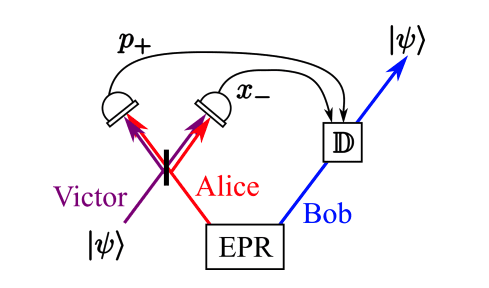
In an April 25, 2025 article titled Teleportation-based Speed Meter for Precision Measurement, researchers Yohei Nishino, James W. Gardner, Yanbei Chen, and Kentaro Somiya propose a quantum teleportation-based speed meter that enhances precision in interferometric displacement sensing, offering potential advancements in gravitational wave detection.
The research proposes a quantum teleportation-based speed meter for interferometric displacement sensing, offering two implementations: an online approach using real-time displacement operation and an offline method relying on post-processing. Both reduce quantum radiation pressure noise and surpass the standard quantum limit for displacement measurement. The scheme enhances low-frequency sensitivity in detectors without requiring modifications to conventional Michelson interferometer optics. This approach enables back-action evasion through quantum entanglement, providing a novel path for precision sensing applications.
Gravitational waves—ripples in spacetime caused by massive cosmic events such as black hole mergers—have revolutionized our understanding of the universe. Since their first detection in 2015 by LIGO and Virgo observatories, these waves have provided unprecedented insights into astrophysics. However, current detectors face limitations in sensitivity, restricting our ability to observe weaker signals from distant events.
Detecting gravitational waves is akin to spotting a
Detecting gravitational waves is akin to spotting a tiny ripple in an ocean of noise. Quantum noise, arising from the quantum nature of light used in interferometers, poses a significant challenge. This noise can obscure faint signals, making it difficult to detect less powerful sources or those occurring beyond our local universe.
To address this challenge, researchers have developed the concept of paired carriers. Instead of using single laser beams, paired carriers involve two light beams with specific phase relationships. This method reduces quantum noise by exploiting correlations between the beams, enhancing sensitivity without increasing laser power.
Paired carriers operate on the principle that combining two carefully synchronized light beams can cancel out much of the quantum noise. By adjusting their relative phases and amplitudes, scientists can optimize the system to suppress noise more effectively than traditional single-beam methods. This approach maintains the benefits of higher laser power while minimizing noise contributions.
Initial studies suggest that paired carriers could significantly improve detector sensitivity. Simulations indicate a potential reduction in quantum noise by up to 50%, allowing detectors to observe weaker signals and expand their range. This advancement could enable the detection of events previously beyond our observational capabilities, such as mergers involving intermediate-mass black holes or neutron star collisions at greater distances.
Enhancing gravitational wave detection sensitivity has profound implications
Enhancing gravitational wave detection sensitivity has profound implications for astronomy. It would allow us to study a wider variety of cosmic phenomena, test theories of gravity under extreme conditions, and potentially observe events that are invisible through electromagnetic observations alone. This innovation could pave the way for new discoveries, deepening our understanding of the universe’s most energetic processes.
The introduction of paired carriers represents a significant step forward in gravitational wave astronomy. By reducing quantum noise, this method promises to enhance detector sensitivity, enabling astronomers to explore previously inaccessible cosmic events. As technology continues to evolve, such innovations will play a crucial role in unlocking new insights into the workings of the universe, pushing the boundaries of human knowledge and our ability to observe the cosmos.
🗞 Teleportation-based Speed Meter for Precision Measurement
🧠 DOI: https://doi.org/10.48550/arXiv.2504.18111