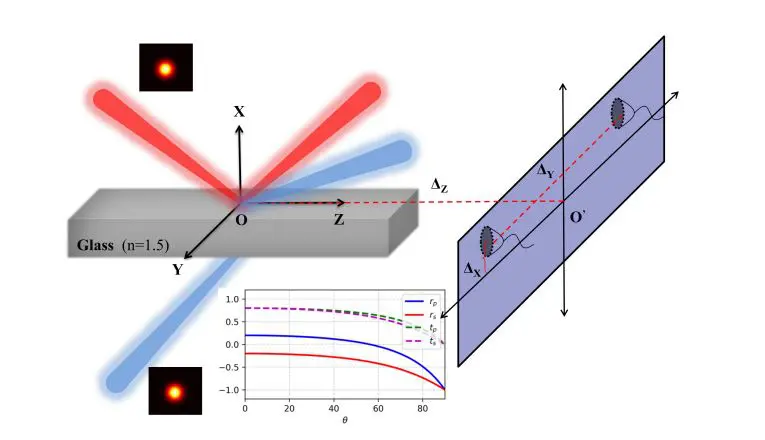
The behaviour of light coherence at boundaries between materials remains a fundamental question in optics, and recent work by Yuetao Chen, Gaiqing Chen, and Jin Wang, all from Xi’an Jiaotong University, alongside Qiang Ma and Shoukang Chang from the same institution, and Shaoyan Gao, addresses this challenge with a novel theoretical framework. The team develops an extension of the van Cittert-Zernike theorem to describe how reflection and refraction alter the coherence and polarization of light beams as they propagate, revealing that these processes inherently couple polarization states. This research demonstrates a surprising ability to manipulate the statistical properties of light, even achieving sub-Poissonian statistics, fluctuations below the standard quantum limit, with ordinary thermal light through careful measurement. Crucially, the team establishes a mechanism for controlling light states without complex interactions, offering a new pathway for advancements in optical information processing and potentially other applications reliant on precise light control.
Multiphoton Quantum Coherence and Spatial Correlations
This research advances our understanding of light coherence, particularly when multiple photons interact, by extending the van Cittert-Zernike theorem to encompass quantum properties like entanglement and correlations in multiphoton scenarios. The team investigates how light maintains coherence when interacting with materials, specifically at interfaces, demonstrating that the polarization of light beams is predictably altered by reflection and refraction, and that these changes can be harnessed to control the statistical properties of the light itself. This provides a new pathway for advancements in optical information processing and other applications reliant on precise light control.,.
Coherence Measurement via Reflection and Refraction
Recent research pioneers a novel approach to controlling light coherence by examining how light beams behave when they reflect from or pass through materials like glass. Scientists developed a method to measure second-order coherence, a key indicator of light’s statistical properties, using detectors positioned to capture the light after interaction with the glass surface. Experiments revealed that observed coherence strongly depends on the spatial arrangement of detectors and the angle of incidence, remarkably finding conditions where even ordinary thermal light can display sub-Poissonian statistics, indicating a more ordered light distribution. Detailed measurements reveal a scaling law linking beam collimation to optical field thermalization, demonstrating that second-order coherence depends on the ratio of the beam’s waist to the wavelength of light. This innovative approach provides a robust mechanism for controlling light coherence, advancing our fundamental understanding of optics.,.
Light Coherence at Material Interfaces Explained
Recent research establishes a new understanding of how light maintains its coherence after interacting with materials, specifically at interfaces like those of glass. The work demonstrates that the polarization of light beams is predictably altered by reflection and refraction, and that these changes can be harnessed to control the statistical properties of the light itself. Scientists achieved a detailed description of this behavior through a modified van Cittert-Zernike theorem, extending its application to light beams undergoing these fundamental optical processes. The study involved directing two light beams onto a glass surface, separating the reflected and transmitted beams, and then measuring their correlations.
Researchers determined the four-point correlation matrix, revealing how interaction with the glass modifies the light’s properties. Measurements confirm that the reflected and transmitted beams exhibit altered polarization states, governed by the angles of incidence and the refractive index of the glass. Notably, the team discovered regimes where thermal light can display sub-Poissonian statistics through post-selection of detected intensities, tunable by adjusting the angle at which the light strikes the glass. The team demonstrated that the polarization properties of light beams are predictably altered by reflection and refraction, and that these changes can be harnessed to modify the statistical characteristics of the light without relying on conventional light-matter interactions. Importantly, the work reveals conditions under which even thermal light can display sub-Poissonian statistics through careful post-selection of measurements. The findings demonstrate a clear relationship between the collimation of the light beam and the thermalization of the optical field, governed by a quantifiable scaling law, suggesting a pathway for controlling the statistical properties of light by manipulating its spatial characteristics. While the study focused on a specific light beam and material, the authors acknowledge that extending the model to encompass more complex scenarios represents a natural progression for future work, potentially exploring applications in advanced imaging and information technologies.
👉 More information
🗞 Quantum Coherence in Reflected and Refracted Beams: A Van Cittert-Zernike Approach
🧠 ArXiv: https://arxiv.org/abs/2512.12968