The fundamental relationship between information and thermodynamics receives renewed scrutiny in new work led by Shou-I Tang and Emery Doucet of the University of Massachusetts, Boston, alongside Akram Touil from Los Alamos National Laboratory and Sebastian Deffner from the University of Maryland, Baltimore County, and Akira Sone from the University of Massachusetts, Boston. This team investigates how information processing impacts the laws governing energy transfer in self-contained systems, extending existing theoretical frameworks to account for initial correlations between components. They demonstrate that a crucial requirement for a ‘work source’ to function effectively, acting as a catalyst without altering its inherent randomness, directly links to the underlying mathematical structure of the system’s Hamiltonian. Importantly, the researchers derive a new speed limit governing the combined dynamics of a system and its memory, which offers a dynamic interpretation of Landauer’s principle and provides insights into the limits of information processing itself.
Quantum Thermodynamics, Fluctuation Theorems and Heat Engines
Foundational Frontiers of Quantum Information Theory
This extensive collection of research papers explores the frontiers of quantum thermodynamics, quantum information theory, and the foundations of quantum mechanics. Researchers investigate systems operating outside of traditional equilibrium conditions, focusing on entropy production and quantum counterparts of established thermodynamic relations. Studies characterize quantum heat engines and refrigerators, seeking to understand how thermodynamic cycles function at the quantum level and how work is defined and measured. Precision measurements of temperature in quantum systems, known as quantum thermometry, also form a key area of investigation.
A significant focus lies on quantum information theory, with studies characterizing entanglement and quantum correlations, including detailed analyses of Werner states. Researchers are also investigating how quantum information is transmitted and processed through quantum channels, and developing secure communication protocols based on quantum principles, known as quantum cryptography. Understanding how to distinguish between different quantum states is also a prominent theme. The foundations of quantum mechanics receive considerable attention, with studies addressing decoherence and exploring the concept of quantum Darwinism, which seeks to explain how classical reality emerges from the quantum world.
The work of Wojciech Zurek is heavily represented, particularly his contributions to understanding decoherence and the emergence of classicality. Researchers are also investigating the quantum measurement problem, seeking to understand the process of measurement and its implications for our understanding of reality. The study of pointer states, which are robust against decoherence, and open quantum systems, which interact with their environment, are crucial for understanding how classical behavior arises. Mathematical tools, including matrix analysis, elliptic integrals, and information theory, are essential for advancing these investigations.
Sandu Popescu and collaborators, particularly David Deffner, are prominent figures in this research area, focusing on quantum thermodynamics, fluctuation theorems, and the foundations of quantum mechanics. Marc Plenio contributes significantly to quantum information theory and quantum communication, while J. M. Horowitz and P. Talkner specialize in quantum fluctuation theorems.
Advanced Concepts: From Theorems to Quantum Darwinism
A. Specific areas of research highlighted include extending the classical Jarzynski relation and Crooks fluctuation theorem to the quantum realm. Quantum Darwinism, the process by which information about a quantum system is amplified and made accessible to multiple observers, is a central theme. Researchers are also investigating how quantum states can be distinguished and how information about them can be amplified, and characterizing the role of quantum correlations and entanglement in quantum information processing and thermodynamics. Modeling the interaction of quantum systems with their environment and understanding how decoherence leads to the loss of quantum coherence are also key areas of investigation. This bibliography represents a vibrant and interdisciplinary field at the intersection of quantum physics, information theory, and thermodynamics, highlighting ongoing efforts to understand the foundations of quantum mechanics, the emergence of classical reality, and the potential applications of quantum principles to information processing and energy conversion.
Modeling Information Processing in Autonomous Systems
Autonomous Systems, Correlations, and Unitary Evolution
This research introduces a new approach to understanding the fundamental limits of information processing in autonomous systems, extending established principles to systems with initial correlations. Scientists constructed a composite system comprising a principal system, a heat bath, a memory, and a work source, all described by a self-contained Hamiltonian. Crucially, the team derived constraints on the total Hamiltonian, ensuring the work source functions as a catalyst while preserving its inherent randomness, achieved by demanding a specific mathematical property for the total system’s evolution. The study demonstrates that this requirement is mathematically equivalent to the commutativity of operators acting on the combined principal system, bath, and memory, directly influencing the Hamiltonian structure.
Researchers then generalized the speed limit governing the joint dynamics of the system and memory, deriving a dynamical version of Landauer’s bound, a cornerstone of information theory. Importantly, this speed limit was reinterpreted within the context of hypothesis testing, revealing its implications for decision-making processes in physical systems. This work involved rigorous theoretical analysis of Hamiltonian constraints and their impact on the speed of information processing, providing a foundational framework for future investigations into the thermodynamics of computation.
Entropy Equivalence and Thermodynamics of Information Processing
Scientists have established a comprehensive framework for understanding thermodynamics in classical information processing, explicitly modeling devices, a heat bath, a work source, and a memory reservoir as evolving autonomously under a time-independent Hamiltonian. The work source is designed to maintain its initial randomness throughout the evolution, while the memory reservoir’s energy remains constant, allowing for generalizations of the Kelvin-Planck, Clausius, and Carnot statements in the presence of information gathering. Results demonstrate that Shannon entropy and Clausius entropy should be considered equivalent in formulations of the second law, suggesting that extracting work from a single heat bath or achieving efficiencies beyond the Carnot limit is possible, provided entropy reduction is balanced by information storage in the memory. This work extends the framework to the quantum realm, replacing classical dynamics with unitary evolution under a time-independent total Hamiltonian, Shannon entropy with von Neumann entropy, and classical ensemble averages with quantum expectation values.
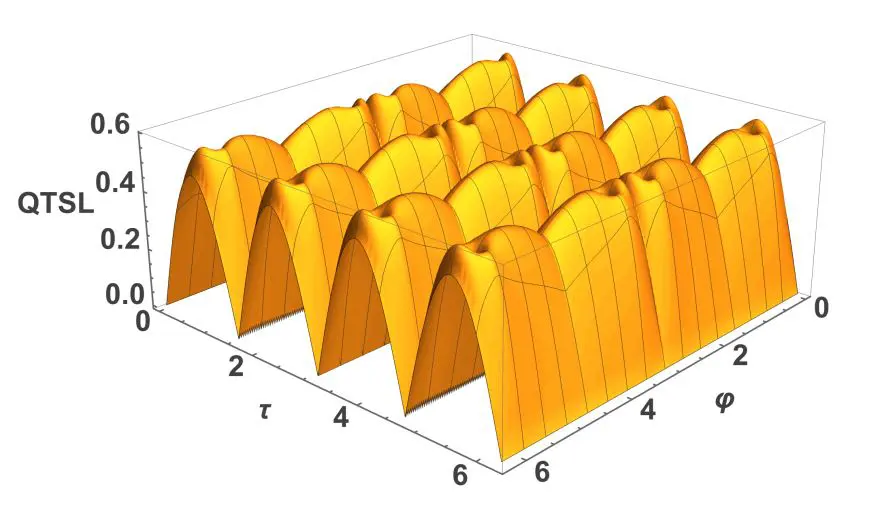
Researchers emphasize autonomous Hamiltonians, providing a closed description of all subsystems and ensuring energy and entropy exchanges arise solely from internal interactions, allowing thermodynamic laws to emerge naturally from the underlying quantum dynamics. The team determined conditions for the total system evolution and Hamiltonian to be thermodynamically consistent, deriving a quantum version of Landauer’s principle to capture energetic constraints and investigating the effective quantum speed limit for the composite of the principal system and memory. Measurements confirm that the work source preserves its von Neumann entropy throughout the evolution, requiring the reduced dynamics of the work source to be a unitary operation, while the memory maintains a Hamiltonian proportional to the identity, indicating complete degeneracy and preventing energy exchange with the rest of the system. The team established a quantum thermodynamic speed limit, demonstrating its connection to the quantum Landauer principle and elucidating its operational significance in the context of quantum hypothesis testing, revealing how it determines the scaling ratio between the initial and final states of the full system.
Quantum Thermodynamics Constrains Computation Speed and Energy
This research extends the established framework of information processing in thermodynamics into the quantum realm, offering new insights into the energetic and temporal limits of computation. Scientists have developed a unified theory describing how these limits apply to autonomous quantum systems, encompassing a principal system, heat bath, memory, and work source. By generalizing the second law of thermodynamics to account for information processing, the team derived constraints on the total Hamiltonian of the system, ensuring the work source functions as a catalyst without altering its randomness. The work demonstrates a connection between the quantum speed limit, a measure of how quickly a system can evolve, and the energetic cost of computation, providing a fundamental understanding of the limits imposed by quantum thermodynamics on information processing.
🗞 Information Processing in Quantum Thermodynamic Systems: an Autonomous Hamiltonian Approach
🧠 ArXiv: https://arxiv.org/abs/2511.08858