This research comprehensively investigates noise affecting quantum systems, particularly those built with neutral atoms trapped and controlled by optical tweezers. The work focuses on accurately quantifying noise, moving beyond simple identification to detailed measurement of its properties across the entire system’s quantum state space. Researchers employ advanced mathematical tools, including random matrix theory and free probability, to model and understand the complex nature of this noise, crucial for building scalable quantum computers and simulators. The study extends beyond simple noise models, incorporating realistic descriptions of disturbances affecting quantum systems and utilizing open quantum system techniques to model interactions between the system and its surroundings. By combining theoretical modeling with experimental validation, the team aims to push the boundaries of understanding noise and develop new tools for building more robust and reliable quantum computers and simulators.
Temporal Ensembles Characterize Quantum Thermalization
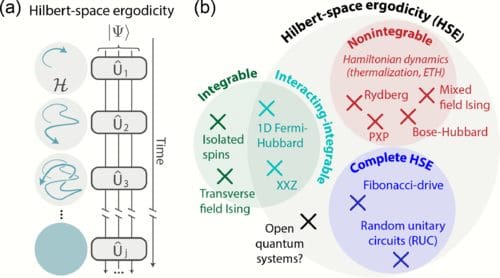
Researchers investigated how quantum systems reach thermal equilibrium, employing a framework based on Hilbert-space ergodicity. The team established a theoretical foundation for experimental validation, focusing on the concept of a “temporal ensemble,” which represents the system’s evolution under constant energy input, allowing analysis of the system’s behavior at different moments and understanding its long-term statistical properties. Scientists defined the “diagonal ensemble,” an average over all states within the temporal ensemble, capturing how initial conditions influence the system’s behavior and predicting state populations. This framework connects to the “random phase ensemble,” demonstrating that, under specific conditions, the system’s behavior statistically aligns with a uniformly random distribution across its accessible quantum state space.
Universal Fluctuations Challenge Quantum Thermalization Expectations
Researchers have demonstrated a novel understanding of quantum thermalization, revealing that while local parts of a quantum system appear to randomize as expected, global properties exhibit persistent, universal fluctuations. This work establishes a framework based on Hilbert-space ergodicity, discovering that systems obeying this principle exhibit predictable fluctuations, specifically that relative probability fluctuations over time precisely follow an exponential distribution, confirmed through experimental and numerical analysis. Employing a Rydberg quantum simulator undergoing thermalizing dynamics, scientists found that temporal fluctuations of bitstring probabilities are consistent with the emergence of the Porter-Thomas distribution, validating key predictions of Hilbert-space ergodicity. Extending this framework to systems interacting with their environment, researchers predicted and observed a universal form for temporal fluctuations of projective observables at infinite effective temperature, described by the Erlang distribution, demonstrating a quantum-to-classical transition. The team established that these findings are exact and universal for ergodic systems, holding true both globally and locally, and independent of specific system details, contrasting with previous studies that either bounded fluctuations or predicted scaling with total system dimension. For open quantum systems, the research clarifies that fluctuations are not simply dampened, but follow a predictable pattern dictated by Hilbert-space ergodicity, offering a new avenue for classifying the behavior of noisy quantum systems and improving experimental noise learning.
Erlang Distribution Reveals Quantum Thermalization Dynamics
This research provides new insight into quantum thermalization, demonstrating that while local parts of a quantum system may appear to reach thermal equilibrium, global properties continue to exhibit persistent and universal fluctuations. The team found that the probability of observing specific bitstring measurements follows a predictable distribution, known as the Erlang distribution, even in systems with constraints or at finite temperatures, supporting the concept of Hilbert-space ergodicity and revealing a smooth transition from quantum mechanical to statistical mechanical descriptions as the system interacts with a larger environment. Furthermore, the researchers developed a new model for describing noise in open quantum systems, using a hypoexponential distribution, allowing for the categorization and discrimination of different noise types based on their effect on bitstring measurements, offering a way to experimentally identify the most likely noise source. Future research could focus on calculating the full probability distribution at all orders for finite temperatures and exploring the applicability of these findings to a wider range of quantum systems.
👉 More information
🗞 Experimental Signatures of Hilbert-Space Ergodicity: Universal Bitstring Distributions and Applications in Noise Learning
🧠 DOI: http://link.aps.org/doi/10.1103/h6xy-zpx4