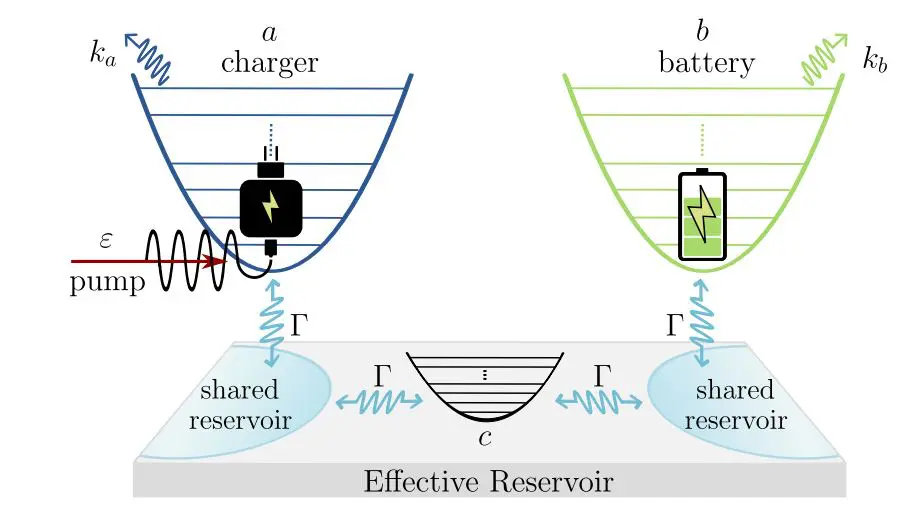
Exceptional points, unusual states where system properties change dramatically even with minor disturbances, present a compelling opportunity for advanced energy storage, but realising this potential has proven challenging. Borhan Ahmadi, André H. A. Malavazi, and Paweł Mazurek, all from the University of Gdańsk, alongside colleagues including Paweł Horodecki and Shabir Barzanjeh, now demonstrate a novel energy-storage mechanism that harnesses exceptional-point physics within a completely passive system. Their research overcomes previous limitations by employing reservoir engineering to create a complex interaction between energy-charging and energy-storage modes, generating exceptional points without requiring amplification or non-Hermitian components. This innovative approach enables rapid energy accumulation through dissipative interference, offering a pathway to fast, robust, and scalable energy-storage technologies with implications for diverse fields including optomechanics, superconductivity, and magnonics, and potentially reshaping our understanding of thermodynamics.
Quantum Batteries, Charging and Efficiency Limits
This collection of research papers demonstrates a rapidly evolving field focused on quantum batteries, exploring how quantum mechanics can create batteries with superior charging speeds, energy storage capacity, and efficiency compared to classical designs. Researchers employ reservoir engineering, carefully designing the environment surrounding a quantum system to manipulate its dynamics and enhance charging performance by controlling dissipation. Non-reciprocity, where energy flows preferentially in one direction, is also a growing area of interest, offering potential for improved charging and energy robustness. Cavity optomechanics often serves as a tool to create these reservoirs and mediate interactions necessary for quantum battery operation.
The research highlights the importance of collective effects and maintaining quantum coherence to improve battery performance. Traditionally viewed as detrimental, dissipation is now being harnessed through careful engineering to drive charging and manipulate quantum states. The collection reveals a progression of research, beginning with theoretical work exploring the potential advantages of quantum mechanics for energy storage, then focusing on reservoir engineering, and more recently demonstrating the potential of non-reciprocal elements and increasingly sophisticated control techniques, including reinforcement learning and hybrid approaches. The latest papers reveal developments including charging protocols exceeding the limits of classical batteries, techniques for transferring energy in ways impossible with classical systems, and methods for manipulating charge without losing energy.
Researchers are utilizing machine learning algorithms to optimize charging and reservoir designs, and even using dephasing to speed up charging. This collection suggests that quantum batteries have the potential to revolutionize energy storage and enable new applications in quantum technology, with a focus shifting from theoretical exploration to practical implementation and optimization. Researchers are actively investigating scalability and robustness, aiming to build batteries with a large number of cells and protect them from noise and decoherence. Materials science plays a crucial role, with scientists identifying and developing materials with the necessary properties. Integration with quantum circuits is also a key focus, exploring how to incorporate quantum batteries into larger quantum computing systems, ultimately aiming for real-world applications in portable electronics, energy storage, and quantum computing.
Dissipative Interference Creates Exceptional Point Storage
This research introduces a novel energy-storage mechanism leveraging exceptional-point physics within a fully passive, physically consistent open system, circumventing the need for amplification. Scientists employed reservoir engineering to create a complex interaction between a charging mode and a storage mode, mediated by a dissipative element, directly generating an exceptional point within the system’s drift matrix. This innovative approach allows for rapid charging through dissipative interference, significantly boosting energy flow without requiring gain media or nonlinear amplification. The study meticulously characterized the system’s behavior through detailed analysis of the matrix exponential, enabling precise modeling of the energy storage dynamics.
Researchers calculated key elements of this matrix, allowing them to predict the energy stored as a function of time and system parameters. The team investigated two operational regimes: an exceptional point regime and a distinct eigenvalues regime, simplifying the solution for energy storage in the exceptional point regime. To ensure safe operation, the study established operational limits within the broken phase, where exponential energy storage occurs, and derived a critical operation time beyond which the stored energy would exceed the device’s breakdown threshold. This methodology demonstrates a pathway toward fast, robust, and scalable energy-storage technologies applicable to optomechanical devices, superconducting circuits, and magnonic systems.
Dissipative Exceptional Points Enhance Quantum Battery Performance
This research establishes a new route to quantum batteries, demonstrating energy storage enhanced not by strong nonlinearities or external gain, but through dissipatively generated exceptional points embedded within an open quantum device. Scientists realized this mechanism using a fully passive, physically consistent open system, avoiding the need for amplification or precise balancing of loss. The team engineered an effective complex interaction between a charging mode and a storage mode through a dissipative mediator, generating an exceptional point in the drift matrix of the system’s dynamics while maintaining complete positivity. Experiments reveal two distinct regimes of operation: a stable phase where stored energy saturates, and a broken phase where energy grows exponentially under a bounded coherent drive.
This rapid charging arises from dissipative interference, greatly boosting energy flow without relying on gain media or nonlinear amplification. The team analytically derived equations of motion describing the system, demonstrating that the energy of the storage mode is directly influenced by the engineered dissipative interactions. Further analysis shows that the system’s behavior is described by a set of coupled differential equations, allowing scientists to predict and control the energy transfer process. By rescaling time, the team simplified the equations and derived a normalized matrix governing the system’s dynamics. This work demonstrates compatibility with optomechanical devices, superconducting circuits, and magnonic systems, offering a practical route to fast, robust, and scalable energy-storage technologies, and establishing a blueprint for next-generation architectures in quantum information processing, sensing, communication, and energy science.
Dissipative Interference Enables Rapid Quantum Charging
This research demonstrates a new mechanism for energy storage that utilizes exceptional points within a physically consistent, open quantum system. Unlike previous approaches requiring amplification or specifically designed non-Hermitian systems, the team achieves this through carefully engineered reservoir engineering, creating a complex interaction between charging and storage modes. The resulting dynamics exhibit two distinct phases: a stable phase where stored energy saturates, and a broken phase characterized by exponential energy growth under constant input. This rapid charging arises from dissipative interference, effectively boosting energy flow without relying on gain media or nonlinear amplification. The findings establish a new approach to quantum batteries, enhancing charging performance through dissipatively generated exceptional points embedded within the device itself. This method is broadly compatible with various experimental platforms, including optomechanical, superconducting, and magnonic architectures, offering potential for scalable and robust energy storage technologies.
🗞 Reservoir-Engineered Exceptional Points for Quantum Energy Storage
🧠 ArXiv: https://arxiv.org/abs/2511.20569