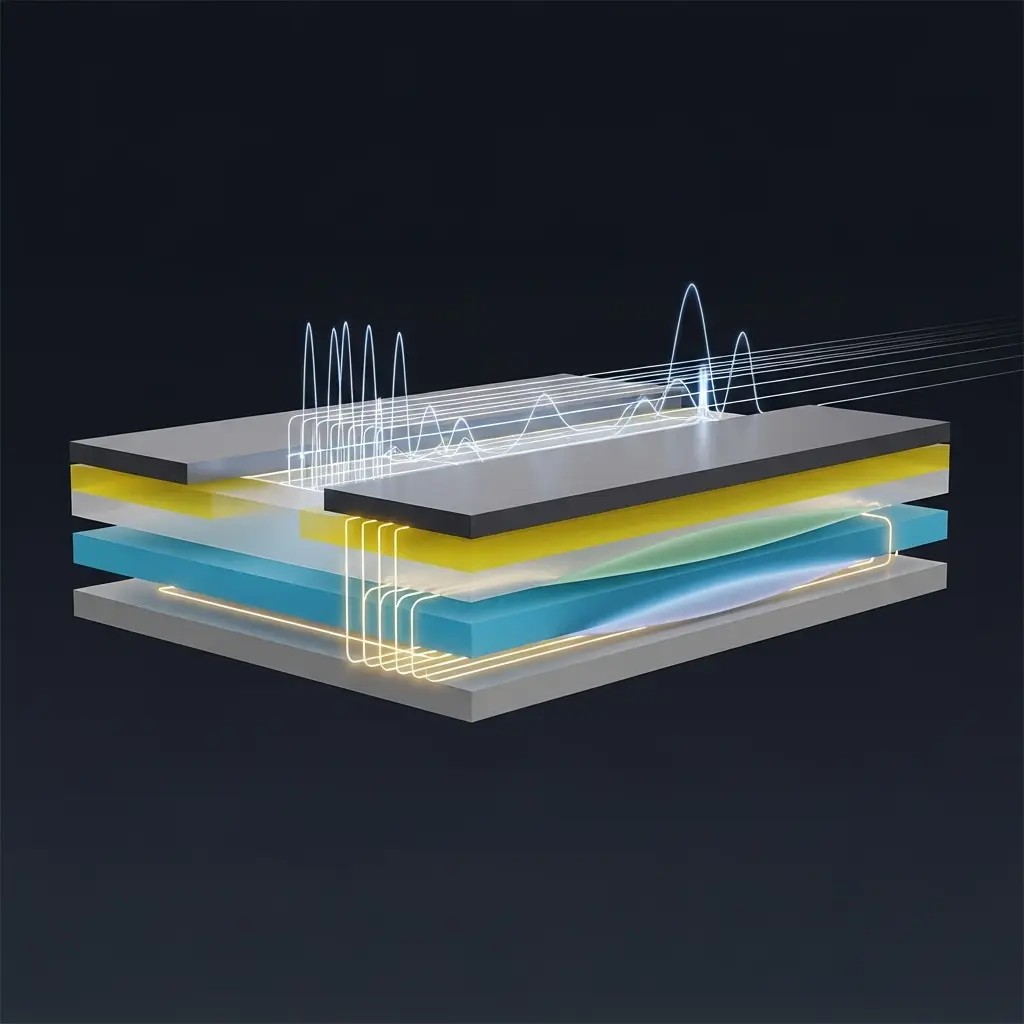
Scientists are tackling a critical challenge in quantum and atomic technologies: precise and versatile control of optical signals. Nick Montifiore, Andrei Isichenko, and Nitesh Chauhan, alongside colleagues from the University of California Santa Barbara, have developed integrated PZT silicon nitride modulators capable of operating across a broad spectrum from blue to near-infrared wavelengths, a significant step towards miniaturised, stable, and portable quantum systems. Their research details four distinct modulator designs , coil Mach-Zehnder, coil pure phase, bus-coupled, and add-drop ring resonators , demonstrating wavelength independence, low power consumption and broadband frequency response, all crucial for scalable photonic integration. These advancements overcome limitations in current technology and pave the way for fully integrated, chip-scale atomic clocks, computers, and sensors.
The research establishes a versatile platform for manipulating optical signals crucial for trapped-ion and cold neutral atom quantum systems, addressing a key limitation in the field of scalable photonic integration. This breakthrough reveals a pathway to compact and efficient control of lasers and optical signals, essential for advancements in quantum computing, atomic clocks, and quantum sensors.
The team achieved wavelength-independent operation, maintaining low optical waveguide loss and a high resonator quality factor, alongside DC-coupled broadband frequency response and remarkably low power consumption, all critical for scalable photonic integration. Specifically, the coil Mach-Zehnder modulator operates at 532nm, requiring a voltage (Vπ) of 2.8V, exhibiting a 3-dB bandwidth of 0.4MHz, and achieving an impressive extinction ratio of 21.5dB. The coil phase modulator, functioning at 493nm with a Vπ of 2.8V, demonstrates low residual amplitude modulation (RAM) of -34 dB at a 1kHz offset, ensuring signal fidelity. These results highlight the precision and control attainable with the newly developed modulators.
Experiments show the ring-based modulators possess intrinsic quality factors of 3.4 million and 1.9 million, alongside linear tuning strengths of 0.9GHz/V and 1GHz/V, respectively. The bus-coupled ring resonator operates at 493nm with a 3-dB bandwidth of 2.6MHz, while the add-drop ring resonator functions at 780nm with a 3-dB bandwidth of 10MHz. This combination of high quality factors and bandwidths enables precise and rapid control of optical signals, crucial for complex quantum operations. The study unveils a solution where all four modulator designs maintain the inherent low optical loss of silicon nitride, are DC-coupled with broadband frequency response, operate independent of wavelength, and consume only tens of nanowatts per actuator.
Enabling Miniaturization of Quantum and Atomic Systems
Such solutions unlock the potential for further integration with other precision silicon nitride components, paving the way for realizing fully integrated, chip-scale atomic and quantum systems. This work establishes a clear path towards miniaturizing complex quantum experiments, enabling the development of portable, robust, and scalable quantum technologies for a wide range of applications, from advanced computing to highly precise sensing and timekeeping. The demonstrated modulators are particularly well-suited for controlling Ba+ ions at 493nm and 532nm, as well as rubidium atoms at 780nm, broadening the scope of potential applications.
PZT-on-SiN Modulators for Visible and NIR Control
Engineering Versatile Optical Modulators Using PZT Materials
Scientists engineered four distinct integrated optical modulators leveraging stress-optic lead zirconate titanate (PZT) on silicon nitride (Si3N4) platforms to address the need for versatile control of lasers and optical signals in trapped-ion and cold neutral atom systems. The research team successfully demonstrated operation across the visible to near-infrared spectrum, specifically from 493nm to 780nm, paving the way for compact and robust quantum technologies. These modulators, a coil Mach-Zehnder modulator (MZM), a coil pure phase modulator, and both bus-coupled and add-drop ring resonator modulators, were meticulously designed to maintain low optical waveguide loss inherent to SiN, alongside DC-coupled broadband frequency response and minimal power consumption. The coil MZM was characterised at 532nm, achieving a Vπ of 2.8V, a 3-dB bandwidth extending to 0.4MHz, and a high extinction ratio of 21.5dB.
Detailed Component Performance Metrics and Signal Analysis
This performance was attained through precise fabrication of the coil structure and careful optimisation of the PZT actuation parameters. Similarly, the coil phase modulator, tested at 493nm, exhibited a Vπ of 2.8V and impressively low residual amplitude modulation (RAM) of -34 dB at a 1kHz offset, demonstrating exceptional control over phase modulation with minimal unwanted amplitude fluctuations. Researchers employed a carefully calibrated PZT driving scheme to minimise RAM and maximise modulation depth. Further expanding the modulator capabilities, the study pioneered ring-based designs, including bus-coupled and add-drop configurations operating at 493nm and 780nm, respectively.
These ring resonators achieved intrinsic quality factors (Qi) of 3.4 million and 1.9 million, indicating exceptionally low optical losses within the resonator cavity. The team measured a linear tuning strength of 0.9GHz/V and 1GHz/V, coupled with 3-dB bandwidths reaching DC to 2.6MHz and DC to 10MHz, respectively, demonstrating rapid and precise tuning capabilities. This was accomplished by precisely controlling the stress applied by the PZT actuators, altering the refractive index of the SiN waveguide and thus tuning the resonant wavelength. Crucially, all four modulator designs consume only tens of nanowatts per actuator, representing a significant advancement in power efficiency. This low power consumption, combined with wavelength independence and broadband response, unlocks the potential for seamless integration with other SiN components, enabling the realisation of fully integrated, chip-scale atomic and quantum systems. The work demonstrates a versatile platform for building complex photonic circuits for quantum information processing and precision sensing applications.
PZT Silicon Nitride Modulators Demonstrate Low Power
Scientists have demonstrated four distinct types of integrated stress-optic lead zirconate titanate (PZT) silicon nitride modulators, functioning across a spectrum from 493nm to 780nm. These modulators, a coil Mach-Zehnder modulator (MZM), a coil pure phase modulator, and both bus-coupled and add-drop ring resonator modulators, represent a significant step towards compact and portable quantum technologies. The team meticulously fabricated all designs using ultra-low loss, CMOS-compatible silicon nitride waveguides, achieving low optical waveguide loss and maintaining a high resonator quality factor. Measurements confirm that these devices operate independently of wavelength and consume only tens of nanowatts per actuator, unlocking potential for chip-scale atomic systems.
Experiments revealed the coil MZM operates at 532nm with a Vπ of 2.8V, exhibiting a 0.4MHz 3-dB bandwidth and an impressive extinction ratio of 21.5dB. The directional coupler was designed for an equal 50/50 split, contributing to the high extinction ratio achieved at 532nm operation. Tests prove the coil phase modulator, operating at 493nm with a Vπ of 2.8V, delivers low residual amplitude modulation of -34 dB at a 1kHz offset, crucial for applications requiring precise phase control. The PZT actuator and platinum electrode fabrication process avoids undercut structures commonly found in aluminum nitride modulators, simplifying fabrication and improving reliability.
Data shows the bus-coupled ring resonator modulator functions at 493nm, while the add-drop ring resonator modulator operates at 780nm, expanding the versatility of this platform. The ring-based modulators achieved intrinsic quality factors of 3.4 million and 1.9 million, respectively, alongside linear tuning strengths of 0.9GHz/V and 1GHz/V. Scientists recorded 3-dB bandwidths of 2.6MHz and 10MHz for these ring modulators, demonstrating rapid switching capabilities. The coil MZM’s modulation bandwidth is limited by the 19nF capacitance of the actuator, but the design offers a trade-off between bandwidth and tuning efficiency.
Measurements of the coil phase modulator, conducted using a vector network analyzer, demonstrate a residual amplitude modulation (RAM) of -34dB at a 10kHz frequency offset. This low-RAM performance is vital for precision applications like optical gyroscopes and phase-locked loops. The team mitigated etalon effects and associated RAM using index matching gel at the fiber-chip interface, further enhancing performance. The 493nm critically coupled bus-coupled ring resonator modulator boasts an intrinsic quality factor of 3.4 million and a loaded quality factor of 1.9 million, showcasing the potential for highly resonant optical circuits.
PZT Silicon Nitride Modulators Demonstrated Successfully
Scientists have demonstrated four distinct types of integrated stress-optic lead zirconate titanate (PZT) silicon nitride modulators, functioning across a visible to near-infrared spectrum from 493nm to 780nm. These modulators, a coil Mach-Zehnder modulator, a coil pure phase modulator, and both bus-coupled and add-drop ring resonator modulators, exhibit key characteristics for advanced photonic integration, including wavelength independence, CMOS compatibility, and minimal optical loss. The coil Mach-Zehnder modulator achieved a voltage (V) of 2.8V, a 3-dB bandwidth of 0.4MHz, and an extinction ratio of 21.5dB at 532nm, while the coil phase modulator operated at 493nm with a V of 2.8V and a low residual amplitude modulation of -34 dB at 1kHz. Ring-based modulators displayed high quality factors, up to 3.4 million, and linear tuning strengths of up to 1.0GHz/V, alongside 3-dB bandwidths reaching 10MHz.
These newly developed modulators maintain the low optical waveguide loss inherent to silicon nitride and offer DC-coupled broadband frequency responses, all while consuming only tens of nanowatts per actuator. This combination of features unlocks possibilities for integrating these modulators with other silicon nitride components, paving the way for compact, chip-scale atomic and quantum systems. The authors acknowledge that further reductions in waveguide losses could lead to even lower operating voltages, potentially reaching sub-volt levels. Future research may focus on exploring the full bandwidth potential of these PZT silicon nitride actuators, already demonstrated up to 70MHz, and applying them to complex quantum control functions, such as polarization gradient cooling and Zeeman qubit manipulation, as well as integrating lasers for enhanced modulation and frequency tuning.
🗞 Blue to Near-IR Integrated PZT Silicon Nitride Modulators for Quantum and Atomic Applications
🧠 ArXiv: https://arxiv.org/abs/2601.15695