Understanding how quantum light interacts within nonlinear materials presents a significant challenge, particularly when dealing with complex, broadband pulses, but Emanuel Hubenschmid from University of Konstanz and Victor Rueskov Christiansen from Aarhus University, along with their colleagues, have developed a new framework to address this problem. Their research focuses on efficiently calculating the transformation of quantum states as they pass through these materials, even when the number of relevant light frequencies changes, effectively treating the interaction as an ‘open system’. By introducing a generalized mathematical technique, the team successfully predicts the output state of the light pulse, demonstrating how entanglement breaks down and thermalization occurs during the process. This achievement provides a powerful tool for optimising techniques like amplification and frequency conversion, paving the way for generating and characterising quantum states on incredibly fast timescales and advancing the field of ultrafast quantum optics.
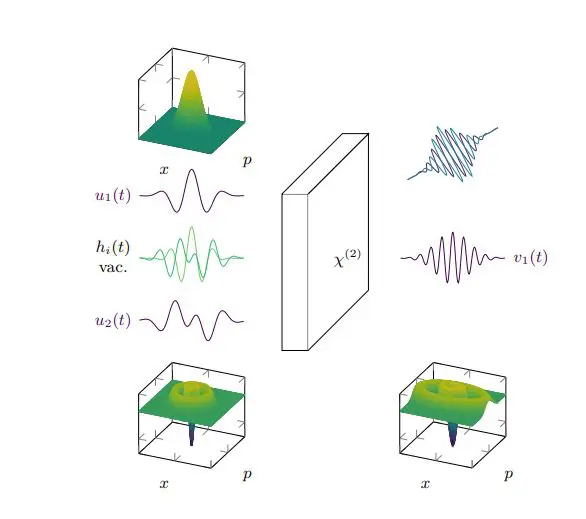
The research focuses on calculating the relationship between quantum states before and after interaction with a nonlinear element, specifically considering only the relevant broadband temporal modes. Because the number of significant input and output modes often differs, creating an open quantum system, the team introduces the generalized Bloch-Messiah decomposition. This decomposition reduces the description to an equal number of input and output modes, simplifying the analysis and allowing calculation of the multimode Wigner function of the output state by convolving the rescaled Wigner function of the reduced input state.
Time-Domain Quantum State Characterisation Techniques
This body of work represents a comprehensive overview of cutting-edge research in quantum optics, focusing on time-domain measurements of quantum states of light and utilizing electro-optic sampling techniques. The central goal is to fully characterize quantum states of light, not just in frequency, but also in the time domain, which is crucial for manipulating and processing quantum information. Electro-optic sampling is the primary experimental technique, continually being refined to resolve increasingly short timescales and complex quantum states. The research extends beyond single temporal modes, focusing on characterizing and manipulating multimode states essential for more complex quantum information processing.
Squeezed states of light, possessing reduced noise in one quadrature, are a key resource, and this work explores their generation, manipulation, and measurement in the time domain. Scientists are also investigating quantum non-demolition measurements, aiming to measure quantum properties without disturbing the system, and exploring optical parametric amplifiers to achieve this in the time domain. Ultimately, the research aims to develop new techniques for quantum information processing, leveraging the capabilities of time-domain quantum optics, and is increasingly focused on directly measuring and manipulating vacuum field fluctuations, fundamental to quantum optics, and utilizing nonlinear optics and frequency conversion techniques. Here’s a breakdown of the research into key areas: A.
Foundational Quantum Optics and Theory: Works by Vogel and Welsch provide a standard textbook on quantum optics, while Braunstein discusses squeezing as a fundamental resource. Law et al. explore continuous frequency entanglement, and foundational works by Bloch and Messiah and Magnus provide the mathematical framework for understanding these quantum states. B. Electro-Optic Sampling (EOS) and Ultrafast Optics: Boyd’s textbook provides a comprehensive overview of nonlinear optics, including EOS, and early work by Namba and Marple established the foundations of the electro-optic effect.
Numerous papers by Beckh, Sulzer, Fritzsche, Riek, and Leitenstorfer focus on the analysis and optimization of EOS techniques. Virally et al., Onoe et al., and Hubenschmid and Burkard explore the use of EOS for characterizing quantum states and performing time-domain measurements. C. Quantum State Tomography and Characterization: Hubenschmid and Burkard focus on subcycle quantum state tomography, while Kalash and Chekhova and Kalash et al. utilize optical parametric amplification for Wigner function tomography.
Yang et al. explore electro-optic sampling of the electric-field operator, and Onoe et al. realize a rapidly switched Unruh-DeWitt detector. D. Squeezed Light and Quantum Non-Demolition Measurements: Yanagimoto et al.
investigate quantum non-demolition measurements with optical parametric amplifiers, while Sendonaris et al. and Ng et al. explore ultrafast single-photon detection using OPAs. Kouadou et al. investigate spectrally shaped multimode squeezed states.
E. Quantum Vacuum and Vacuum Field Fluctuations: Lindel et al. present theoretical work on probing vacuum field fluctuations, while Settembrini et al. demonstrate experimental detection of vacuum field correlations. F.
Theoretical and Mathematical Tools: Tucker and Walls provide a quantum theory of parametric frequency conversion, and Quesada and Sipe explore high efficiency in mode-selective frequency conversion. The field is constantly striving to achieve higher temporal resolution, enabling the characterization of even faster quantum phenomena. Moving beyond single temporal modes to manipulate complex multimode states is a major focus, alongside applications in quantum metrology, sensing, communication, and integration with other quantum technologies. This bibliography represents a very active and exciting area of research at the forefront of quantum optics and quantum information science.
Wigner Functions Link Input and Output States
Scientists have developed a new theoretical framework for precisely relating quantum states before and after they interact with a nonlinear optical element, even when the number of relevant modes changes during the interaction. This work addresses a challenge in quantum optics where the complexity of describing broadband, multimode pulses often hinders accurate analysis. The team introduced the generalized Bloch-Messiah decomposition, a mathematical tool that reduces the description to an equal number of input and output modes. The core achievement lies in establishing a direct relationship between the input and output quantum states through their Wigner functions in phase space, expressed as a convolution with a Gaussian function and subsequent rescaling.
Researchers demonstrated the method’s effectiveness by considering a single pulsed Fock state and a two-mode squeezed vacuum, both operating in the terahertz frequency range and up-converted to optical frequencies. In the case of the single pulsed mode, the up-conversion process exhibits distinct regimes, squeezing and beam-splitting, dependent on the central frequency of the output mode, allowing for optimization of the conversion process. Furthermore, the team investigated the impact of entanglement breakage on the output state when using a two-mode squeezed vacuum as input. Applying the generalized Bloch-Messiah decomposition to reduce the phase-space dimension can induce thermalization, a loss of quantum coherence, due to the disruption of entanglement. Scientists quantified this thermalization using the von Neumann entropy, revealing its dependence on the output mode’s central frequency. These results pave the way for optimizing amplification or frequency conversion of broadband quantum states, enabling the generation and characterization of states on ultrafast timescales, with potential applications in advanced quantum technologies and high-speed detection systems.
Multimode Quantum State Evolution in Nonlinear Optics
This work presents a new framework for calculating how pulsed quantum states evolve during nonlinear optical interactions, a crucial area for advancing ultrafast quantum optics. Researchers developed a method to relate the quantum state before and after a nonlinear process, even when the number of relevant modes changes during the interaction. This was achieved through the generalized Bloch-Messiah decomposition, a mathematical technique that efficiently reduces the complexity of describing these multimode quantum states. The team demonstrated the effectiveness of this approach by modelling the up-conversion of a single broadband pulse and a two-mode squeezed state. These calculations reveal how the process can lead to changes in the quantum properties of the output pulse, including the potential for entanglement breakage and the emergence of thermalization, a loss of quantum coherence.
🗞 Phase-space open-systems dynamics of second-order nonlinear interactions with pulsed quantum light
🧠 ArXiv: https://arxiv.org/abs/2512.03933