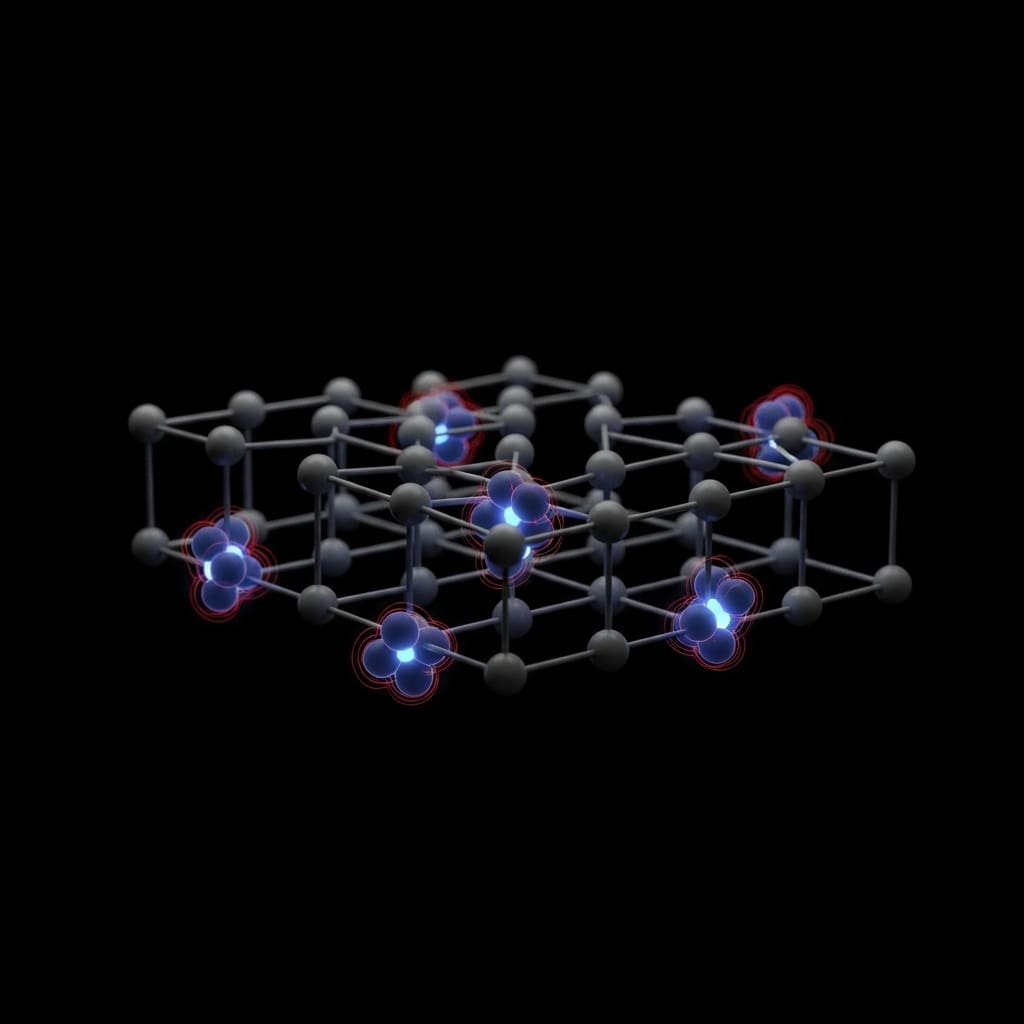
Spin defects within materials represent a promising pathway towards quantum technologies, and researchers are actively exploring their potential for building quantum networks and memories. Pierre Kuna, Erik Hesselmeier-Hüttmann, and Phillip Schillinger, along with colleagues at their respective institutions, now demonstrate a significant advance in controlling these systems, achieving precise, angstrom-level localisation of 25 nuclear spins surrounding a single defect within silicon carbide. This level of control, enabled by a novel correlation-based spectroscopy technique utilising robust nuclear memory, allows scientists to map extended clusters of interacting nuclear spins and their connections to the central electron spin. The achievement represents a crucial step towards realising more complex and powerful quantum registers on the silicon carbide platform, potentially unlocking new capabilities in quantum information processing.
Nuclear Spin Couplings Reveal Molecular Distances
Researchers developed a method to determine the three-dimensional structure of molecules by analyzing the interactions between nuclear spins. The technique relies on measuring the strength of couplings between the nuclei of carbon and silicon atoms, which are sensitive to the distances separating them. By comparing these measured couplings with calculated values, scientists can pinpoint the spatial arrangement of atoms within the molecule. The team implemented an iterative algorithm, iterative_spin_placement, to solve the complex problem of structural determination. This algorithm begins by placing the first atom at a known position and then sequentially adds others, refining the arrangement to best match the experimental data. The process involves evaluating potential positions, calculating expected couplings, and comparing them to measured values, using a tolerance to ensure accuracy. The algorithm efficiently narrows down the possibilities, ultimately converging on a solution that accurately represents the molecule’s structure.
Angstrom-Scale Nuclear Spin Mapping via Spectroscopy
Scientists have pioneered a technique for precisely locating nuclear spins around a defect center within silicon carbide, achieving angstrom-level resolution for 25 nuclear spins. This breakthrough utilizes correlation-based spectroscopy and a robust nuclear memory to efficiently characterize extended nuclear spin clusters, including chains of multiple spins. The method allows for the characterization of interactions between these clusters, even for spins that are difficult to address due to spectral crowding or weak coupling. To overcome the challenges of a complex search space, the team developed an iterative placement algorithm. This algorithm compares measured couplings with theoretical calculations based on the crystal lattice, sequentially placing candidate spins on the lattice and refining the solution until a single arrangement is found. A final refinement step further improves the accuracy of the nuclear coordinates, revealing a hierarchical organization within the nuclear spin network where strongly coupled nuclei form a stable reference framework.
Silicon Carbide Nuclear Spins Show High Fidelity Control
Researchers have achieved angstrom-level localization of 25 nuclear spins surrounding a defect center in silicon carbide, establishing a new standard for nuclear spin control in this material. This work demonstrates all the essential components of a local multi-qubit register, previously achieved only in other solid-state systems. The team measured a remarkably high readout fidelity of 99.99% after 1500 repetitive readout cycles, with each sequence lasting only 7 milliseconds. Experiments revealed long electron spin relaxation and coherence times, further extended using dynamical decoupling techniques. Utilizing a robust nuclear memory as a readout ancilla, the team applied correlation-based spectroscopy to characterize extended nuclear spin clusters and reconstruct the couplings between them, validating a microscopic model of the defect center. They successfully addressed and controlled multiple spins simultaneously, demonstrating precise manipulation and readout via a tailored quantum circuit.
Silicon Carbide Nuclear Spin Mapping Achieved
Scientists have successfully characterized the nuclear spin environment surrounding a defect center within silicon carbide, localizing 25 surrounding nuclear spins with angstrom-level precision. This advance utilizes a robust nuclear memory as a readout ancilla and employs correlation-based spectroscopy to map extended nuclear spin clusters, revealing their couplings to both the central electron spin and neighboring nuclei. The measured parameters closely match predictions from theoretical calculations, demonstrating the accuracy of the modeling approach. These findings represent a significant step towards realizing the potential of silicon carbide for quantum technologies, specifically enabling advanced applications involving local nuclear spin registers. The ability to precisely determine the location and interactions of nuclear spins unlocks opportunities for improved qubit control and memory storage. Future research will focus on developing faster data-driven localization algorithms and benchmarking quantum algorithms designed for this central spin layout.
👉 More information
🗞 Localization and coherent control of 25 nuclear spins in Silicon Carbide
🧠 ArXiv: https://arxiv.org/abs/2512.20281