Open quantum systems, governed by the principles of non-Hermitian operators, exhibit unique behaviours and can host specific degeneracies known as Liouvillian exceptional points. Sayooj P and Awadhesh Narayan, from the Indian Institute of Science, now demonstrate a powerful method for identifying and characterizing these points using Newton polygons and the principles of tropical geometry. This approach reveals the anisotropy and order of Liouvillian exceptional points, and importantly, captures their subtle dependence on the system’s perturbations. By combining analytical calculations with direct numerical simulations of eigenvalue behaviour, the researchers provide a new tool for both understanding and potentially designing open quantum systems with tailored exceptional points, which could have implications for quantum technologies and fundamental physics.
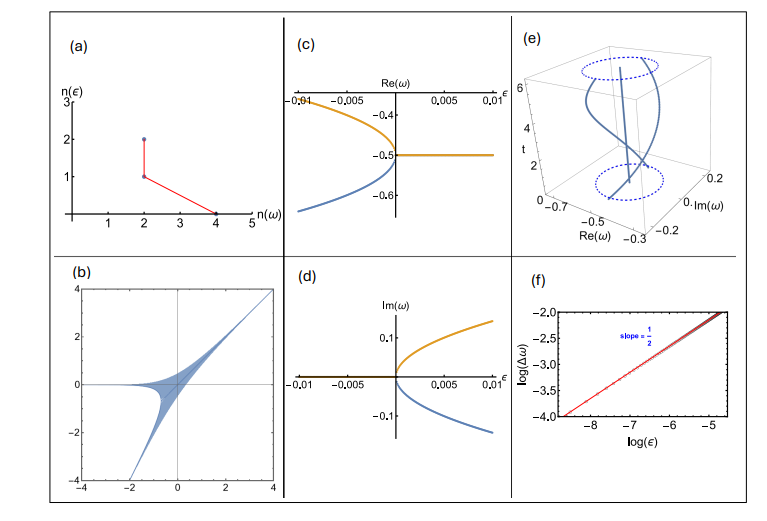
The research demonstrates that Newton polygons and a tropical geometric approach allow for the identification and characterization of these points. To illustrate this method, the team employed two models, a dissipative spin-1/2 system and a dissipative superconducting qubit system, successfully capturing the anisotropy and order of the Liouvillian exceptional points, and revealing a subtle dependence on the specific form of the perturbation applied.
Exceptional Points and Non-Hermitian Hamiltonian Behaviour
Exceptional points are singularities that arise in non-Hermitian systems, representing dramatic changes in a system’s behaviour and making it highly sensitive to external influences. This research explores how tropical geometry, a branch of mathematics dealing with asymptotic behaviour, can be used to understand and characterize these points, bridging the gap between mathematical theory and practical applications in areas like quantum optics and open quantum systems. The work investigates how exceptional points appear, merge, and disappear as system parameters are changed, drawing on concepts from bifurcation theory, which describes qualitative changes in system behaviour. Applications of this research include enhancing light-matter interactions, creating novel optical devices, and understanding the dynamics of systems interacting with their environment, with potential for creating highly sensitive sensors.
Liouvillian Exceptional Points via Tropical Geometry
This work presents a novel approach to characterizing Liouvillian exceptional points, which arise in open quantum systems, using Newton polygons and tropical geometry. Scientists demonstrated that these mathematical tools effectively identify and characterize these points, revealing details about their order and anisotropy. The research team applied this method to both a dissipative spin system and a dissipative superconducting qubit model, confirming the expected square root scaling of eigenvalues near these points and demonstrating the swapping of only two eigenvalues during encirclement. Furthermore, scientists discovered that the order of a Liouvillian exceptional point is significantly influenced by the chosen perturbation, a detail elegantly captured by the tropical analysis. This finding suggests the possibility of using Newton polygons and amoebas to determine the necessary perturbation to achieve a desired exceptional point order, potentially enabling the design of both Liouvillian and Hamiltonian exceptional points with specific properties.
Liouvillian Exceptional Points and Perturbation Dependence
This research demonstrates a novel approach to characterizing Liouvillian exceptional points, which arise in open quantum systems, using tools from Newton polygons and tropical geometry. The team successfully applied this method to two distinct models, a dissipative spin system and a dissipative qubit, revealing how the order and behaviour of these exceptional points depend critically on the specific type of perturbation applied to the system. By analysing the geometry of Newton polygons and amoebas, the team could predict how different perturbations affect the divergence of eigenvalues, providing a means to control the order of these points. The findings highlight that the order of a Liouvillian exceptional point is not an intrinsic property, but rather is determined by the chosen perturbation. This advancement offers a powerful new technique for understanding and manipulating the behaviour of open quantum systems, with potential applications in quantum technologies and beyond.
🗞 Characterizing Liouvillian Exceptional Points Through Newton Polygons and Tropical Geometry
🧠 ArXiv: https://arxiv.org/abs/2510.08156