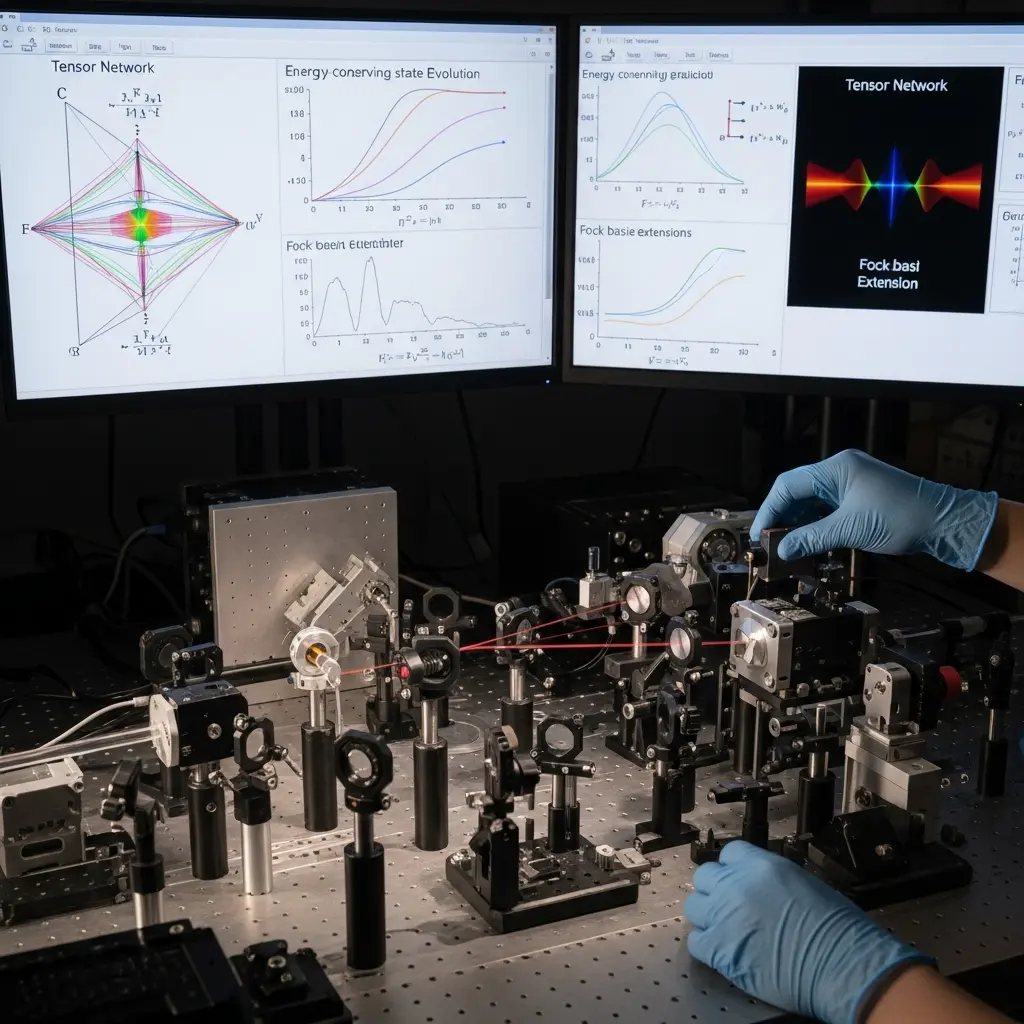
The accurate modelling of light’s behaviour in nonlinear materials is crucial for advancing technologies such as quantum computing and advanced imaging, yet remains a significant computational challenge. Nikolay Kapridov from the Moscow Institute of Physics and Technology, alongside Egor Tiunov and Dmitry Chermoshentsev from the Quantum Research Center, Technology Innovation Institute, now present a new approach that dramatically improves the efficiency of these simulations. Their work introduces a tensor-network method, utilising a technique called matrix product states, to compress the information needed to describe the evolution of light. This allows researchers to directly calculate how light changes within nonlinear systems, accurately reproducing established theoretical predictions for processes like spontaneous parametric down-conversion, even in situations where conventional methods fail, and achieving substantial compression of the data required. This breakthrough provides a scalable pathway to model complex, multimode light and explore nonlinear phenomena previously inaccessible to simulation.
Tensor Networks Model Quantum Optical State Evolution
Researchers are developing new ways to understand how light behaves in nonlinear materials, a crucial step towards building advanced quantum technologies. The team investigates the dynamics of quantum optical states, focusing on scenarios where standard methods for representing these states become inadequate. They have developed a tensor-network approach to accurately model the evolution of these states, overcoming the limitations of traditional techniques. This allows for the simulation of complex quantum optical processes, including those involving strong nonlinearities and high-dimensional systems. The research demonstrates the ability to track how entanglement, a key quantum property, changes as light propagates through nonlinear media, providing insights into the fundamental mechanisms governing quantum light generation and manipulation. This advancement in computational modelling of quantum optics enables the study of previously inaccessible regimes and paves the way for the design of novel quantum devices.
Modelling these processes is computationally demanding, as the resources required grow rapidly with the number of photons and the precision of the simulation. To address this, the team introduces a tensor-network approach that efficiently captures the dynamics of nonlinear optical systems using a continuous-variable representation. By encoding both quantum states and operators in a highly compressed form using the matrix product state (MPS) formalism, they enable direct numerical integration of the Schrödinger equation. They demonstrate the method by simulating degenerate spontaneous parametric down-conversion, showing that it accurately reproduces established theoretical benchmarks, including energy conservation and pump depletion.
MPS Algorithm Solves Linear Equations Efficiently
Scientists have developed a detailed method for solving complex linear equations using Matrix Product States (MPS) and an algorithm inspired by the Density Matrix Renormalization Group (DMRG). This approach offers a powerful way to represent solutions to these equations as a network of low-dimensional tensors, particularly effective for systems with limited entanglement. The key is that the size of these tensors, known as the bond dimension, can be kept relatively small, leading to significant savings in memory usage. The DMRG-inspired algorithm iteratively optimizes the MPS to find the solution, borrowing techniques from finding the ground state of quantum systems.
Traditional methods for solving linear equations can become computationally expensive and memory-intensive for very large systems. MPS offers a potentially more efficient representation, particularly when the solution exhibits smoothness or limited correlation. If the solution is smooth, the bond dimension can be kept small, reducing the computational burden. The method involves discretizing the continuous problem, representing the solution as an MPS, and representing the operators involved as tensors. A functional is constructed, and the algorithm iteratively updates the MPS tensors to minimize this functional, using techniques like Singular Value Decomposition (SVD) to reduce memory usage. This approach offers several advantages, including memory efficiency, computational efficiency, adaptability to the complexity of the solution, and potential for parallelization.
Efficient Simulation of Quantum Optical States
This research presents a new numerical technique for modelling the evolution of quantum optical states, addressing a significant challenge in simulating nonlinear optical phenomena. Scientists developed a method employing a discretized continuous representation of quantum states and operators, encoded within a matrix product state (MPS) framework. This approach allows for efficient simulation of quantum systems, achieving compression ratios exceeding 3000 for high-intensity pump fields, and enabling calculations previously inaccessible to conventional methods. The team validated their technique by simulating degenerate spontaneous parametric down-conversion, demonstrating accurate results consistent with established theoretical benchmarks, including energy conservation and pump depletion. Importantly, the method successfully simulates quantum states containing thousands of photons per mode, a regime where traditional computational approaches struggle.
While the current implementation requires further refinement of the time-stepping scheme to extend to multiple modes, the researchers acknowledge this as a clear direction for future work. They also suggest exploring alternative tensor network representations, such as Tucker decomposition or tree tensor networks, to potentially enhance the method’s capabilities. This work establishes a scalable and transparent route towards simulating and optimizing complex quantum systems, bridging the gap between classical algorithms and advancements in quantum optical technologies.
🗞 Tensor-network approach to quantum optical state evolution beyond the Fock basis
🧠 ArXiv: https://arxiv.org/abs/2511.15295